Nuclear Engineering Radiation Laboratories
About NERL
The Nuclear Engineering Radiation Laboratories (NERL) at Purdue University support hands-on education in radiation measurement and nuclear engineering. Building on Purdue’s long tradition of laboratory-based nuclear instruction dating to the 1960s, NERL provides students with practical experience using radiation detectors, electronics, shielding, and data analysis in a safe, supervised environment. Working with sealed sources and modern instrumentation, students develop the technical skills and confidence expected of practicing nuclear engineers. NERL complements Purdue University Reactor Number One (PUR-1), linking radiation measurement training with research reactor experience while also supporting outreach, visiting student programs, and collaborative educational initiatives.
Student Experience
Beginning sophomore year, NERL transforms theory into hands-on experience. Students work directly with radiation sources, detectors, and reactor-based experiments in a structured, safety-focused environment—often describing it as their first truly immersive nuclear engineering experience.
Across the undergraduate curriculum, students complete more than 20 radiation-focused experiments. They design detector circuits, conduct contamination-style surveys, measure reactor parameters, analyze neutron flux in the PUR-1 reactor, and perform experiments such as gold foil activation and simulated fuel loading.
The laboratory sequence includes two undergraduate courses taken in sequence and a graduate-level lab reserved for incoming grad students who do not have a nuclear background:
- NUCL 205: Nuclear Engineering Undergraduate Laboratory I
Sophomore-level introduction to radiation properties, radioactive materials, and detector systems (10–12 experiments).
- NUCL 305: Nuclear Engineering Undergraduate Laboratory II
Senior-level course building on advanced detection methods, reactor measurements, and system analysis (10–12 experiments).
- NUCL 504: Nuclear Engineering Experiments
Introductory graduate lab covering similar topics at greater depth and pace, including advanced reactor simulations.
For many students, this lab strengthens their commitment to nuclear engineering by giving them a clear path toward reactor operator training and future careers in reactor operations and the broader nuclear industry.
Facility Tours
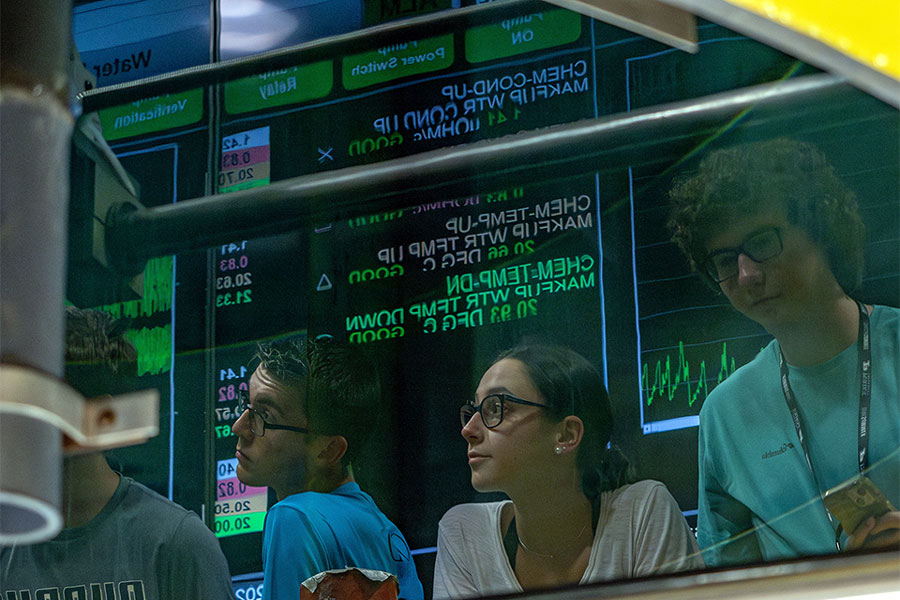
One of the primary roles NERL plays is education and outreach to the community about nuclear topics. We have approximately 1,500 visitors to PUR-1, NERL, and other related labs each year. Each experience is tailored to visitor interests and age. During the tour, we traditionally discuss general radiation principles, common natural radiation sources, health effects of radiation, nuclear reactor basics, and of course take a look at Purdue's Nuclear Reactor. All tours are scheduled and confirmed in advance, and all visitors must have a valid photo ID on hand. Special arrangements and times can be accommodated for large groups.