
Denny Yu honored with HFES Jack A. Kraft Innovator Award
Purdue industrial engineering professor recognized for advancing human factors research through artificial intelligence, wearable sensing and innovative approaches to workplace safety
Denny Yu, the Cubitt Rising Star Professor of Industrial Engineering in Purdue University's Edwardson School of Industrial Engineering, has been selected to receive the Jack A. Kraft Innovator Award from the Human Factors and Ergonomics Society (HFES). The award was presented during the society's 2026 ASPIRE International Annual Meeting, held October 19–23 in Reno, Nevada.
The Jack A. Kraft Innovator Award recognizes individuals who have made significant contributions to extending or diversifying the application of human factors and ergonomics methods and principles. Established in 1970, and renamed in 1996, the award celebrates innovation that advances the profession and demonstrates its value in addressing real-world challenges. Distinguished Engineering Alumna Mica Endsley (MSIE '85) was honored with the award in 2003.
Yu's research focuses on understanding and improving human performance in complex work environments, particularly in healthcare and occupational safety. As director of Purdue's Healthcare Ergonomics Analytics Lab (HEAL), he brings together human factors engineering, artificial intelligence, wearable sensing technologies and data analytics to develop practical solutions that improve safety, efficiency and human well-being.
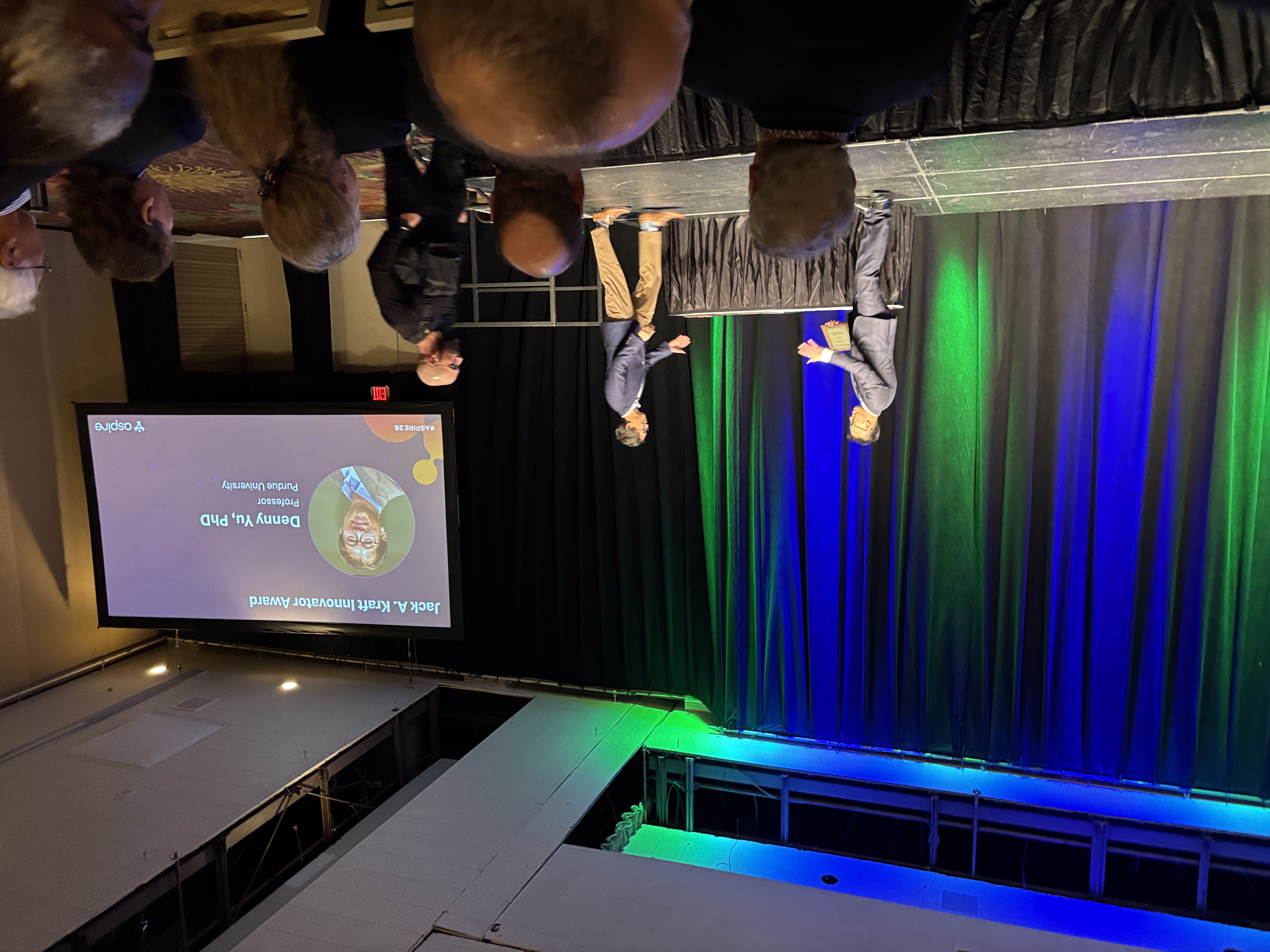
Associate Professor Denny Yu (on stage, right) at HFES Aspire, accepting the 2026 Jack. A. Kraft Innovator Award, presented by Dr. Nathan Lau (left)
One example of this approach is Yu's research into improving surgical teamwork through wearable sensors and artificial intelligence. Supported by a four-year, $1.6 million grant from the Agency for Healthcare Research and Quality, and industry support from companies like Intuitive Surgical, Inc., Yu and collaborators at the Indiana University School of Medicine are developing methods to evaluate communication, teamwork and other nontechnical skills in operating rooms.
Traditionally, evaluating these skills has relied on trained human observers, making assessments time-consuming, costly and potentially subjective. By developing automated, sensor-based approaches, Yu's team seeks to make these evaluations more objective, scalable and accessible, ultimately helping surgical teams improve performance and patient safety.
The research reflects a broader theme in Yu's work: developing advanced technologies and algorithms to better understand how people interact with increasingly complex systems, then translating those insights into adaptive systems that support safer and more effective human performance.
His innovations also extend beyond healthcare. In collaboration with Purdue professor Wenzhuo Wu, Yu is developing bioinspired wearable nanosensors designed to assess injury risks during physically demanding work. Supported by the National Institute for Occupational Safety and Health, the research combines low-cost, printable sensing technology with artificial intelligence to identify ergonomic hazards and support workplace injury prevention. In addition to these efforts, Yu and his team have worked in partnership with Ford Motor Company to study multi-sensory in-vehicle experiences on driver stress.
Together, these projects demonstrate the potential of human-centered engineering to address challenges across industries, from operating rooms to manufacturing environments. Rather than focusing on technology alone, Yu's research emphasizes how advanced tools can be designed to better understand and support the people who use them.
In addition to his research, Yu is actively involved in advancing the human factors and ergonomics profession. He serves as president of the Work Systems Division of the Institute of Industrial and Systems Engineers (IISE), where his leadership focuses on strengthening engagement, collaboration and the application of work systems research.
The Jack A. Kraft Innovator Award recognizes Yu's contributions to a field that continues to evolve alongside advances in artificial intelligence, automation and human-centered technology. His work exemplifies Purdue's commitment to developing engineering solutions that translate research into meaningful improvements in people's lives.
The award was presented during HFES ASPIRE 2026, which brings together researchers, practitioners and industry leaders to share advances in human factors and ergonomics.