
National Science Foundation Grant Awarded to Assistant Professor Yu She
In coordination with the US National Science Foundation, the Advancing Innovations for Empowering NextGen AGriculturE (AI-ENGAGE) initiative recently announced its six international research award recipients, collectively receiving $2.4 million to support artificial intelligence and emerging technologies.
Yu She, the lead of the AI-Engage Collaborative between the US, India, Japan, and Australia, was one of those recipients. With an award of $400,000, he aims to advance precision agriculture by developing an AI-driven Disease Detection system in apple orchards.
She’s project is part of an international research initiative that seeks to leverage emerging technology to solve global challenges. In this case, the issue to solve is rampant disease in globally significant crops.
As the fields of AI and robotics continue to advance, this landmark collaboration harnesses the expertise of pioneers in technological fields to transform the agricultural world. Its potential to empower farmers internationally goes unmatched. Due to the diverse reach of this project, the collaborators chose to examine a global food staple: apples.
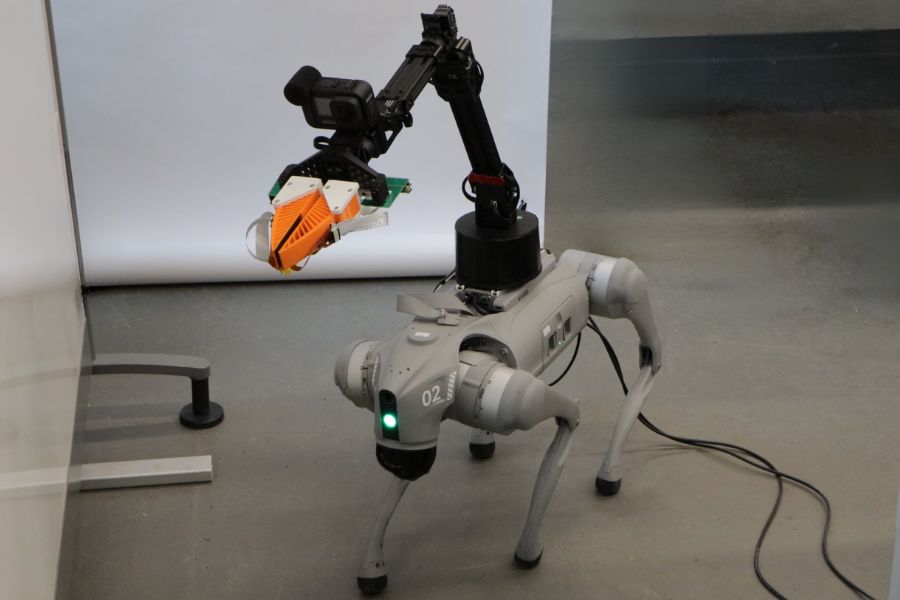 Unmanned Ground Vehicle
The proposed solution integrates unmanned aerial vehicles (UAVs) and unmanned ground vehicles (UGVs). Their purpose is to collect real-time and historic data on IoT platforms for enhanced decision making. The UAVs also have the capability for multi-spectral and thermal imaging, which, when combined with machine learning, allows the system to detect subtle changes in the crop physiology. The project improves the chance of success for targeted interventions by having this early-on detection.
To supplement those interventions, the project also involves Geographic Information Systems (GIS) that provides actionable insights, disease predictions, and preventive measures. With real time health monitoring and disease mapping, precise solutions can come about using adaptive pesticide application, intelligent navigation, and variable-rate spraying.
“By connecting aerial and ground robots into a closed-loop workflow, we aim to detect orchard disease earlier and enable more precise, site-specific responses that improve sustainability and protect yield” says She. This project carries high potential for stakeholders around the world, empowering them to make data-driven decisions based on the success of this research.
Written by Mannsha Assudani
Related Links: