
Purdue University and Redwire continue space-based pharmaceutical manufacturing research with second ISS launch
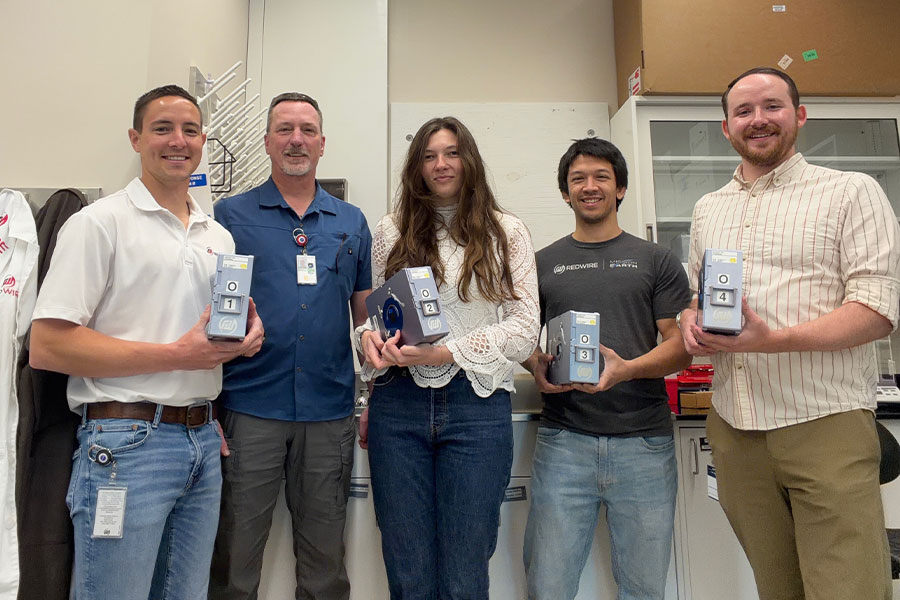
WEST LAFAYETTE, Ind. — Purdue University College of Engineering researcher Zoltan Nagy, the Arvind Varma Professor in Purdue’s Davidson School of Chemical Engineering, and aerospace and biotechnology company Redwire successfully launched a second series of pharmaceutical crystallization experiments to the International Space Station (ISS) on May 15, continuing a collaborative effort aimed at transforming the future of pharmaceutical manufacturing through microgravity-enabled research. The latest experiments build upon the team’s first successful September 2025 mission.
The research is being conducted in Purdue’s Crystallization and Particle Technology Systems Engineering Laboratory and involves Purdue graduate researchers Katherine Young, Nathaniel Michael and Hemalatha Kilari.
Crystals produced during the first flight returned to Earth in February 2026 and are currently being analyzed at Purdue to evaluate how microgravity-grown crystal properties may improve terrestrial pharmaceutical manufacturing processes.
The new flight expands the scope of the research to include several high-value pharmaceutical compounds, including commercial cancer therapeutics and engineered co-crystal systems with challenging manufacturability characteristics. The project investigates how the unique microgravity environment affects crystal nucleation, growth, morphology and crystal quality by eliminating gravity-driven convection and sedimentation effects commonly present on Earth.
“This second launch represents an important step toward establishing a systematic understanding of how microgravity can be leveraged to improve pharmaceutical crystallization and ultimately terrestrial manufacturing,” said Nagy who is principal investigator of the project. “The experiments are designed not only to study fundamental crystallization mechanisms, but also to identify practical pathways for improving crystal quality, manufacturability and downstream processing for important therapeutic compounds.”
The current studies are looking at pharmaceutical compounds that exhibit difficult crystal morphologies and particle handling behavior during manufacturing, as well as model systems selected for their pharmaceutical relevance and suitability for investigating crystallization mechanisms and morphology control under microgravity conditions. In addition, the project is exploring advanced engineered pharmaceutical co-crystals that may offer improved physicochemical and biopharmaceutical properties compared to conventional crystalline forms.
The research aims to identify crystallization conditions that enable improved particle shape and crystal habit, reduced aspect ratio in needle-like active pharmaceutical ingredients (APIs), enhanced crystal quality and uniformity, and more robust downstream manufacturing and handling performance. The experiments are being conducted aboard the ISS using Redwire’s Pharmaceutical In-space Laboratory (PIL-BOX), a commercial microgravity research platform designed to support pharmaceutical crystal growth investigations in orbit.
“The ability to perform highly controlled crystallization experiments in microgravity opens unique opportunities to better understand and engineer pharmaceutical materials,” Nagy said. “What we learn in orbit can ultimately help us design better crystallization processes on Earth.”
The Purdue team is integrating the experimental work with advanced mechanistic modeling, digital design methodologies and artificial intelligence-driven analysis tools to create predictive frameworks for crystallization process development. The long-term vision is to establish microgravity-enabled crystallization as a process intensification strategy for the manufacturing of high-value pharmaceutical products.
Purdue and Redwire expect the program to continue evolving through future ISS missions, with increasing integration of autonomous experimentation, digital twins and AI-guided process optimization.