
Purdue researchers upcycle lithium-ion battery waste into sustainable concrete
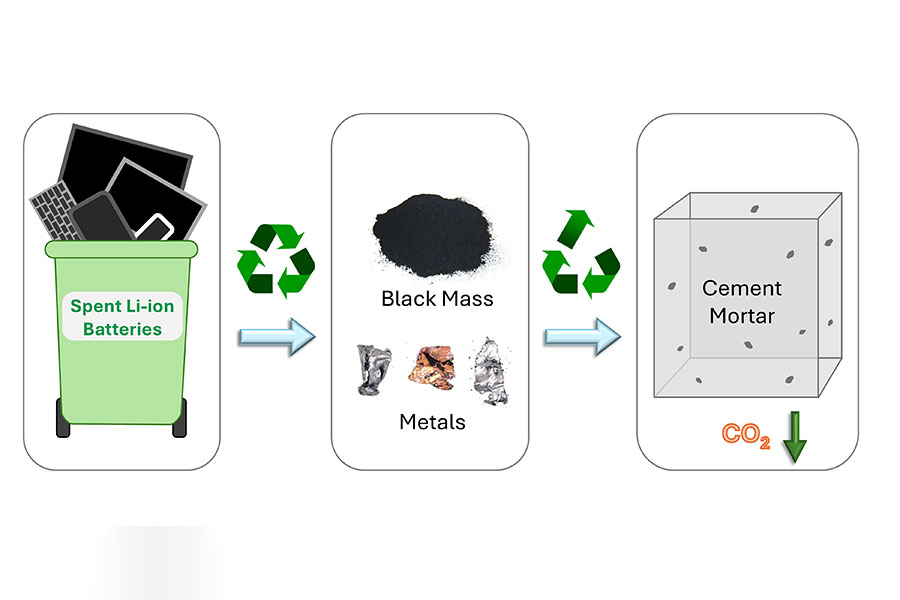
Researchers from Purdue University's Davidson School of Chemical Engineering and Lyles School of Civil and Construction Engineering have found a way to divert spent lithium-ion battery materials from landfills — by mixing them directly into concrete.
The pilot study, published in CivilEng in January 2026, tested whether battery waste could serve as a partial replacement for sand in cement-mortar mixes, offering a low-energy alternative to conventional battery recycling methods while simultaneously reducing the carbon footprint of concrete production.
Electric vehicle sales have surged from 4% of the global market in 2020 to 18% in 2023, driving a sharp rise in spent battery volumes. Lithium-ion battery waste is projected to reach 1.2 million units per year by 2030, yet recycling rates remain below 10%. Current recycling methods — including hydrometallurgy and pyrometallurgy — are costly, energy-intensive, and generate hazardous byproducts.
The researchers prepared three cement-mortar mixes: a standard control, one in which 10% of the sand was replaced by "black mass" (finely ground active cathode and anode materials), and one in which 10% of the sand was replaced by crushed metallic fractions — steel, copper and aluminum recovered from battery casings. Forty-five mortar cubes were cast and tested for compressive strength over 28 days at Purdue's Robert L. and Terry L. Bowen Laboratory.
“Sustainable construction materials and methods are an important focus for the Lyles School, and there is a lot of exciting potential here,” said Amit Varma, the Karl H. Kettelhut Professor of Civil and Construction Engineering and Bowen Lab Director. “With further research and development, this sustainable concrete mix design could be a tremendous energy and environment saver.”
Both additive mixes showed lower compressive strength than the control at 28 days — 35% lower for the black mass mix and 55% lower for the metallic fraction mix. While those reductions rule out high-load structural applications, the researchers found a more compelling story when environmental performance was factored in. By accounting for avoided emissions from diverting battery waste from landfills, the black mass mix achieved a strength-to-net-embodied-carbon ratio four times higher than the control. That metric, the team explains, makes it a strong candidate for sidewalks, curbs, decorative elements, insulating layers, and other non-structural concrete uses.
"What we're really doing here is solving two problems that are usually treated separately — battery waste management and the carbon footprint of construction — and showing they can solve each other," said Vilas G. Pol, professor of chemical engineering. "That's the kind of cross-disciplinary thinking Purdue is well-positioned to pursue." Apart from extracting critical black mass from spent lithium-ion batteries, diverting the remaining 50% of residual metal and plastic mass to replace a portion of sand in concrete mixtures transforms a massive electronic waste liability into a powerful, sustainable construction technology, says Pol.
This innovation was disclosed to the Purdue Innovates Office of Technology Commercialization (OTC). For more information, contact OTC at otcip@prf.org.
The study was led by graduate student, Ishaan Davariya, along with Dr. Gaurav Chobe, Dr. Dheeraj Waghmare, and Dr. Shivam Sharma, under the supervision of Professors Akanshu Sharma and Amit H. Varma of the Lyles School of Civil and Construction Engineering and Professor Vilas G. Pol of the Davidson School of Chemical Engineering. Cement, sand, and aggregates were donated by Irving Materials, Inc. of West Lafayette.
Future work will assess long-term durability — including water absorption, porosity, and leaching behavior — before field deployment can be considered.
About Purdue Innovates Office of Technology Commercialization
ThePurdue Innovates Office of Technology Commercializationoperatesone of the most comprehensive technology transfer programs among leading research universities in the U.S. Services provided by this office support the economic development initiatives of Purdue University andbenefitthe university’s academic activities through commercializing,licensingand protecting Purdue intellectual property. In fiscal year 2025, the office reported 161 deals executed with 269 technologies licensed, 479 invention disclosures received,and 267 U.S. and international patents received. The office is managed by the Purdue Research Foundation, a private, nonprofit foundation created to advance the mission of Purdue University. Contact otcip@prf.org for more information.