
Lyles School taps UC San Diego's Michael Todd as its next head
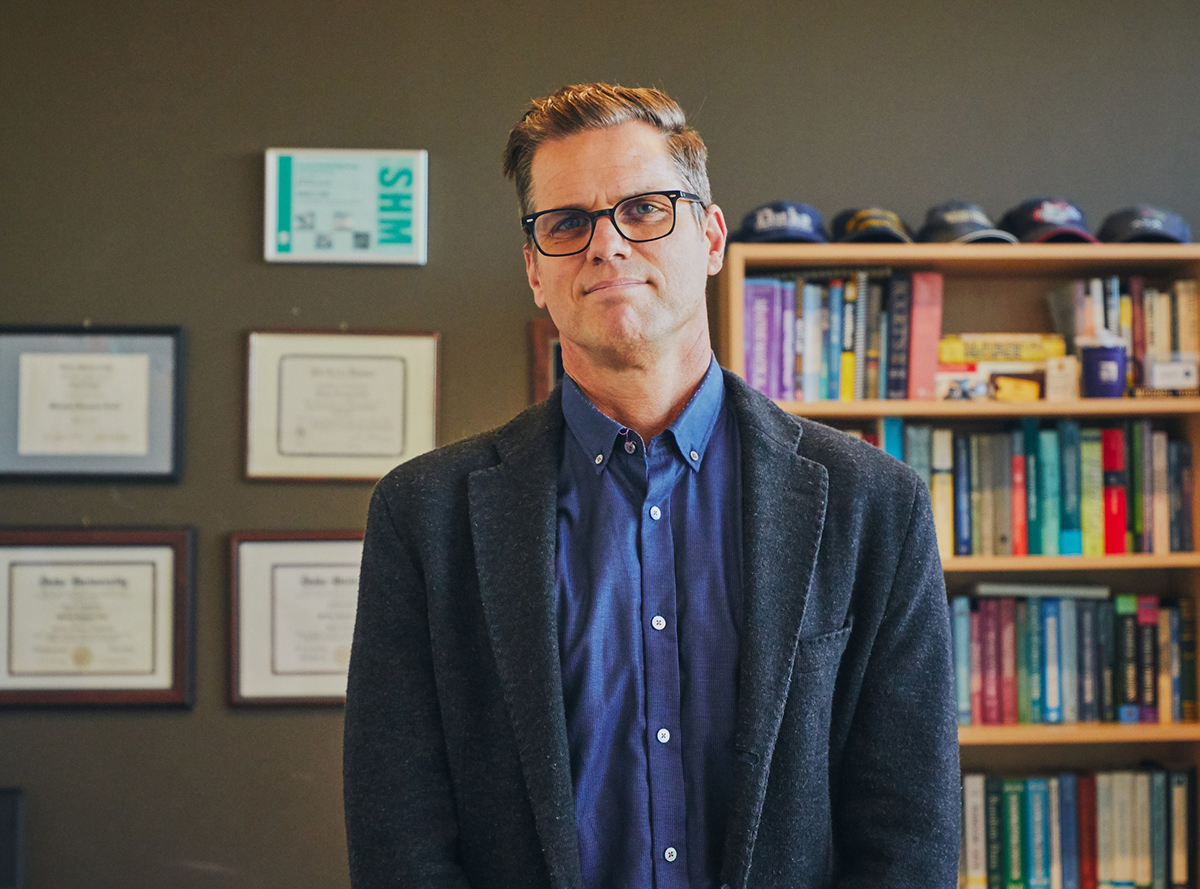
Purdue Engineering has selected Michael D. Todd as the next Bowen Engineering Head of the Lyles School of Civil and Construction Engineering (CCE).
Currently a distinguished professor at the University of California San Diego (UCSD), Todd joined the faculty in 2003 and has served as chair of the Department of Structural Engineering since 2023. Before moving to academia, he worked as a research engineer and section head at the U.S. Naval Research Laboratory in Washington, D.C.
As chair, Todd has led his department through rapid undergraduate growth, nearly doubling enrollment in the last three years.
He is an internationally recognized scholar whose work spans structural dynamics, sensing, uncertainty quantification and risk-informed structural health monitoring/non-destructive evaluation (SHM/NDE), with an emphasis on decision-grade monitoring and life cycle asset management. His research has advanced the use of data-driven and physics-informed approaches in civil infrastructure systems, including applications in digital twin modeling and machine learning for structural performance.
“The Lyles School has exceptional breadth across nine major interconnected disciplines —very rare for a single school,” Todd said. “An opportunity to lead a school at Purdue is an opportunity to lead at one of America’s premier public institutions with a worldwide reputation for producing world-class engineers and engineering research.”
He co-created the UCSD–Los Alamos National Laboratory (LANL) Engineering Institute, the country’s first dedicated, long-term research and education partnership focused on broad, system-level SHM/prognostics enabling technologies aligned with national security priorities.
A particularly meaningful outcome has been the development of a distance-learning graduate program that supports advanced training and professional growth for LANL employees. To date, more than 50 professionals have earned advanced degrees through
the program, supporting both retention and recruitment at LANL.
Todd believes CCE is well positioned to respond to two national objectives, and he plans to invest resources accordingly. First, AI in infrastructure design, construction and life cycle management, and second, the country’s pivot toward reinvestment in nuclear energy.
The 2025 America’s AI Action Plan calls for workforce transformation, which he says is an opportunity for the school to harness and incorporate relevant AI into the curricula to make CCE a highly attractive, modernized option for prospective undergraduate and master’s students. On the R&D side, the vast AI infrastructural ecosystem — data centers, supercomputing centers and other specialized facilities — will pose opportunities in design, construction, performance, operations, safety/security, environmental impact, monitoring and energy/services. “These are all areas in which the school already has a leading footprint,” Todd said.
The Indianapolis campus, he added, affords freedom for the school to expand its impact in a major urban and industrial environment. “I would treat Indianapolis as a strategic node for CCE, especially for professional graduate programs, industry-engaged education and applied research partnerships in construction technology, infrastructure modernization, resilience and data-enabled asset management, among many other possibilities,” he said.
Right away, Todd was impressed with Purdue’s 66,000-square-foot Robert L. and Terry L. Bowen Laboratory for Large-Scale Civil Engineering Research, saying it has the right foundation to become a national user facility. “The Bowen Lab has few peers in the USA, and I would certainly like to see it be front and center of CCE’s portfolio.”
Fundamentally, he said, the faculty and staff are the drivers that make the whole system excel. “They are at the absolute core of the ‘team concept’ in which I firmly believe. I look forward to bringing lots of energy, enthusiasm, and hopefully some humor to empower them in their core roles as the collective team leaders of the next phase of the Lyles School.”
A Duke University alumnus, he earned his bachelor’s (1992), master’s (1993) and PhD (1996) in mechanical engineering. Over the course of his 23 years at UCSD, Todd has mentored nearly 30 PhD and 30 master’s students and co-mentored several others internationally.
In his career, Todd has logged dozens of substantial achievements. Selected milestones include:
- Structural Health Monitoring (SHM) Person of the Year Award in 2005 and the SHM Lifetime Achievement Award in 2021, together comprising the highest honors that could be given to researchers working in the SHM community. Fewer than five people to date have ever won both awards.
- 2024 SPIE Smart Structures & Nondestructive Evaluation Lifetime Achievement Award, together with the 2023 Roy Sharpe Prize for Outstanding Contribution to Nondestructive Testing.
- Longest-serving managing editor of the premier journal in the SHM field, Structural Health Monitoring: An International Journal. Impact factor rose from 2.5 to 5.7 under his leadership between 2016-2026.
- In his free time, made a substantial contribution in building statistical predictive models for an optical measurement system completely sourced from his own ideas without funding or support. His culminating work in 2011 presented, for the first time, a completely general intensity-to-phase 3x3 demodulator noise model. “I always like to point out that this was achieved by a mechanical/structural engineer, not an electrical one,” Todd said.
- Single-authored a collection of three papers on input noise/output noise for the Journal of Lightwave Technology.
Todd’s appointment is effective Jan. 1, 2027. He will replace Interim Head Robert J. Frosch.