Congratulations to Shauna Weaver, P.E., BSCE '94, who has been promoted to vice president, Land Development,
where she will lead a team of engineers and technicians designing major projects for both the public and
private sector.
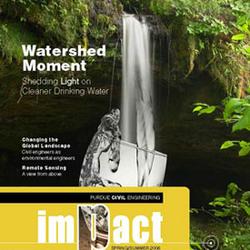
In our environmental engineering theme Spring/Summer 2006 issue of Impact you will read how a research trio develops technology to ensure safe drinking water, how remote sensing is taken to new heights, how civil engineers are making a world of difference, plus much more.
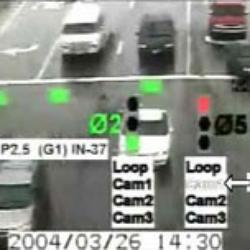
Zachary T. Clark, undergraduate student, Avery Rhodes, MSCE 2005, Professor Darcy M. Bullock of Transportation,
James Sturdevant, Traffic Management and System Operations Specialist with
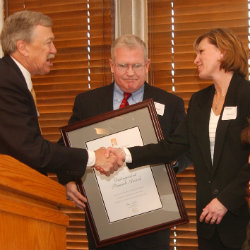
USDOT, and Dave Candey, Technical Support Manager at Econolite Control Products, received the Transportation Research Board D. Grant Mickle Award
for best paper in the area of operations and maintenance, titled "Evaluation of Stop Bar Video Detection Accuracy
at Signalized Intersections".
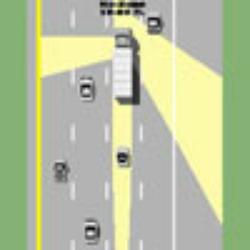
Traffic safety can be greatly impacted by non-truck drivers' and freight truck drivers' behavior toward one another. Professor Srinivas Peeta, graduate student Pengcheng Zhang, and former graduate student Weimin Zhou is the research team of this study titled "Behavior-based analysis of freeway car-truck interactions and related mitigation strategies".
Lesley H. Sneed, graduate student, received the PCA Education Foundation Fellowship for the following
research project titled "Effect of Member Depth on the Shear Strength of Reinforced Concrete Flexural Members".
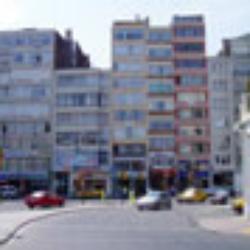
Distinguished Professor Mete Sozen is currently teaming up with other engineers and scientists urging action to protect Istanbul from future earthquakes.
Farshad Rajabipour, graduate student, was awarded first place in poster contest for his work on the development of a sensor
for assessing drying in concrete during the Spring 2006 meeting of the Center
for Advanced Cement Based Materials.
This year's 2006 Bryant Mather Award was given to Gaurav Sant, undergraduate student, Pietro Lura,
post-doc, and Associate Professor Jason Weiss, Materials, for their paper titled "Measurement of volume change in cementitious materials at early ages: review of testing protocols and interpretation of results".
Geotechnical Design has traditionally been done using working stress design (WSD), a design approach in which a factor
of safety is used to either magnify the applied loads or reduce the available resistance to ensure safety. In WSD,
all the uncertainties are lumped in the factor of safety. Load and Resistance Factor Design (LRFD) is an approach in
which the uncertainties related to the imposed loads are accounted for by magnifying these loads, while the uncertainties
involved in reducing resistances are accounted for by reducing the resistances.
Sybil Sharvelle, environmental graduate student, received the Greeley and Hansen Elmer F. Ballotti Memorial Fellowship and the Association of University Women Dissertation Fellowship.
Ph.D. student Victor M. Nakano was selected as the poster winner in the multidisciplinary category for his work on "Multizone Modeling to Predict Contaminant Dispersion within a Healthcare Facility" at the 2006 St. Vincent Hospitals and Health Services Research Symposium, held on June 7, 2006.
Purdue researcher uses remote sensing to study environmental and property related issues in the aftermath of Texas coast hurricanes, monitor endangered species' habitats at Kennedy Space Center, assess earthquake damage in Algeria, and map wildfires in the Australian outback.