
ABE Graduate Student Policies & Procedures Manual
Download PDF version of the manual
This accessible web version is intended to provide the same manual content in a readable, navigable page format. The PDF remains available as a secondary download for printing or archival use.
ABE Graduate Student Policies & Procedures Manual August 2025 - July 2026
Welcome
Welcome to Purdue University and the Department of Agricultural and Biological Engineering (ABE)!
We are delighted that you will be joining us in ABE and are excited to be a part of your professional journey. The purpose of this manual is to acquaint you with the graduate policies and the Department of Agricultural and Biological Engineering at Purdue University.
We believe that you will find your journey meaningful and intellectually challenging. We encourage you to take advantage of the vast resources and opportunities available to you at Purdue University as you strive to reach your professional and personal goals. If you have any questions or need further information, please contact Graduate Program Administrator Nikki Zimmerman at nzimmerm@purdue.edu, or Academic Program Coordinator, Yvonne Hardebeck at hardebey@purdue.edu.
Jane Frankenberger and Dharmendra Saraswat
ABE Graduate Co-Chairs
Nathan S. Mosier
ABE Department Head

Your Path to a Degree
While timelines are different for each student, the list below provides an overview of what to plan for and expect as you work to complete your degree, with links to the section of this manual where you can find more information.
Before Your First Semester
- Communicate regularly with your major professor before your arrival at Purdue about research, courses, and your arrival plans.
- Arrive at least one week before classes start, as graduate assistantships start one week before classes. Attend ABE Graduate Student Orientation and the Office of the Vice Provost for Graduate Students and Postdoctoral Scholars’ (OGSPS)
Orientation during this week.
- Meet with your major professor to plan first semester courses and research.
- Register for courses (often 6-9 credits) and research credits, which should normally total 10 credits for fall/spring. Include graduate student orientation seminar ABE 69400. (See Section 3 of the Manual for details.)
- Discuss research expectations and complete the Research Registration Form, which should help ensure that you and your major professor have shared expectations. (See Section 3 and Appendix D of the Manual.)
Semester 1
- Take courses and ABE 69400, the ABE Graduate Student Seminar (offered fall semesters).
- If you had any admissions conditions that remain to be satisfied per the OGPSPS, complete these.
- Develop your Plan of Study as a part of ABE 69400, based on discussions with major professor, your research project, and your interests. You must include a draft Committee, which can be changed later if needed.
- Register for the following semester. Complete the registration form for the following semester of research credit registration, discussing research expectations with your advisor.
Each Semester
- Meet with your Committee to discuss courses, research, and progress each semester.
- Take ABE 696 Seminar in a spring semester before completing your prelim exam or master’s degree.
- Register for the next semester including research credits. Discuss expectations with your advisor and complete the Research Registration Form.
Before Your Final Semester
- Register as CAND 99100 or 99200 for the semester you plan to graduate (See Section 6)
- Plan process for final exam with your major professor and committee.
- Ensure that your Plan of Study is complete, courses in your Plan are correct, and all degree requirements are met, including ABE 69400, 69600, and if required, ABE 69700 (Ph.D. Only)
Final Semester
- Schedule Defense date with major professor and committee. The Defense date must be at least 2 weeks before the end of the semester.
- Follow the details of the defense and submittal process in Section 6. Your responsibilities include filing Form 8 “Request for Appointment of Examining Committee” and getting electronic approvals at least 2 weeks before the exam, preparing a Defense Announcement using the ABE template, printing rubric forms, submit your thesis/dissertation to the Office of the Vice Provost for Graduate Students and Postdoctoral Scholars for a formatting consultation, and then uploading your thesis to the OGSPS. Read these carefully and discuss with Nikki and your major professor to make sure all are clear.
After Graduation
- Keep in touch with your major professor and the ABE Graduate Program. We look forward to hearing about your successes!
Ph.D. students only
- If you are a direct to Ph.D. student, complete Qualifying Sequence starting in Year 2. See Section 1 for details.
- All Ph.D. students: Complete Preliminary Exam as described in Section 5. You must complete this at least one full year before you graduate.
- Complete ABE 697 seminar in a fall term before your prelim exam.
1. Degrees, Concentrations, and the Graduate Certificate
(This section is primarily for prospective students for whom the degree is not yet determined.)
All applicants are required by the Office of the Vice Provost for Graduate Students and Postdoctoral Scholars (OGSPS) to hold a bachelor’s degree from a college or university of recognized standing prior to registration and should have achieved a grade point average of 3.0 on a 4.0 scale, or higher. Three-year degrees may also be accepted, however, these are evaluated and approved on a case-by-case basis.
MASTER’S DEGREES Master of Science (MS) programs are directed by professors who work in close association with the graduate student. In practice, programs are composed of formal courses, guided individual study in a chosen field or discipline, study in such associated subjects as may be required by the candidate’s advisory committee, and original research that serves as the basis of a scholarly thesis. A standard thesis-based MS degree requires 18 credits of formal coursework and an additional 12 credits of research requirements with the student’s work culminating in a written thesis.
A non-thesis MS degree requires 30 credits of formal coursework, and, in some cases, a final project.
Non-thesis master’s students are not required to have a committee, only the major professor will be listed in the Plan of Study.
Admission to the Graduate Program at the master’s level is restricted to those with an excellent undergraduate record who show potential for graduate success.
ABE offers two master’s degrees for those students with strong undergraduate academic records. These
include:
- Master of Science in Agricultural and Biological Engineering (MS-ABE): generally, for students with a bachelor’s degree in engineering, and
- Master of Science (MS): for students with non-engineering bachelor’s degrees.
Master of Science in Agricultural and Biological Engineering Students who have received a Bachelor of Science in Engineering from an ABET (Accreditation Board for Engineering and Technology)-approved engineering program are normally admitted to this program. The guidelines for an engineering degree are defined by ABET to include 32 hours of engineering sciences, math requirements, and at least 16 hours of design courses.
International students are also eligible for the MS-ABE degree, if their undergraduate degree is in engineering, or a closely related program. Given the diversity of engineering programs and educational systems throughout the world, the Purdue ABE Graduate Committee may ask the student to document their eligibility for this degree option. In this case, the student may be asked to list their courses and to provide translations of any catalogue descriptions not found in English, which correspond to the 32 hours of engineering sciences, math requirements, and at least 16 hours of design, as specified above.
Members of the ABE Graduate Committee will ultimately decide whether an applicant is eligible for admission to the program.
Master of Science Admission to the Master of Science program is available to graduates with non-engineering baccalaureate degrees. Students with a bachelor’s degree in Agricultural Systems Management, for
example, or an equivalent area, are normally admitted to this degree program. Such students must have demonstrated an acceptable level of performance at the undergraduate level in the areas of biological sciences, chemistry, physics, mathematics, economics, management, and have thorough knowledge of computer use for communications and problem-solving.
International students are also eligible for this degree. The ABE Graduate Committee may ask the student to provide documentation that demonstrates an equivalent academic background. Members of the ABE Graduate Committee will ultimately decide whether an applicant is eligible for admission to the program.
Students without an Engineering Degree Applicants with BS degrees from non-engineering or non-accredited programs are normally admitted to the MS program rather than the MSABE. They may become eligible for the MSABE by taking courses to meet the guidelines for an engineering degree as defined by ABET. A minimum of 15 credit hours of remedial undergraduate engineering courses from the five categories listed below are required. Credit for these remedial courses may be applied from equivalent courses from the applicant’s BS degree, subject to approval by the major professor and the ABE Graduate Program Committee. The selection of courses from the five categories is left to the student and subject to the approval of the student’s major professor and advisory committee.
The equivalent of two semesters of engineering physics and four semesters of mathematics (through differential equations) are prerequisites for the engineering courses and must be considered part of the remedial coursework if the applicant's background does not include them. Two suggested remedial (20000 and 30000-level) course plans of study are given below. Remedial courses at the 10000, 20000 and 30000-level cannot be listed on the student’s graduate plan of study and need to be taken in addition to all courses required for the graduate plan of study.
Agricultural Engineering
- Engineering Statics (ME 27000 - Basic Mechanics I or equivalent)
- Engineering Dynamics (ME 27400 - Basic Mechanics II or equivalent)
- Thermodynamics (ABE 21000, ME 20000, or equivalent)
- Fluid Mechanics (ME 30800, CE 34000, or equivalent) - also called Hydraulics, Momentum Transfer
- Mechanics of Materials (NUCL 27300, or equivalent) - also called Strength of Materials or Geotechnical Engineering 1 (CE 34300, or equivalent)
Biological Engineering
- Thermodynamics (ABE 20200 or equivalent)
- Physical Chemistry/Advanced Thermodynamics (ABE 30300 or equivalent)
- Fluid Mechanics (ABE 30700 or equivalent) - also called Hydraulics, Momentum Transfer
- Heat and Mass Transfer (ABE 30800 or equivalent)
- Kinetics and Reaction Engineering (ABE 37000 or equivalent)
Depending upon the applicant’s background and work experience, completion of at least one 40000- or 50000-level engineering design course is required, and a senior capstone engineering design class (ABE 48400 and ABE 48600, or ABE 55700 and ABE 55800) is strongly encouraged.
Remedial courses taken at the 10000, 20000 and 30000-level cannot be listed on the student’s graduate plan of study. Courses completed in addition to the above suggestions, which meet the 32 credit hours
of engineering science and 16 credit hours of design (48 hours total), may be applied toward the requirements of completing the MS degree. A maximum of 6 hours of 40000-level (at a grade “B-” or higher) and any 50000-level engineering science or design courses may be listed on the student’s MS degree plan of study if approved by the student’s major professor and ABE Graduate Program Committee.
Completion of these courses does not guarantee eligibility for the Fundamentals of Engineering exam, which depends on the state engineering licensing agency requirements for candidates without an ABET- accredited engineering degree.
DOCTOR OF PHILOSOPHY DEGREE Ph.D. programs are directed by professors who work in close association with the graduate student. In contrast to the various master’s degrees, the Purdue doctoral degree is not designated by department or by area of specialization. Only concentrations and majors are recorded on graduate transcripts, along with thesis and dissertation titles. The Ph.D. is available to qualified students desiring either an engineering, technology, or systems management program in the Agricultural and Biological Engineering Department.
Admission to the Ph.D. program is usually contingent upon the satisfactory completion of a MS degree in an Engineering, Technology, Sciences, or Agricultural Systems Management program. If the MS is received from ABE at Purdue University, a recommendation of the examining committee is also required, which will be stated in the MS Exam Rubric. A direct-to-Ph.D. option is also available (see next section).
Doctoral programs are composed of formal courses, successful completion of oral and written preliminary exams (see Section 6), guided individual study in a chosen field or discipline, study in such cognate subjects as may be required by the candidate’s advisory committee, and original research that serves as the basis of a scholarly thesis. A Ph.D. requires 30 hours of formal coursework beyond the BS (normally 18 credits beyond the MS), and an additional 60 credits of research with the student’s work culminating in a written dissertation.
Request for admission of a student who has received an MS degree in another department or university will be carried out through the established Office of the Vice Provost for Graduate Students and Postdoctoral Scholars and Department of Agricultural and Biological Engineering application procedures.
Direct-to-Ph.D. Option Students with an outstanding record at their undergraduate institution, and a minimum cumulative GPA at graduation of 3.5/4.0, who are entering the program on a Ph.D.-track without an MS may choose the Direct-to-Ph.D. option. Students choosing this option will be required to complete the Ph.D. Qualifying Sequence (Quals) as described below. If successful, they will continue to the Preliminary Exam one to two years later and must meet all other requirements of all Ph.D. students to graduate with a Ph.D.
degree.
The Direct to Ph.D. is an alternative track to the Ph.D. for some outstanding students that do not wish to complete an MS.
Ph.D. Qualifying Sequence Overview and Timeline The purpose of the Qualifying Sequence is to ensure that the student is prepared to conduct independent research as demonstrated by the student’s ability to effectively summarize the literature in their research area; propose appropriate hypotheses or research questions that will advance knowledge; and, to develop appropriate research studies to test the hypotheses and
answer the research questions. The Qualifying Sequence consists of three parts:
- Student performance in coursework to ensure that the student demonstrates understanding of and ability to apply key principles in their Area of Specialization at the graduate level. (see below)
- Request by the student, with approval from the student’s research advisor, to proceed with Quals. (see below)
- Preparation and defense of a written report on their research and an oral presentation of the report. (see below)
Students should attempt the Quals in the semester after they have completed one year (i.e., fall for those who entered in the fall), and are required to complete it by the end of the following semester (i.e., spring for those who entered in fall).
Master’s students may enter the Direct-to-Ph.D. track up to one year after they begin, by submitting a request to the Graduate Program Coordinator with advisor approval.
Qualifier Outcomes
Each student's Advisory Committee will be responsible for preparing a short write-up summarizing the results of the examination. Based on an evaluation of the student's coursework and performance in the qualifying procedure, there are four possible outcomes:
- 1. Pass: The student is admitted to the Ph.D. program and must complete all Ph.D. program requirements to be awarded a Ph.D. degree. The Quals does not replace the Ph.D. preliminary exam, which must be completed at least one year after the Quals date.
- 2. Retake: The student is asked to retake the qualifier (oral, written, or both) by the end of March (October for Spring Admissions).
- 3A. MS required for Ph.D.: The student must complete an MS (thesis) degree for evaluation for admission to the Ph.D. program by the graduate committee.
- 3B. Graduate with MS: The student may graduate with an MS (thesis or non-thesis) degree. Funding support during completion of the MS degree will be at the discretion of the major professor and the Department Head.
Funding support during completion of the MS degree will be at the discretion of the major professor and the Department Head.
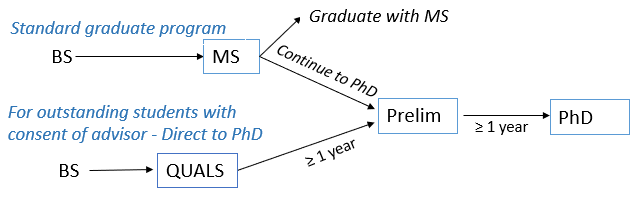
Direct to Ph.D. steps and potential outcomes Coursework Performance Students on a Direct-to-Ph.D. track must complete at least 12 credits of courses from their Plan of Study before their fourth semester (including summer) at Purdue and maintain an overall GPA of 3.0 or higher. A student who does not maintain this GPA or receives a grade lower than a B in any course may not proceed on a Direct-to-Ph.D. program but may continue on the regular Ph.D. track.
Student Request to Proceed Through QUALS A student on a Direct-to-Ph.D. track must submit a request for Quals comprising: 1) written approval from research advisors; 2) unofficial transcripts for coursework taken during their graduate program at Purdue; 3) CV. The Request for Quals must be submitted to the Graduate Program Coordinator at least two weeks before the intended date of the oral exam. As stated in Section A.1, the Quals should normally be completed in the semester after a student has completed one year (i.e., fall for those who entered in the fall).
QUALS Committee The advisory committee for the Quals consists of the major professor and at least two other members of the graduate faculty, with at least one member being from outside the Department of Agricultural and Biological Engineering. When the major professor has a courtesy appointment in ABE, the advisory committee should include at least one regular ABE faculty member.
Written QUALS Research Report The qualifying written report should review literature in the student’s research area, summarize the initial research plan for the Ph.D. work with emphasis on the immediate future work (approximately one year), and present preliminary results, in about 5,000 words (10 to 15 pages at 1.5 line spacing).
This is not expected to be a complete Ph.D. proposal as will be done for the Prelim, but rather to show that the student is capable of conducting graduate research based on evidence of critical thinking skills, understanding of the scientific method, and knowledge of relevant subject matter. A
typical written report for the examination will have the following structure:
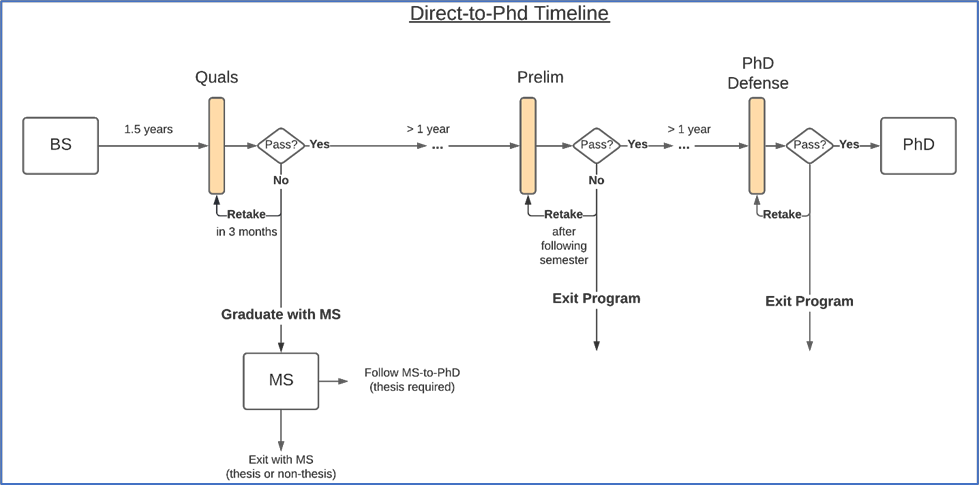
Text description of Direct-to-Ph.D. flowcharts
The standard graduate program path begins with the BS degree, continues to the MS degree, and may either end with graduation with an MS or continue to the Ph.D. path. Students continuing to the Ph.D. complete the preliminary examination, then complete at least one year before the Ph.D. defense.
The Direct-to-Ph.D. path is for outstanding students with advisor consent. The typical timeline begins after the BS degree, with Quals at approximately 1.5 years. If the student passes Quals, the student proceeds toward the preliminary examination after more than one year. If the student does not pass Quals, the student may retake Quals in 3 months or graduate with an MS, with options to exit with an MS or follow an MS-to-Ph.D. path where a thesis is required.
After the preliminary examination, a passing outcome leads toward the Ph.D. defense after more than one year. A non-passing outcome may require a retake after the following semester or may result in exiting the program. After the Ph.D. defense, a passing outcome leads to the Ph.D.; a non-passing outcome may require a retake or may result in exiting the program.
- Introduction, including research objectives
- Literature review and theory that form the basis for your study
- Methods and materials you plan to use, based on what you know so far (recognizing they will be expanded and fine-tuned in future years)
- Preliminary results (if available) and/or discussion of what you have learned so far
- Plan for next 12 months The student should engage consistently with the advisor to coordinate the document and submit the report to the Advisory Committee at least two weeks before the exam. The report will be used as the basis for evaluation along with the student’s performance in oral presentation.
Oral QUALS Examination All students must undergo an oral examination on the thesis research and the subjects of relevance to the respective area of specialization in front of the Advisory Committee. Oral examination dates should be scheduled with the Advisory Committee to occur before the end of the third semester, not including summer (in other words, fall of the second year for those who start in the fall.) If unsuccessful, the student may retake the exam in the fourth semester. The student should prepare and print Rubric Forms (available in Appendix E of the ABE Grad Manual) for each member of the Advisory Committee.
The purpose of the oral examination is to provide an early assessment of the student’s knowledge of their discipline, critical thinking skills, experimental and/or computational skills, communication skills, as well as their vision and motivation to complete the Ph.D. They should not be expected to display the same level of mastery that would be expected at the Prelim. The Oral Quals exam may last up to two hours, beginning with a short presentation from the student to the committee, followed by questions and additional discussion. The committee may ask questions on the written report, the presentation or other topics related to the area of specialization. Time should be reserved for a closed-door deliberation among the committee members (in the absence of the student) during which the committee will determine the results of the exam among the choices in section B., complete the rubric, and provide the results to the student.
CONCENTRATIONS A concentration is used to allow a specialized area of graduate study to be reflected on a student’s final
transcript. The department currently offers the following:
- Biotechnology (PULSe)
- Biotechnology Innovation and Regulatory Science (offered to Purdue Online students only)
- Computational Science and Engineering (CIGP)
- Computational Life Sciences (CIGP)
- Data Science for Agricultural and Biological Engineering (DSAG)
- Fluid Power and Motion Control (FLPR)
- Interdisciplinary Ecological Sciences and Engineering (IESE)
Approved core courses for these concentrations can be found in Appendix B. Please note that some concentrations offered in ABE are independent of the department. Computational Interdisciplinary Graduate Programs (CIGP), Interdisciplinary Ecological Sciences and Engineering (IESE), and PULSe, an
Interdisciplinary Life Science Program, all offer interdisciplinary concentrations in collaboration with the ABE department. Please visit their websites for more information.
GRADUATE CERTIFICATE Two Graduate Certificates that are popular with ABE students are the Hybrid Vehicle Systems certificate available through the School of Mechanical Engineering. The other is the Geospatial Information Science certificate offered by the Purdue Libraries and School of Information Sciences. Please see their respective websites for information.
A third certificate, Biotechnology Quality and Regulatory Compliance (BQRC) is available for online professional students usually with interest in the online Biotechnology Innovation and Regulatory Science master’s program.
TRANSFERRING TO ABE FROM ANOTHER PURDUE UNIVERSITY GRADUATE PROGRAM Requirements The student must meet the Office of the Vice Provost for Graduate Students and Postdoctoral Scholars’ requirements to be considered by ABE for a transfer from another Purdue department. This means the student’s GPA must be at least a 3.0. The student should be coming from a discipline which closely relates to work done in the ABE department and must be able to demonstrate knowledge of the field of agricultural and biological engineering and articulate how ABE is a good fit for them based on their research goals. Students must have an ABE faculty member willing to serve as their major professor.
Materials Needed to Approve Transfer
- 1. A Statement of Purpose for Transfer will be written by the student, explaining which degree they are currently pursuing (master’s or Ph.D.), the justification for the transfer, and explaining why ABE is an appropriate fit for the student.
- 2. A letter or statement by the ABE major professor justifying the transfer and indicating a willingness to supervise and provide funding for the student as per the OGSPS requirement.
Process of Assessment Members of the ABE Graduate Committee will review the file and determine whether the transfer is appropriate for the student and for the department.
2. Major Professor
When admitted to Purdue, most ABE graduate students have already chosen a major professor. If not, they will be initially assigned to one. This initial assignment is based on expressed research interest, the research programs of the staff member, and the availability of research funds. Faculty with courtesy or adjunct appointments are members of the graduate faculties of Purdue and may serve as a major professor or an advisory committee member.
3. Coursework and Plan of Study
COURSE REQUIREMENTS Courses provide fundamental knowledge needed for graduate students to not only excel in today’s research, but also to be equipped to address new research questions in the future. Therefore, students
and their advisory committees should ensure that students take the breadth and depth of courses needed to provide this foundation.
The ABE department has set the minimum requirements described below, but it is appropriate for many students to take more courses to ensure they have the fundamental knowledge needed for current and future research. The ABE department does not have a “common” or “core” set of graduate courses, and students’ degree programs are customized to meet their goals.
Master’s Degree - Thesis Minimum requirements for the program are 18 course credits beyond the bachelor’s level, and an acceptable research thesis that contributes to knowledge in the field of research specialization. At least half of these credits must be taken at Purdue University. For the thesis option, courses taken must
include:
- At least three credits of graduate coursework (50000 or 60000-level) in any mathematics, statistics, quantitative data processing and/or data science course. (See Appendix C.)
- At least six credit hours of graduate coursework (50000 or 60000-level) in ABE, ASM, or core courses as listed in a specific ABE concentration (see Appendix B).
- Two semesters of Graduate Seminar, ABE 69400 (typically taken in fall of the first graduate year), and ABE 69600 (typically taken in spring). Class attendance and participation in Graduate Seminar is mandatory and required for graduation. ABE 69400 and 69600 should not be entered on the electronic copy submitted through the OGSPS.
The plan of study should provide a well-balanced and integrated program in support of the student’s concentration or area of interest. Students should normally complete at least 12 to 18 credit hours of coursework within the first twelve months of the student’s entry into the department, although in cases where the student has a heavy initial research involvement due to the nature of the research, 16 months may be required for coursework completion. The coursework total can include up to three credits of ABE 59000 (see Appendix F for the Special Topics Contract), or an equivalent designation in another department.
A maximum of six hours of 30000 or 40000-level course credits (with a grade “B-” or higher) and any 50000 and 60000-level engineering science or design courses may be listed on the student’s MS degree plan of study if approved by the student’s major professor and ABE Graduate Program.
Master’s Degree - Non-Thesis The non-thesis MS requires 30 semester hours of graduate coursework beyond the BS. At least half must be taken at Purdue University. A non-thesis degree is not a typical route to a master’s degree for ABE students; instead, nearly all ABE students complete thesis-based degrees. For the non-thesis option,
courses must include:
- At least three credits of graduate coursework (50000 or 60000 level) in any mathematics, statistics, quantitative data processing and/or data science course. (See Appendix C.)
- At least six semester hours of graduate credit (50000 or 60000 level) in ABE, ASM, or core courses if identified in a specific concentration (see Appendix B).
- One semester of Graduate Seminar - ABE 69400 (typically taken in fall of the first graduate year), Class attendance and participation in Graduate Seminar is mandatory and required for graduation. ABE 69400 should not be entered on the electronic copy submitted through the
OGSPS.
The plan of study should provide a well-balanced and integrated program in support of the student’s concentration or area of interest. The coursework total can include up to three credits of ABE 59000 (see Appendix F for the Special Topics Contract), or an equivalent designation in another department.
Further recommendations for coursework should come from A maximum of six hours of 30000 or 40000-level course credits (with a grade “B-” or higher) and any 50000 and 60000-level engineering science or design courses may be listed on the student’s MS degree plan of study if approved by the student’s major professor and ABE Graduate Program.
Doctor of Philosophy Degree Minimum requirements for the Ph.D. program are 30 semester hours of graduate work and the completion of an acceptable research dissertation that contributes to knowledge in the field of research specialization. This total can include three credits of ABE 59000 (see Appendix F for the Special Topics Contract), or an equivalent designation in another department. At least half of Ph.D. course credits must be taken at Purdue University, not including credits taken to complete the MS degree. The plan of study should be a well-balanced and integrated program including in-depth work in the concentration or research area of interest, breadth in Agricultural and Biological Engineering, and a sound mathematical
background including:
- At least six credits of graduate coursework (50000 or 60000-level) in any mathematics, statistics, quantitative data processing and/or data science course. (See Appendix C.)
- At least twelve credits of graduate coursework (50000 or 60000-level) in ABE, ASM, or core courses as identified in a specific concentration. (See Appendix B for course lists.)
- Three semesters of Graduate Seminar, ABE 69400, ABE 69600, and ABE 69700. ABE 69400 is generally taken in the first fall semester of graduate studies. ABE 69700 is taken after the second year of graduate studies is completed, but before, or in the same semester as the prelim exam. ABE 69600 is generally taken after the student has compiled enough research results to develop a departmental seminar on their work.
The three Graduate Seminar courses are not to be listed on the electronic plan of study.
A maximum of six hours of 30000 or 40000-level course credits (with a grade “B-” or higher) and any 50000 and 60000-level engineering science or design courses may be listed on the student’s Ph.D.
degree plan of study if approved by the student’s major professor and ABE Graduate Program.
Up to 18 credit hours may be waived from the requirements of a completed MS degree. These should conform to the requirements for the MS outlined above. Individual courses applied to the MS degree from Purdue University or another institution, should not be listed in the Ph.D. electronic plan of study.
Instead, the student’s major professor and/or Graduate Program Administrator will enter and approve the total number of semester hours applied from a MS, up to 18 total.
4. Plan of Study
Each graduate student admitted to a degree program must file a Plan of Study through the myPurdue portal before the end of the first semester of graduate work, or in their first fall semester. Plans of Study are discussed and created as a part of the ABE 69400 Graduate Seminar requirements. The Plan of Study includes the specific courses the student is expected to complete. No courses that have S/U grades, such as research credits (ABE/ASM 69800 or 69900), should appear on the Plan of Study, nor should any P/NP classes.
Waiver of course requirements (only for Ph.D. students with a MS earned from Purdue University or another accredited institution) are subject to the rules as described in the last paragraph of section 3 (above) and are subject to the approval of the student’s major professor and ABE graduate committee.
Waived courses from another institution will not appear on the Purdue University transcript. Waived courses applied to a MS earned at Purdue University or another institution should not be individually listed in the student’s electronic plan of study. The major professor (or designee) will enter and approve the total number of waived credit hours (≤18) on the electronic plan of study.
Course credits earned by a student whose graduate study and/or professional activity have been inactive for five years or more cannot be used in a plan of study for an advanced degree. A plan of study approved prior to such a period of inactivity is invalid. A preliminary examination passed prior to such a period of inactivity is invalid.
Up to six credits of 30000- or 40000-level course credits, with a grade of B- or better, are allowed on plans of study for both a master’s and Ph.D. degree.
FILING THE PLAN OF STUDY An initial plan of study will be developed as part of each new graduate student’s successful completion of ABE 69400, the Graduate Seminar Course.
The Plan of Study Worksheet (Appendix A) can be used to outline coursework and to assure that the coursework fulfills the requirements described in section 3. The Plan of Study must be approved by the major professor.
The approved worksheet will aid in completing the electronic submission of the plan of study. The Plan of Study is filed electronically and must be completed by the student after his or her major professor has approved. It includes the specific courses the student is expected to complete and other requirements of the degree being sought. No research credits (ABE 69800 or 69900) or graduate seminars (ABE 69400, 69600, or 69700), should appear on the plan. No courses taken pass/fail (P/NP) or satisfactory/unsatisfactory (S/U) may be included in the plan. The initial Plan of Study must be finalized and submitted for approvals before the end of the first semester in a graduate degree program.
The Plan of Study for a Ph.D. must be filed by the end of the student’s first academic semester in the Ph.D. program in order to meet departmental requirements. For students who complete a MS degree at Purdue or at another institution, up to 18 credit hours may be waived, subject to the approval of the major professor and the graduate committee. See details above in the first paragraph of this section.
After the initial electronic plan of study has completed the approval process, it may be amended at any time, subject to the major professor’s and graduate committee’s approvals.
CREDITS FROM ANOTHER UNIVERSITY Students who transfer to ABE from another university may transfer graduate courses to fulfill course requirements at Purdue, provided they are approved by the student’s advisory committee and meet the
following criteria:
- 1. Courses are graduate level and taken at an institution regionally accredited at the graduate level
- 2. A grade of B- or better was earned
- 3. Credits were not used toward another awarded degree
- 4. There is less than a five-year gap between when the courses were taken and the beginning of the graduate program at Purdue University.
The advisory committee should ensure that the courses are suitable for transfer to Purdue and may review the course syllabus or other information before approving. At least 50% of the course requirements for any degree must be taken at Purdue.
RESEARCH AND COURSE REGISTRATION PURPOSE Registration for all students should reflect the student’s activity as accurately as possible. Any student must be registered for research during each semester or summer session when doing research utilizing faculty direction or consultation, and/or requiring the use of university facilities. Research includes literature reviews and thesis writing. Policy requires that each graduate student supported by an assistantship (teaching or research) must be registered as a full-time student each semester. In fulfilling degree requirements, a maximum of 18 credit hours will be allowed from any one semester (nine credit hours for the summer session.)
Research credits represent effort to reach research goals outside of the employment appointment (usually 20 hours per week for a research or teaching assistantship). Learning to conduct research with mentorship by the advisor is an important part of the graduate student experience and is different than work required by the assistantship. At least one research credit is required for all students in every semester.
- The ABE Department recommends that students with assistantships (RA or TA) register for a total of 10 credits (course plus research credits) during the fall and spring semesters, and eight credits in the summer. (Note that international students on assistantships must be registered for a minimum of eight credits to maintain legal F-1 status.)
- Students on fellowships or who are self-funded may register for more research credits if they wish, because they do not have assistantship-based employment responsibilities. (International students who do not have assistantships must be registered for a minimum of eight credits to maintain legal F-1 status, so international students on fellowships may want to register for more than 10 credits to ensure they do not fall below this minimum.)
These are general recommendations, but student circumstances may lead to different levels of research activity in various semesters and therefore graduate students and their advisors should select an appropriate number of credits each semester.
All master’s students must be registered in ABE or ASM 69800 (Research MS Thesis) and all Ph.D.
students must be registered in ABE or ASM 69900 (Research Ph.D. Thesis). ABE/ASM 69800 and ABE/ASM 69900 should not appear on the Plan of Study but count toward meeting residency requirements. Early registration is recommended. Late registration will result in additional fees.
RESEARCH REGISTRATION PROCESS The Office of the Vice Provost for Graduate Students and Postdoctoral Scholars (OGSPS) requires that each student complete a “syllabus” for each semester of research credit registration. This includes general goals and expectations agreed upon by a student and their major professor for the semester in question. In ABE, the form found in Appendix D is used both to fulfill this requirement and to allow a process for students to request registration for research credits. The syllabus should be filled out by the student and approved by the major professor.
The Research Expectations section includes two parts. The top part is standard and applies to all students each semester. The second part should describe the specific accomplishments expected during
the upcoming semester and should be developed by the student and advisor together. This clarification of expectations is very helpful in ensuring smooth progress forward.
After completion, the student should email the form to the Graduate Program Administrator from their @purdue.edu email account, copying their major professor, and requesting they respond with approval or edits. Once approval is given (also via the faculty member’s @purdue.edu email), the Graduate Program Administrator will enter the research credits and communicate with all parties. This must be completed before the end of the first week of a term, or the student will have to use the Scheduling Assistant found in myPurdue.
REGISTRATION AND BILLING When registration is completed, fees and payment schedules will be posted on the myPurdue portal. It is the student’s responsibility to provide the correct mailing address or direct deposit account information, to the Office of the Registrar, Bursar’s Office, and Agricultural and Biological Engineering Department, for billing purposes.
Students employed through an assistantship or fellowship receive tuition remission, which is processed by the ABE Business Office and the Bursar’s Office after they have registered for full time credits for that term. Please note that some fees are NOT covered by tuition remission. For example, the College of Engineering charges differential fees, and the university charges student health and wellness fees. For more information regarding fees paid by the students, and for information regarding payment plan options, please visit the Bursar’s Office website. Additionally, tuition and fees can be estimated using the Tuition Calculator.
REGISTRATION AND HOLDS To check if you have a Hold on your account that may prevent registration, please login to your myPurdue and locate the Registration Holds card. Common examples of holds that will prevent you
from being able to register or obtain official transcripts are:
- Immunizations - All Purdue students must have their immunization records on file with Purdue University Student Health (often called PUSH). For office information, see
Appendix G.
- Financial Responsibility - The Division of Financial Aid requires all Purdue students to acknowledge and accept their responsibility for incurred charges. This hold is placed on every student account before spring registration opens each year. For office information, see Appendix G.
- Emergency Contact - The University requires each student list an Emergency Contact.
This hold is also placed on every student’s account before spring registration opens each year. If you have an Emergency Contact listed already, you must click “Verify” to remove the hold once it is in place.
- Outstanding Admission Conditions (such as missing official transcripts or official diploma) - This is a hold that you may see in your first semester. Many students fail to provide official transcripts or certificates to the OGSPS upon their arrival to Purdue. This hold means you still need to contact the OGSPS Admissions Office to fulfill an admission condition.
GRADE REQUIREMENTS The graduate student is expected to perform on a high academic level. Only grades of C- or better are acceptable in fulfilling OGSPS requirements on any plan of study. No more than six credits of "C" grades
will be accepted toward graduation. The major professor and the advisory committee may require performance of B or better in certain courses. This requirement must, however, be stated in writing to the student and placed in the student’s file at least one month before the student takes the course.
Please note: Pass/no pass grades are not acceptable in fulfilling degree requirements.
All graduate degree candidates must have a minimum of 3.0 (out of 4.0) Grade Point Average (GPA) to graduate. The GPA is computed from all courses on the plan of study. The student’s progress will be reviewed each semester by both the Office of the Vice Provost for Graduate Students and Postdoctoral Scholars and the Department. Should the student fail to perform on a level satisfactory to the major professor and the advisory committee, or to the Dean of the Office of the Vice Provost for Graduate Students and Postdoctoral Scholars, he or she may be asked to discontinue graduate study at Purdue University. The same scholastic requirements in effect during the regular university year apply to graduate study during the summer session and in work taken at the university’s regional campuses.
In situations where a graduate student does not satisfactorily complete a graduate level course with the grade of C or better, the student may re-enroll in the course only once. The first grade will not be considered in the graduation GPA. If a student receives a D or below in more than one course, the student could lose his/her departmental graduate appointment. In the case of students with fellowships, the sponsor will be notified of the student’s unsatisfactory academic performance. A student who falls below the guideline will be notified, in writing, by the Graduate Program Chair and will have one semester in which to raise his/her GPA above 3.0. If the GPA falls below 3.0, the student’s grade report will be marked as such by the OGSPS. The student must raise their semester GPA above 3.0 the following semester or may be asked to leave the graduate program. A plan of study GPA below 3.0 may result in the loss of the student’s assistantship or fellowship.
Graduate students who receive an incomplete grade in any course will have one year from the date the Incomplete was given to receive a completion grade. If that is not done, the Registrar’s Office will convert the grade to failing (noted as IF on the official transcript).
REGISTRATION REQUIREMENTS The Office of the Vice Provost for Graduate Students and Postdoctoral Scholars requires that one-half of the total credits for the master’s degree and one-third of the total credits for the Ph.D. degree be earned at Purdue University. The ABE Department requires one-half of the total credits for each degree be earned at Purdue University. (See VI., B. Degree and Registration Requirements.)
5. Graduate Research
ADVISORY COMMITTEE Each student completing the Quals, a thesis master’s degree, or Ph.D. degree must select an advisory committee. The major professor will help identify faculty members who have expertise in the area of research or professional interest. The advisory committee will advise on courses selected for the plan of study, and as needed during graduate studies. Since the advisory committee must approve plans of study, research project outlines, and theses, the student is responsible for keeping committee members informed of his/her progress. Failure to meet the filing deadlines may result in loss of a student’s graduate assistantship, until the process has been satisfactorily completed.
The advisory committee for the Quals and a master’s degree consists of the major professor and at least two other members of the graduate faculty. For a Ph.D. degree, the advisory committee should consist of the major professor and at least three other members of the graduate faculty, with at least one
member being from outside the Department of Agricultural & Biological Engineering. When the major professor has a courtesy appointment in ABE, the advisory committee should include at least one regular ABE faculty member for both master’s and Ph.D. degrees.
INTEGRITY IN RESEARCH Integrity in research is an essential part of Purdue University’s intellectual and social structure, and adherence to its spirit and principles must be maintained. These principles include commitment to truth, objectivity, fairness, honesty, and free inquiry. Violations of integrity may result in dismissal from the university.
Serious violations of integrity in research are rare. However, those that do occur strike at the very heart of scholarship and the concept of the university. Advances in scientific knowledge depend on reliable data and honestly reported conclusions. In any academic institution, scholars, researchers, and artists have a special obligation to exemplify the best qualities and highest standards of personal and professional conduct.
All ABE students are required to complete the online training course on Responsible Conduct of Research developed by the Collaborative Institutional Training Initiative (CITI) available at https://www.purdue.edu/gradschool/research/rcr/. This is a requirement of the ABE 69400 seminar.
Students should also be familiar with policies on responsible conduct of research at the above website.
6. The Preliminary Exam for Ph.D. Students
Admission to candidacy for the degree of Doctor of Philosophy takes place only after the student has passed the preliminary examination. (Note that this is not the same as candidacy for graduation.) A student must be enrolled for at least 2 full semesters (summer is counted as a semester) between successful completion of the preliminary exams, and the defense of the dissertation, (e.g., If the prelim is completed in fall 2024; the final defense can be held in fall 2025 or later).
The preliminary examination consists of three parts: 1) research proposal, 2) written examination, and 3) oral examination. The preliminary examination is administered by the student’s major professor and the preliminary examining or thesis advisory committee. It determines if students have an adequate understanding of their research program, have a reasonable plan for completing the research, and have the necessary academic background and capability to conduct the research successfully. The process should be determined and scheduled with the entire committee well in advance, usually early in the semester during which the prelim will take place.
The research proposal should follow a format determined by the student’s major professor and preliminary examination/thesis advisory committee. Specific expectations for the format, length, and content of the research proposal should be set by the major professor and communicated to the student. The research proposal should be submitted to the examining/thesis advisory committee before the written prelim takes place and at least three weeks prior to the oral examination.
The format and content of the written examination are developed by the student’s major professor and the preliminary examining/thesis advisory committee. The ABE Department expects that the written examination should include subject matter other than material directly related to the student’s specific Ph.D. research topic and that it should be at a level that requires the student to demonstrate expertise in the subject matter. Often each member of the committee provides one or more questions. Types of questions that may be used include critiquing an article selected by a committee member, writing a short proposal on a problem different than the student’s research proposal, or solving a problem related
to the proposed research. The written examination process should be clearly communicated to the student in advance, including the day and time each member of the committee will provide the question(s). Each committee member should provide instructions for their question(s), the time allowed (often 4 to 24 hours), and allowable resources to be used. The entire process should normally take less than two weeks, including all questions and breaks between them. The completed questions will be submitted to the major professor and preliminary examining/thesis advisory committee, and results will be returned to the student in a timely manner. The written exam must be passed before proceeding to the oral exam.
The oral examination should include a presentation by the student summarizing their research proposal. As students should meet with their advisory committee annually to discuss their research progress, the presentation typically provides an update on prior results or a summary of work to date.
Most of the oral presentation should focus on the proposed methodology, data collection plans, data analysis, anticipated results, and timeline. The exact format, length, and content should be followed as directed by the major professor. The preliminary examination/thesis advisory committee is expected to ask the students questions about their research and other relevant topics, including material from their written exam.
At least two weeks prior to the oral examination, a Request for Appointment of Examining Committee (electronic G.S. Form 8) must be filed by the student and approved by the student’s major professor. At or after the oral exam, committee members will be asked to complete the Rubric for Ph.D. Dissertation Research Proposal, Written Prelim, and Oral Prelim.
If the report of the examining committee is unfavorable, the student may repeat the examination after the following semester or summer session at the recommendation of the examining committee. Should the preliminary examination be failed twice, the student may not be given a third examination, except on the recommendation of the examining committee and with special approval of the Dean of the
OGSPS.
Please refer to the following chart for a simplified outline of this timetable
Preliminary Exams Timeline Timeline Actions Near the beginning of the semester in which you take your Preliminary Exams.
- Confirm that your Plan of Study has been approved by the OGSPS.
Make any necessary changes.
- Discuss the schedule and format for your written and oral preliminary exams and research proposal with your major professor. Select a date for the oral prelim, recognizing that the written prelim must be passed before proceeding to the oral.
Several weeks before the Oral Preliminary Exam.
- Submit your Research Proposal to your committee
- Take your Written Preliminary Exam At least 2 weeks before the Oral Preliminary Exam.
- Submit electronic Form 8 (Request for Appointment of Examining Committee).
At the Oral Preliminary Exam
- The major professor directs the exam, which normally includes a presentation by the student, followed by questions related to the written exam and the proposed research.
- At the end of the exam, Committee members should complete the “Ph.D. Dissertation Research Proposal, Written Prelim, and Oral Prelim Rubric”.
- The major professor should initiate the exam results form, which will then be completed by other Committee members.
7. Thesis and Defense
DECLARING CANDIDACY FOR GRADUATION Graduate students must declare candidacy for the semester in which they intend to defend their thesis or dissertation and have their degree awarded. The OGSPS Deadlines Calendar provides the dates by which requirements must be completed, normally 1-2 weeks before the end of the semester. It is the student’s responsibility to communicate graduation intentions with their major professor and the Graduate Program Administrator during the registration period for any given semester. Candidacy for graduation is only valid for one semester and does not carry forward to other semesters if the thesis/dissertation defense and submission deadlines are missed. Should a student miss the deadlines for graduation, they can register as many times as needed. However, any student registered for candidacy in three consecutive semesters will be assessed a $200 fee by the OGSPS.
A “CAND” course, either 99100 or 99200 should appear on the student’s registration for the appropriate semester of their graduation.
It is the student’s responsibility to confirm that the coursework on their plan of study matches the coursework completed at Purdue.
Appropriate CAND course registrations
CAND 99100 (General Candidacy) CAND 99200 (Degree only)
Students plan to fulfill all requirements during the semester. (See OGSPS Deadlines Calendar for due dates.)
Students must have met all degree requirements, except for defending and/or depositing. Satisfactory research is required in the previous session, and students must meet a mid-semester deadline.
*If assistance is needed in deciding which CAND course is correct, contact the ABE Grad Program Administrator.
CAND 99200 is considered a “privileged registration” status which results in lower fees, but not in full- time student status. As a general rule, students registered for CAND 99200 may NOT be funded (supported on an assistantship). Be aware that most students who select CAND 99200 leave campus before semester’s end.
THESIS OR DISSERTATION The final product of most graduate research programs is a thesis or a dissertation. This document represents the diligent and original work of the student. Care should be taken to be sure this document is of high quality. The thesis or dissertation must be distributed to the advisory committee at least two weeks before the final exam is given. In their written document, students must demonstrate that they have met the expectations of PhD graduates (i.e., that they are able to critically analyze existing literature to identify gaps in their research area, design methodologies to address these gaps, employ appropriate tools or techniques to conduct their work, and rigorously analyze, interpret, and communicate their findings to advance their field). It is also expected that students will demonstrate adherence to principles of responsible research conduct throughout their dissertation. Please visit the
Thesis/Dissertation Office’s website for instructions regarding formatting, running iThenticate, and other submission questions.
The Office of the Vice Provost for Graduate Students and Postdoctoral Scholars (OGSPS) requires a specific format for all theses and dissertations. Detailed information on formatting your thesis or
dissertation can be found at the OGSPS’s Thesis/Dissertation Office Website:
http://www.purdue.edu/gradschool/research/thesis/. Each student is responsible for completing and submitting these as required by the OGSPS. In the ABE Department, authority for approving the thesis/dissertation format has been delegated to chairs of the final examining committee.
FINAL EXAMS Determining when a student is prepared to defend is a collaborative decision between the student and advisor, based on mutual agreement that the student has fulfilled PhD requirements. A final oral examination is taken after the completion of all course work and the thesis or dissertation. This exam may cover any material in the candidate's program but is typically a defense of the thesis or dissertation.
In the case of Ph.D. candidates, at least two full registered semester sessions (which may include summer) of devoted research must lapse between the passing the preliminary exam and taking the final defense.
The Graduate School mandates strict deadlines for defense scheduling and dissertation submission, therefore, students are advised to confirm deadlines several months before their intended graduation date.
Final examination requests must be approved by the Department Head and received by the OGSPS at least two weeks before the examination date. A final oral examination will be given to candidates before the completion of requirements of the graduating student. Once you have passed the final examination for your degree, your chair and examining committee members will electronically sign the OGSPS Examination Report (GS Form 7 for master’s candidates or Form 11 for doctoral candidates). Once other required signatures are secured, the report is finalized in the OGSPS.
Students should have electronic or paper copies of the appropriate rubrics for each member of their committee. Committee members should complete the rubric forms and submit originals or copies to the Graduate Program Administrator and provide a summary to the student.
Expectations for PhD Defense During the oral defense, students must demonstrate that they have met PhD-level expectations, including the ability to critically evaluate literature, identify research gaps, design and execute methodologies, analyze results, and communicate findings effectively to advance their field. Students must also show adherence to ethical research practices.
While there is no fixed requirement for published papers, a common benchmark is to aim for two accepted or published journal articles by the defense date, with additional manuscripts in preparation.
THE DEPOSIT PROCESS Both MS and Ph.D. theses/dissertations are required to be submitted electronically to the Purdue Office of the Vice Provost for Graduate Students and Postdoctoral Scholars for review. An electronic PDF file of all theses/dissertations will be uploaded to the Hammer Research Repository (HammerRR). A final copy of the thesis/dissertation should be delivered to the major professor and committee members, or as the major professor dictates. Please visit the Thesis/Dissertation Office’s Deposit Process website for more
information: https://www.purdue.edu/gradschool/research/thesis/requirements.html. Note that the deadline to submit the Form 9 and the thesis or dissertation is 24 hours before the published deadline.
8. Other Policies
STUDENT CONDUCT Graduate students, like all students officially enrolled at Purdue University, are subject to all university regulations. At the same time, their rights as individuals and as students are duly protected. Graduate students who feel that their rights have been violated by a disciplinary decision may seek redress through the Community Standards Board, according to procedures specified in Regulations Governing Student Conduct, Disciplinary Proceedings, and Appeals, Section C-8 of the University Regulations, Student Conduct Policy.
ACADEMIC STANDARDS Graduate students must be proactive in matters pertaining to their academic program, coursework, and research. It is recommended that all graduate students in ABE meet with their advisor at the beginning of each semester to be certain both the student and advisor understand and agree upon expectations regarding registration, research credits, and other academic matters. While this should help avoid any major issues before they arise, there are Office of the Vice Provost for Graduate Students and Postdoctoral Scholars and University processes in place should more guidance be necessary.
Graduate students who wish to appeal decisions concerning matters of academic standards may seek redress according to procedures specified in the Student Conduct Policy, Regulations Governing Student Conduct, Disciplinary Proceedings, and Appeals, Section E-Grade Appeals System, of University Regulations and to the procedures detailed in Graduate Council Document 91-C which have been established in accordance with the authority thereby delegated to the Graduate Council. Further information regarding graduate student Appeals Concerning Academic Standards can be found in the Policies and Procedures for Administering Graduate Student Programs, section IX, A. Student Conduct and Rights of Appeal.
NONDISCRIMINATION POLICY STATEMENT Purdue University is committed to maintaining an inclusive community that recognizes and values the inherent worth and dignity of every person; fosters tolerance, sensitivity, understanding and mutual respect among its members; and encourages individuals to strive to reach their own potential. The University believes that intellectual and cultural diversity among its many members strengthens the institution, stimulates creativity, promotes the exchange of ideas and enriches campus life.
Purdue University views, evaluates and treats all persons in any university-related activity or circumstance in which they may be involved solely as individuals on the basis of their own personal abilities, qualifications and other relevant characteristics.
Purdue University does not condone and will not tolerate Discrimination against any individual on the basis of race, religion, color, sex, age, national origin or ancestry, genetic information, disability, status as a veteran, marital status, parental status, sexual orientation, gender identity or gender expression.
Purdue University promulgates policies and programs to ensure that all persons have equal access to its employment opportunities and educational programs, services and activities. The principal objective of this policy is to provide fair and consistent treatment for all students and employees of the University.
Any question of interpretation regarding this Nondiscrimination Policy Statement shall be referred to the Vice President for Ethics and Compliance for final determination.
9. Professional Development
- PROFESSIONAL SOCIETIES: Attendance at professional meetings and membership in professional societies is encouraged. In most cases travel and lodging are the student’s personal responsibility except in cases where project funds are available for this purpose. The Department often arranges a van to attend the annual American Society of Agricultural and Biological Engineers meeting. Many professional and research associations have branches on campus such as Sigma Xi and Alpha Epsilon. Students are expected to be active in professional societies while pursuing advanced degrees at Purdue University.
- ABE GRADUATE STUDENT ASSOCIATION: Students are strongly encouraged to participate in the Agricultural and Biological Graduate Student Association. As an admitted graduate student in the Agricultural and Biological Engineering Department, students are automatically members. Your level of participation in the organization is your decision. The ABE GSA is made up of graduate students dedicated to improving the experience of their fellow graduate students in the ABE department at Purdue University. Please visit their website for more information: https://engineering.purdue.edu/abegsa/.
- GRADUATE STUDENT AWARDS: As part of both the College of Agriculture (COA) and the College of Engineering (COE), graduate students in the ABE department may be eligible for many awards annually. Award opportunities that are typically offered annually are listed below, although any of these may change each year. The Graduate Program Administrator sends email notification to all graduate students of specific awards, application materials needed, and deadlines, which graduate students are responsible for meeting if they wish to be considered.
The list below includes those that are evaluated and decided upon in the department, including those awards for which we nominate a candidate, who may or may not receive the award. A brief, partial description is given, please see actual award criteria for specific information.
| Award |
Typical Deadline (subject to change) |
Description |
|---|---|---|
| Outstanding Graduate Research Award (COE) | February | Based on publications, awards for research, and contribution to research field and society. |
| Magoon Teaching Award (COE) | February | Must have half-time teaching assistantship and other eligibility as determined by COE. |
| Outstanding Graduate Service Award (COE) | February | Service to the department, college, university, and community. |
| OGSPS Excellence in Teaching Award (Nomination to OGSPS) | February | Eligible students are contacted by ABE Grad Admin. Students must have been awarded Magoon or Teaching Academy Award previously. |
| Teaching Academy Graduate Teaching Award | February | Eligible students are contacted by ABE Grad Admin. Students must have been awarded Magoon previously. |
| ABE Outstanding MS and Ph.D. Awards | March | Based on research contributions, academic excellence, teaching or mentoring, and service to ABE. |
| Bilsland Dissertation Fellowship | December | For Ph.D. students in final year. Selection based on funding need, merit, service, and career promise. |
10. Graduate Student Employment
WORKLOADS OF STUDENTS WITH GRADUATE STAFF APPOINTMENTS Most graduate students in the Agricultural and Biological Engineering Department are supported by half-time research assistantships (50% RA) or teaching assistantships (50% TA). A half-time appointment constitutes a contract for 20 hours of service per week. If an assistant’s duties are independent of the student’s course work and research, the definition of the half-time workload is relatively straight forward: not more than 20 hours per week.
Any research relating to a graduate student’s degree is not included in the 20 hours and must be done in addition to the 20 hours the half-time appointment involves. Nearly all students will register for research course hours (ABE 69800 or ABE 69900) every semester to account for the time spent on research in the lab, field, or desk each week beyond their work as a research or teaching assistant.
Disputes between graduate assistants and major professors should be discussed between the parties involved and moderated by the Department Head if necessary. Contact the Graduate Program Administrator with questions. See the Purdue University OGSPS Policies and Procedures for Administering Graduate Student Programs in the University Catalog: http://catalog.purdue.edu/ for additional information.
Any appointment over 50% FTE (20 hours per week) must be approved by the OGSPS and the office of International Students and Scholars (ISS) if applicable.
To be eligible to hold a graduate staff appointment during any session, an individual must be enrolled as a degree-seeking graduate student and be registered full time for the duration of each semester during the entire appointment period. Graduate staff on appointment during the summer are obligated to register for full time status during at least one of the summer modules.
DIRECT-TO-PH.D. STIPEND Students interested in the Direct-to-Ph.D. program and who are on assistantship will earn a stipend equivalent to that of an MS student until a determination is made following completion of the Quals (see section 1., B.). If the student successfully advances to the Ph.D. program (section 1., B., Outcome 1), the student will receive a stipend at the Ph.D. level beginning the semester following the one in which the student takes the qualifier and subject to the availability of funds and continued satisfactory performance. If the determination is that the student retakes the qualifier or first completes an MS before advancing to the Ph.D. (1., B., Outcomes 2 or 3A) the student will remain on an MS stipend subject to the availability of funds and continued satisfactory performance. Funding support for students set to graduate with MS degree (section 1., B., Outcome 3B) will be at the discretion of the major professor and the Department Head.
VACATION AND SICK LEAVE POLICY As staff of the department, graduate research assistants receive 22 days of vacation per fiscal year.
These vacation days do not automatically occur during university breaks, unless vacation is requested.
Vacation or other absences from the Department can be requested through SuccessFactors. Those
graduate assistants employed only during the academic year are not paid during university breaks and are not required to use vacation.
Graduate student fiscal-year staff terminating their employment with the University forfeit any unused vacation allowance. This allowance will not be paid to the staff member, nor may their appointment be extended to cover any unused vacation.
Official holidays are announced annually by Purdue’s president and provide for additional leave days.
Up to two weeks (10 working days) per year sick leave and 15 working days per year military leave (with pay) may also be granted. Benefits-eligible graduate staff are eligible for paid bereavement leave due to death in the immediate family. Up to five workdays over six consecutive calendar months are allowed.
Up to one workday for the death of extended family members, or fellow employees. All graduate students must complete a sick leave form upon returning to work for time missed due to illness.
For specific details regarding leave, bereavement, sick leave, etc. please see the Graduate Student Employment Manual, available at: http://www.purdue.edu/gradschool/documents/gpo/graduate-student-employment-manual.pdf and the Graduate Student Staff Benefits policy at https://www.purdue.edu/policies/human-resources/s3.html.
STUDENT OFFICES Graduate students that are employed by the ABE Department are assigned office space, as available, when they begin their studies. The ABE Schedule Deputy assigns office spaces. Any requests for changes in the graduate student offices must be submitted to the Schedule Deputy.
KEYS Graduate students are also assigned keys so that they can enter the building after it is officially closed.
The outside doors are open to the public Monday- Friday 6 a.m. to 8 p.m. A key request form can be obtained from the ABE Administrative Assistant. The form should be signed by the major professor and returned to the ABE Administrative Assistant to obtain keys. Keys must be returned and the proper space on the checkout sheet signed by the Department Head before your degree will be awarded and your last paycheck approved.
TRAVEL Travel Requests and Reimbursement Travel requests and reimbursements must be submitted through Concur. The link to Concur can be found within the OnePurdue portal (https://one.purdue.edu/). Students traveling must obtain a valid account number and approval from their major professor.
- Before traveling, review the travel guidelines at http://www.purdue.edu/business/travel/index.html
- The business office can only pre-pay registration fees on departmental credit cards.
- Obtaining a travel card is a 2-3 week process. Allow plenty of time!
- Registration fees must be reimbursed through Concur and not the purchasing center.
- Student can request pre-payment of airfare and lodging through AAA. The process can be found on the Travel website. You must complete a travel request for each expense being paid. Make sure you complete the process, or the reservations will be canceled within 24 hours.
- Because travel cards can only be used to pay for expenses of the card holder, if you share a hotel room, you must have the hotel split the expense and charge each individual.
- Combining personal time and business travel requires additional documentation. Failure to collect this documentation prior to the trip could cause you money. Follow the travel guidelines found on the travel website.
Departmental Vehicles Vehicles are available in ABE for transportation on project work. Students using these vehicles must possess a valid U.S. drivers’ license. Please be aware that you will need to allow approximately 2 weeks for processing of Driver Authorization Requests, which must be secured PRIOR to your first use of a Departmental Vehicle. The Driver’s Authorization form is completed through iLab under ABE’s Vehicle Recharge. Please inquire through the Business Office on the process.
ABE Vehicles are to be reserved through the iLab System, which requires a valid account number, and this account will be charged for the miles driven. Keys can be obtained for those vehicles from the Main Office. The Main Office can help with this process. Vehicle problems and accidents are to be reported to the Building Deputy. Seat belt use is mandatory in all university vehicles. You must record the mileage driven on the log sheet in the vehicle.
Requests for university-related travel must be approved, and funding must be obtained from your supervisor prior to the trip.
11. Resources for Graduate Student Research
SAFETY TRAINING All graduate students are required to complete online safety training as appropriate for their work. This will include at least Hazard Communication or Laboratory Safety Fundamentals, and additional trainings as required in each lab space. The training will be online but facilitated by the ABE Department Safety Committee Co-chairs. Each lab has a Safety Committee member assigned as a resource for questions about safety training, or other safety concerns.
BUILDING ISSUES Any building or equipment issues should be reported as soon as possible to Tyler Finley, ABE Facilities and Equipment Manager. Please be aware of your surroundings and email Tyler at tjfinley@purdue.edu or call him on his cell phone at (765) 585-7117.
FABRICATION OF RESEARCH EQUIPMENT All graduate students are required to attend a Hazard Communication training session. This will include a short segment on the proper use of Personal Protective Equipment. The training will be conducted in the ABE Department by the Safety Committee Chair.
SHOP The express purpose of the shop is to build or assist in building research apparatus along with assisting with senior design projects. It is not for personal use. The procedure for obtaining assistance in the shop is as follows: (1) in consultation with your major professor determine what type of equipment is needed for your research; (2) develop an engineering drawing clearly showing the apparatus desired, giving necessary dimensions, sizes, type of material, and notes for its fabrication; (3) provide an account number for acquisition of components and material; (4) discuss your project with the Shop Manager. In some cases, it may be necessary for you to assist the Shop Manager or his assistants in the work.
There is a short safety training course required for students to work in the Shop. Students with Machine Shop experience are allowed to assist with projects.
TOOLS Tools may not be borrowed from the ABE Shop without permission from the Shop Manager. Return tools as promptly as possible. If you break a tool, inform the Shop Manager so it can be replaced or repaired. Contact Logan Heusinger with shop questions at lheusing@purdue.edu.
RESEARCH MACHINING SERVICES Research Machining Services (RMS) is equipped and staffed to perform work requiring precision machining, machining on large work pieces and specialized fabrications which cannot be performed economically in departmental machine shops. Material for student projects can be purchased from RMS by going through the ABE Machine Shop Manager. Work orders are available from the Machine Shop Manager and must be submitted by the Machine Shop Manager.
PRINTING AND PHOTOCOPYING Use of the photocopiers for research must be approved by your major professor. Duplicating services are also available at several locations on campus. Each student is expected to pay the cost of reproducing their thesis/dissertation. Physical copies of the thesis/dissertation are not required for submission, but students should ask their major professor if they want a physical copy before printing.
To make copies for your major professor, obtain their copy code from them. See the main office for help.
PURCHASING SUPPLIES Laboratory Supplies can be obtained from Fisher Stores located in LILY. You must obtain a valid account number from your major professor and present the account number at the store.
Most supplies and equipment should be ordered by regular requisition. The supplies and equipment must be approved by the major faculty member in writing and the approval must indicate a valid account number. Once approvals have been obtained, the student should submit the order using the TDX system. The processing time of the order is determined by the amount and the vendor. The larger the order, the more approves are necessary and the more time is needed. A small order would only take 1-5 business days.
Additional information concerning the order process and requirements can be found at https://ag.purdue.edu/department/business-office/purchasing.html Students can check out the departmental credit card for purchases from local vendors from the Business Office with the approval of their major professor. This approval must be in writing and document the account number to charge.
The department credit cards cannot be used online.
Please contact the Business Office with any questions concerning purchasing.
12. Beyond Research: Taking Advantage of Life at Purdue
Purdue University, as one of the world’s great universities, provides valuable opportunities for learning beyond the classroom, laboratory, and field research sites. While you have many responsibilities to fulfill as an ABE graduate student researcher, you are also encouraged to take advantage of the unique resources to which you have access while you are a student here.
- Getting to know other ABE graduate students is a great benefit of being at Purdue. The ABE Graduate Student Association (https://engineering.purdue.edu/abegsa/) works to foster a sense of community among ABE graduate students through organized social activities, philanthropy events, mentoring, and professional development programs, and all graduate students are encouraged to participate. Purdue ABE graduate students come from around the world, and being part of such an international community is an opportunity to get to know and celebrate our diverse cultures that you are unlikely to have again in the future.
- Extracurriculars: ABE graduate students are active in many extracurricular activities, including organized athletics, classes at the co-rec, activities at the LGBTQ center, religious activities, and cultural organizations of many nations and cultures. Purdue’s clubs representing many interests can be found at https://boilerlink.purdue.edu/. These activities can provide balance and enrichment in your life while serving others, and graduate students are encouraged to get involved.
- Graduate Women in Engineering organizes networking and professional development events.
https://engineering.purdue.edu/WiE/current-students/community-building/grad-wie-network Personal development: Purdue offers courses in a wide variety of topics, and registration for additional courses (up to 18 credits in the fall and spring, and up to 9 credits in the summer)
does not increase your tuition. Talk with your major professor about taking additional courses to meet your professional and personal development goals; in most cases if you keep up with your research and plan of study it will be welcome. These courses will not count towards your degree requirements. You can also audit courses if you receive permission from the instructor and register as an auditor with the appropriate from required by the Registrar’s Office.
- Health and Wellness: Purdue provides a variety of health and wellness programs including general wellness, nutrition services, massage therapy, and more. For more information, please visit https://www.purdue.edu/recwell/programs/wellnessPrograms/.
- The Graduate School provides links to many other opportunities at https://www.purdue.edu/gradschool/student/services/.
- The OGSPS Office of Graduate Assistance has an ombudsman, as well as many helpful resources from landlord and lease issues, to parking, and academic and mental health resources linked here: https://www.purdue.edu/gradschool/student/oga/resources.html
Appendix A: Plan of Study Worksheet
(See section 3 of this Manual for details)
Agricultural and Biological Engineering Note: This form is to help plan your classes and degree progress. Plans of study must be filed electronically in the OGSPS Database located in myPurdue, under the Academics Tab.
Current Program of Study Degree programs: MS Ph.D. (with prior MS) Direct-to-Ph.D. (no MS)
- 1. Math, Stat, or Data Science Minimum 3 credits for MS degree, 6 credits beyond BS for Ph.D. or Direct-to-Ph.D.
COURSES Grade Date Completed Official Title (Abbreviated)
Subject Course # Credit Hours Total Credit Hours:___________
- 2. ABE/ASM or Concentration Core Courses Minimum 6 ABE or ASM credits for MS degree, 12 credits beyond BS for Ph.D. or Direct-to-Ph.D.
COURSES Grade Date Completed Official Title (Abbreviated)
Subject Course # Credit Hours Total Credit Hours:___________ Other related courses pertaining to your research Minimum 12 credits to equal 21 for MS, 24 credits to equal 48 total for Ph.D. without MS
COURSES Grade Date Completed Official Title (Abbreviated)
Subject Course # Credit Hours Total Credit Hours:___________ Minimum Course Credits: 21 (MS or Ph.D. with prior MS) or 42 (Ph.D. without MS)
ABE 69400 MS/Ph.D. Beginner Seminar (1st fall semester): _____ ABE 69600 MS/Ph.D. Research Seminar (spring before prelim if Ph.D.): _____ ABE 69700 Ph.D. Professional Seminar (fall before prelim if Ph.D.): _____
Appendix B: Core Courses for Concentrations
Core courses in DSAG, Fluid Power, and Ecological Sciences and Engineering are approved, structured requirements for degree completion. Other Areas of Interest do not currently have structured course requirements outside of those required by the general ABE guidelines described in section 3.1 of this manual. As always, please follow the guidance of your major professor when choosing your courses.
CONCENTRATION: DATA SCIENCE FOR AGRICULTURAL AND BIOLOGICAL ENGINEERING
(DSAG)
Core courses are to be selected from each of the following categories
- Statistics/Math [3 credits] (STAT 51100 - Statistical Methods, STAT 51200 - Applied Regression Analysis, STAT 51400 - Design of Experiments, MATH 51100 - Linear Algebra with Applications, MATH 52700 Advanced Mathematics for Engineers and Physicists I, MATH 51400 Numerical Analysis, CS 51500 - Numerical Linear Algebra, AGRY 64100 - Statistical Hydrology)
- Computational thinking, data structures and management [6 credits] (ABE 65100 - Environmental Informatics, ABE 59100 - Machine Learning and Vision for IoT, MGMT 58100 - Big Data Technologies, ASM 53200 - Introduction to Agricultural Informatics, STAT 50600 - Statistical Programming and Data Management, MGMT 54400 - Database Management Systems)
- Data acquisition and visualization [3 credits] (ABE 46000 - Sensors and Process Controls, ASM 42000 - Electric Power and Controls, ABE 53100 - Instrumentation and Data Acquisition, AGRY 54500 - Remote Sensing of Land Resources, FNR 55800 - Remote Sensing Analysis and Applications, CGT 57500/ABE 59100 - Data Visualization Tools And Applications)
- Applications/domain expertise courses [3 credits] (ASM 42200 - Advanced Machine Technology For Agricultural Crop Production, ABE 52700 - Computer Models In Environmental And Natural Resources Engineering, ASM 54000 - Geographic Information System Application, HORT 53100 - Applied Plant Genomics, ABE 53000 - Plant Phenotyping Technologies)
Students select 15 credits from a list of core courses suggested above and additional six credits (i.e., two courses) in consultation with their advisor and advisory committee.
CONCENTRATION: ECOLOGICAL SCIENCES AND ENGINEERING (IESE)
All ESE students must take
- A minimum of 3 credits of the ESE Seminar.
- Recommended for all students but required of all Non-thesis MS only: 2-credit integrating Maymester course or Summer Internship experience.
All students must take during their degree program or have taken in their previous degree program the
following courses:
- Biology 59500 (Ecology) 3 credits
- One course (3 credits) in the area of Environmental Policy, Economics, Human Dimensions, and/or Institutional Analysis
- GRAD 61200 (Responsible Conduct in Research) 1 credit or comparable course
- One course each from two of the four of the following ESE cores:
- Life Cycle Thinking/Sustainable Design Core
- Biogeochemistry
- Hydrological Sciences
- Ecosystem Analysis Tools An updated listing of courses for each core area is available in an Excel file on the ESE web site.
At least one professional development activity is also required.
CONCENTRATION: FLUID POWER AND MOTION CONTROL To fulfill the requirements for the Fluid Power and Motion Control concentration, students must complete at least nine credit hours from the courses listed below (Group A or B), at least three of which must be from Group A.
Group A focuses on fluid power theories and applications, while Group B includes courses essential for the design, modeling, optimization, and control of fluid power systems.
Group A - Fluid Power Theories and Applications ABE 43500 Hydraulic Control Systems for Mobile Equipment ABE 53500 / ME 53500 Design and Modeling of Fluid Power System ME 55600 Lubrication, Friction, & Wear Group B - Supporting Topics ABE 53100 Instrumentation and Data Acquisition ABE 54500 Design of Off-Highway Vehicles ECE 51018 Hybrid Electric Vehicles ECE 61000 Electromagnetic and Electromechanical Component Design ME 57500 Theory and Design of Control Systems ME 61400 Computational Fluid Dynamics
Appendix C: Course Recommendations and Mathematics/Statistics/Data Science Courses
Mathematics/Statistics/Data Science Courses All Mathematics, Statistics, and Computer Science courses meet this requirement for ABE. The following
courses have been suggested by faculty and students as helpful for some ABE students:
MA 51000 - Vector Calculus MA 51100 - Linear Algebra Applied MA 51400 - Numerical Analysis MA 52700 - Advanced Math for Engineers and Physicists I ME 58100 - Numerical Methods in Mechanical Engineering STAT 50300 - Statistical Methods in Biology STAT 51100 - Statistical Methods STAT 51200 - Applied Regression Analysis STAT 51300 - Statistical Quality Control STAT 51400 - Design of Experiments STAT 52400 - Applied Multivariate Analysis The following courses from other departments have been determined to meet the criteria.
ABE 65100 - Environmental Informatics ABE 59100 - Machine Learning and Vision for IoT AGRY 64100 - Statistical Hydrology BCHM 61200 - Bioinformatic Analysis of Genome Scale Data BIOL 58210 - Ecological Statistics CHE 63000 - Applied Mathematics for Chemical Engineers CS 57800 - Statistical Machine Learning CE 61400 - Statistical and Econometric Methods I ENTM 64200 - Analysis of Ecological Data IE 53500 - Linear Programming ILS 55200 - Quantitative Research Data Management Data Science courses, including the following, meet the criteria: (https://www.science.purdue.edu/data-science/academics/online-modules.html)
CS 59000 DEI: Data Engineering I CS 59000 DEII: Data Engineering II CS 59000 FCS: Foundations of Computer Science CS 59000 FDM: Foundations of Decision Making CS 59000 NCDS: Numerical Computing for Data Science MA 59800: Linear Algebra for Data Science STAT 59800 PS: Probability and Statistics Note: PHIL 29300 DL: Ethics for Data Science is recommended, as it addresses an important Data Science foundation, but as a 200-level course it may not be included on a Graduate Plan of Study.
Not Allowable
Special Topics courses e.g. COM 68200 - Seminar: Special Topics in Quantitative Research - courses that do not involve quantitative analysis.
General Course Recommendations for ASM students
Agricultural Systems Management AGEC 42400 - Financial Management of Agricultural Business ASM 44400 - Engine Design & Machining (Bob S.)
AGEC 52800 - Global Change and the Challenge of Sustainably Feeding a Growing Planet AGEC 55200 - Introduction to Mathematical Programming ASM 53000 - Power and Machinery Management ASM 55000 - Grain Drying and Storage ASM 51000 - AgroSecurity ASM 51100 - Foundation of Homeland Security ASM 51200 - Applications of Homeland Security ASM 54000 - Geographic Information System Applications
ASM 59000 - GEAPS ASM 53200 - Introduction to Agricultural Informatics HSCI 44600 Applied Industrial Hygiene (Ambrose)
Mathematics/Statistics/Data Science Courses STAT 50100 - Experimental Statistics I STAT 50200 - Experimental Statistics II STAT 50300 - Statistical Methods in Biology STAT 50600 - Statistical Programming and Data Management STAT 51100 - Statistical Methods STAT 51200 - Applied Regression Analysis STAT 51300 - Statistical Quality Control STAT 51400 - Design of Experiments STAT 52200 - Sampling and Survey Techniques MATH 51100 - Linear Algebra with Applications MATH 52700 Advanced Mathematics for Engineers and Physicists I MATH 51400 Numerical Analysis CS 51500 - Numerical Linear Algebra AGRY 64100 - Statistical Hydrology
Appendix D: ABE Syllabus for Research Credits
** Contact Nikki for fillable form
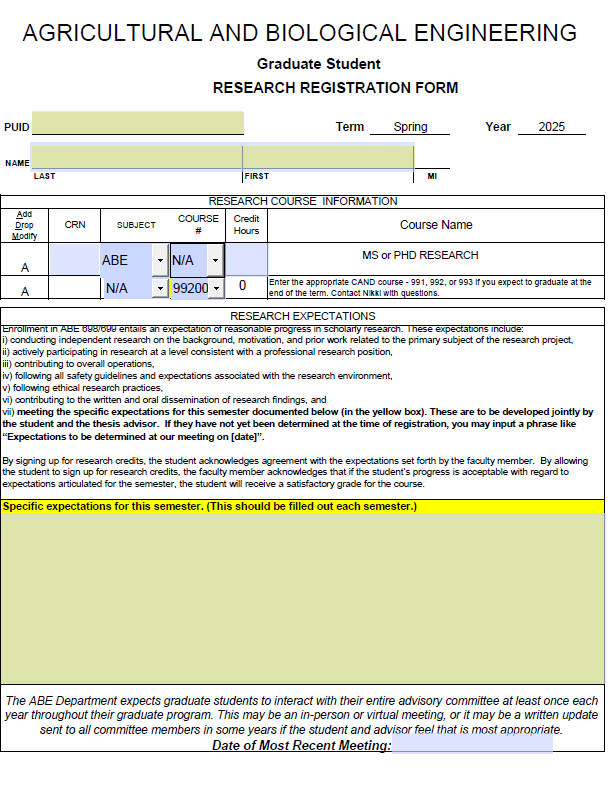
Appendix E: Forms and Rubrics for Examinations
PH.D. DISSERTATION AND DEFENSE RUBRIC Also available at https://engineering.purdue.edu/ABE/academics/graduate/ABE-Ph.D.-4-dissertation-and-defense-rubric.docx
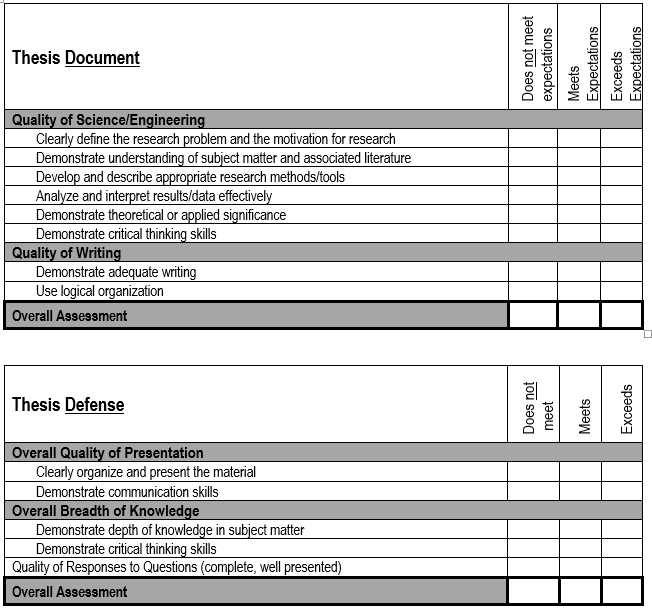
Text version of research registration form expectations
The research registration form is used for ABE graduate student research registration. It includes student identification fields, term and year, research course information, course number and credit hours, and the course name for MS or Ph.D. research.
Enrollment in ABE 69800 or ABE 69900 entails an expectation of reasonable progress in scholarly research. These expectations include:
- Conducting independent research on the background, motivation, and prior work related to the primary subject of the research project.
- Actively participating in research at a level consistent with a professional research position.
- Contributing to overall operations.
- Following all safety guidelines and expectations associated with the research environment.
- Following ethical research practices.
- Contributing to the written and oral dissemination of research findings.
- Meeting the specific expectations for this semester documented below. These are to be developed jointly by the student and the thesis advisor. If they have not been determined at the time of registration, the form allows a phrase such as "Expectations to be determined at our meeting on [date]."
By signing up for research credits, the student acknowledges agreement with the expectations set forth by the faculty member. By allowing the student to sign up for research credits, the faculty member acknowledges that if the student's progress is acceptable with regard to expectations articulated for the semester, the student will receive a satisfactory grade for the course.
The form also includes a large field for specific expectations for the semester and a field for the date of the most recent advisory committee meeting.
PH.D. DISSERTATION RESEARCH PROPOSAL, WRITTEN PRELIM, AND ORAL PRELIM RUBRIC Also available at https://engineering.purdue.edu/ABE/academics/graduate/ABE-Ph.D.-3-proposal-and-prelim.docx
DIRECT TO PH.D. QUALS EVALUATION RUBRIC
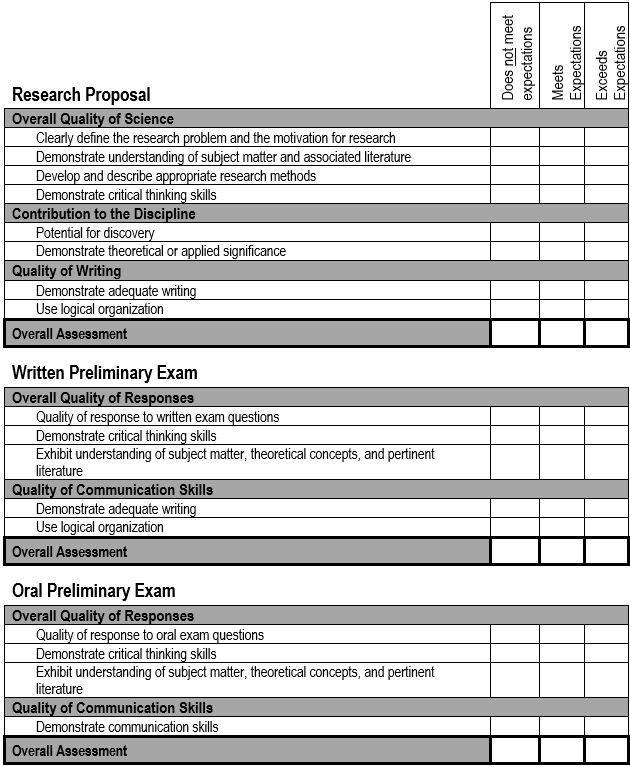
Text version of Ph.D. proposal, written prelim, and oral prelim rubric
The Ph.D. proposal, written preliminary examination, and oral preliminary examination rubric includes rating columns for Does not meet expectations, Meets Expectations, and Exceeds Expectations.
Research Proposal
Overall Quality of Science: clearly define the research problem and the motivation for research; demonstrate understanding of subject matter and associated literature; develop and describe appropriate research methods; demonstrate critical thinking skills.
Contribution to the Discipline: show potential for discovery; demonstrate theoretical or applied significance.
Quality of Writing: demonstrate adequate writing; use logical organization.
Overall Assessment: committee members provide an overall assessment for the research proposal.
Written Preliminary Exam
Overall Quality of Responses: provide quality responses to written exam questions; demonstrate critical thinking skills; exhibit understanding of subject matter, theoretical concepts, and pertinent literature.
Quality of Communication Skills: demonstrate adequate writing; use logical organization.
Overall Assessment: committee members provide an overall assessment for the written preliminary exam.
Oral Preliminary Exam
Overall Quality of Responses: provide quality responses to oral exam questions; demonstrate critical thinking skills; exhibit understanding of subject matter, theoretical concepts, and pertinent literature.
Quality of Communication Skills: demonstrate communication skills.
Overall Assessment: committee members provide an overall assessment for the oral preliminary exam.
Also available at https://engineering.purdue.edu/ABE/academics/graduate/ABEQualsRubric

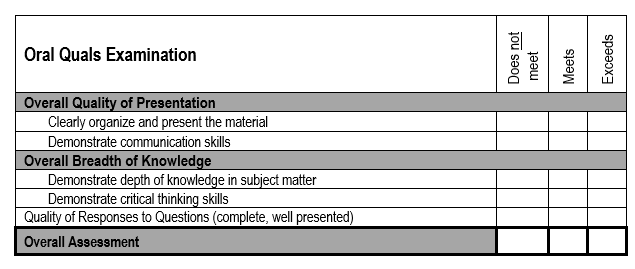

Text version of Direct-to-Ph.D. Quals evaluation rubric
The Direct-to-Ph.D. Quals evaluation rubric includes rating columns for Does not meet expectations, Meets Expectations, and Exceeds Expectations.
Written Quals Research Report
Quality of Science/Engineering: clearly define the research problem and the motivation for research; demonstrate understanding of subject matter and associated literature; develop and describe appropriate research methods/tools; analyze and interpret results/data effectively; demonstrate theoretical or applied significance; demonstrate critical thinking skills.
Quality of Writing: demonstrate adequate writing; use logical organization.
Overall Assessment: committee members provide an overall assessment for the written Quals research report.
Oral Quals Examination
Overall Quality of Presentation: clearly organize and present the material; demonstrate communication skills.
Overall Breadth of Knowledge: demonstrate depth of knowledge in subject matter; demonstrate critical thinking skills; provide complete and well-presented responses to questions.
Overall Assessment: committee members provide an overall assessment for the oral Quals examination.
Exam Outcome
- 1. Pass: Student continues to Ph.D.
- 2. Retake: Student retakes Quals to correct indicated deficiencies.
- 3A. MS Required for Ph.D.: Student completes MS research thesis and evaluation for Ph.D.
- 3B. Non-thesis MS: Student graduates with non-thesis MS after meeting associated requirements.
MASTER’S THESIS DEFENSE RUBRIC Do you recommend the student continues for a Ph.D., should they choose? (Y/N) _______________ Also available at https://engineering.purdue.edu/ABE/academics/graduate/ABE-MS-3
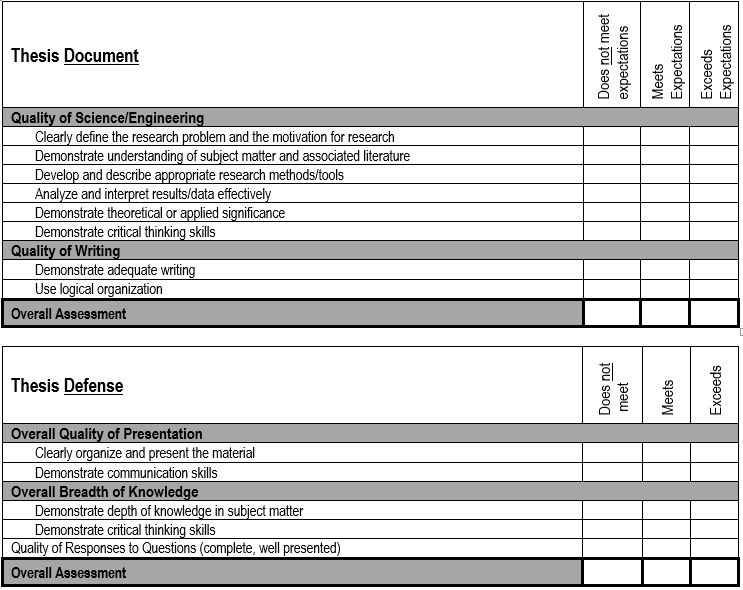
Text version of Master's thesis defense rubric
The Master's thesis defense rubric includes rating columns for Does not meet expectations, Meets Expectations, and Exceeds Expectations.
Thesis Document
Quality of Science/Engineering: clearly define the research problem and the motivation for research; demonstrate understanding of subject matter and associated literature; develop and describe appropriate research methods/tools; analyze and interpret results/data effectively; demonstrate theoretical or applied significance; demonstrate critical thinking skills.
Quality of Writing: demonstrate adequate writing; use logical organization.
Overall Assessment: committee members provide an overall assessment for the thesis document.
Thesis Defense
Overall Quality of Presentation: clearly organize and present the material; demonstrate communication skills.
Overall Breadth of Knowledge: demonstrate depth of knowledge in subject matter; demonstrate critical thinking skills; provide complete and well-presented responses to questions.
Overall Assessment: committee members provide an overall assessment for the thesis defense.
The Master's thesis defense rubric also asks: "Do you recommend the student continues for a Ph.D., should they choose? (Y/N)"
Appendix F: ABE/ASM 59000 Special Topics Contract Instructions
The ABE/ASM 59000 contract is completed by the student and constitutes an agreement between an instructor and a student/group of students for individual/small group study of a special problem in a selected area. ABE/ASM 59000 is used for independent study equivalent to an academic course and should not be used for research projects. The 59000 contract must be submitted to Nikki Zimmerman at least one week prior to the first day of classes of the semester in which the course is to appear. The contract is then sent to the Chair of the ABE Graduate Committee for approval, which must be secured prior to registration. Approved copies will be distributed to the Academic Advisor and the 59000 Instructor.
If you are looking to complete an internship with credit connected to professional studies, the 59000 contract can be used to register for course credits.
(If you are creating a 59000 to receive credit for taking a GEAPS (Grain Elevator and Processing Society)
course, please do not use this form. Contact Nikki - nzimmerm@purdue.edu)
INTERNATIONAL STUDENTS!!!
If you are registering for CPT (practical training that takes place during your studies) or OPT (practical training that occurs after your studies end) DO NOT USE THIS FORM. Contact Nikki for instructions - nzimmerm@purdue.edu.
Instructions for students
Meet with your major professor or the instructor for the 59000 course and fill out the attached form.
Email the form to Nikki, requesting that you be registered for the course. Copy the course instructor (often your major professor but not necessarily) who will need to email their approval.
Nikki will have the form reviewed for approval by the ABE Graduate Committee representative. If there are any issues, the student will be notified and should work with the instructor to edit the form and approve. Nikki will notify student once approval complete.
Once these approvals are in place, input the necessary information to have the course created in
myPurdue, using a variable title course:
How to request a Variable Title form https://www.youtube.com/watch?v=TL_P6UQuWdg
Confirmed Creation of Variable Title request https://www.youtube.com/watch?v=aJSZoI_fDio
Agricultural and Biological Engineering Department ABE 59000 or ASM 59000 - Special Problems: This is a contract between an advisor and a student/group of students for individual/small group study of a special problem in a selected area. ABE/ASM 59000 is for independent study equivalent to an academic course and should not be used for research projects. This form must be submitted to the ABE graduate administrator at least one week prior to the first day of classes of the semester in which the course is to appear. ABE Graduate Committee approval must be secured prior to registration.
Date Form Submitted (at least 1 week before class begins)
Student Name PUID Number Proposed Course Name (No more than 30 characters including spaces)
Semester and Year of Course (e.g. spring 2025)
Credits 1-3 (Each credit = 40-45 hours of work)
ABE or ASM Course Instructor Student’s major professor (If different than Instructor)
Grade Option: G= Grade, P= Pass/No Pass (To use on a plan of study, it must be for a Grade)
[Delete all text in brackets - it is meant to aid you in completing the form.] Justification Describe why this course needs to be a Special Problems course. A typical reason is because no similar course is offered, but there could be other reasons. Do not justify a research problem to be studied.
Student Time Commitment Fill in the middle column below with total hours over the semester. (If needed, multiply hours/week by 15 weeks in the semester). The total should add to 40 to 45 hours per credit, or 120 to 135 hours for a 3- credit course.
Student Time Commitment Number of Hours Notes Student-Instructor Meetings Day and time of meetings Reading, Online Modules, etc.
Analysis, Lab Work, other Assignments
Final Report Preparation, if applicable Report due date
Other
Semester Total Hours (approx. 40-45 hrs/cr)
Learning Objectives: Clarify what the student will learn in this independent study course. These should not be written as research objectives. Learning objectives are usually in the form of “Learn to …”, or “After completing the course, the student will be able to… Course Procedure: Describe what the student will do to achieve the learning objectives. The procedure may include readings, assignments, meetings with the Advisor or other faculty, completion of online modules, reports, etc.] Include a detailed list of readings, assignments, etc. with their due dates if applicable. Use an extra page if needed.
Basis for Grading
Appendix G: Important University Offices & Their Duties
University Parking Services
MMDC
700 Ahlers Dr.
West Lafayette, IN 47906
(765) 494-9497
Parking Services website
- Get a parking permit.
- Appeal a parking ticket.
Card Services Office
Stewart Center, room 194
(765) 496-0444
Card Services website
PurdueIDCardOffice@purdue.edu
- Get your student identification card.
- Add money to your Boiler Express account.
ITaP / Purdue IT
Customer Service Centers located in HIKS or WALC
(765) 494-4000
itap@purdue.edu
Purdue IT help website
- Ask questions about your student email account.
- Get computer support.
- Buy discounted computers.
- Obtain information about cell phone discounts.
PUSH: Purdue University Student Health
601 Stadium Mall Dr.
(765) 494-1700
PUSH website
- Immunization requirements.
Office of the Vice Provost for Graduate Students and Postdoctoral Scholars
Young Hall, room 170
(765) 494-2600
OGSPS website
- Admissions and turn in original documents.
- Fellowship Office.
- Thesis and Dissertation Office.
- Office of Graduate Assistance and ombudsman services: Office of Graduate Assistance website.
Purdue Fire and Purdue Police
Purdue Fire: (765) 494-6919
Purdue Police: (765) 494-8221
International Students and Scholars
Young Hall, 5th floor
(765) 494-5770
iss@purdue.edu
ISS website
- Immigration services.
- International student orientation.
- Visa questions and issues.
Office of the Dean of Students
Schleman Hall, 2nd floor
(765) 494-1747
Office of the Dean of Students website
- Find a student organization to join.
- Disability Resource Center.
Office of the Registrar
Stewart Center, room 176
(765) 494-6165
Registrar website
registrar@purdue.edu
- Course registration issues.
- Holds.
- Schedule changes.
- Transcripts.
- Commencement and diploma questions.
Bursar's Office
Stewart Center, room 194
(765) 494-7570
Bursar website
askbursar@purdue.edu
- Pay tuition or fees.
- Aid disbursement.
- Fee deferment.
Division of Financial Aid
Stewart Center, room G18
facontact@purdue.edu
(765) 494-5050
Division of Financial Aid website
- Financial assistance eligibility.
- Grants and loans.
Appendix H: ABE Staff Directory & Duties
Graduate Program Administrator and Academic Program Coordinator
Nikki Zimmerman, ABE, room 1041, nzimmerm@purdue.edu
Yvonne Hardebeck, Academic Program Coordinator, ABE, room 1044, hardebey@purdue.edu
- Contact when you need help and/or when you do not know where to start.
- Contact when you have questions about anything: departmentally, university-wide, West Lafayette/Lafayette area, or pretty much anything else.
- Support: academic, emotional, whatever...
- Plans of Study and registration.
- Filing prelim, defense, or graduation forms.
- You can also check the Padlet for more info.
- Contact Yvonne for poster printing.
ABE Business Office
Kathy Best, Payton Wilson, Tyler Kallis, and Rachel Mithoefer, ABE, room 1021
kjbest@purdue.edu, wils1475@purdue.edu, tkallis@purdue.edu, rmithoef@purdue.edu, or boff_ageng@lists.purdue.edu
- Travel.
- Purchasing.
- Payroll.
- Information regarding student insurance, time off for students on assistantships, etc.
Assistant to the Department Head and Academic Coordinator
Dan Taylor, ABE, room 1033, taylordc@purdue.edu
- Able to help in Nikki's absence.
- Undergraduate recruiting.
- Anything that needs departmental action: start with Dan.
Executive Assistant to the Department Head
Becky Peer, ABE, room 1005D, peerb@purdue.edu
- Things related to Dr. Mosier.
- Desk assignment and keys.
- Room scheduling.
- Reserve departmental vehicles for driving off-campus. Pre-registration is required.
- Mail questions.
Lab Managers
Logan Heusinger and Amanda Limiac, ABE, room 2087A
lheusing@purdue.edu, montgom8@purdue.edu
- Safety training.
- If you TA an undergraduate course with a lab, they can help.
- Address any Shop questions to Logan.
- Lab equipment and space questions.
Alumni Relations and Communications
Vacant, ABE, room 1005A
- News items.
- Website information.
- Social media items.
Shop Manager and Building Deputy
Tyler Finley, ABE, room 1005C, tjfinley@purdue.edu
- Building issues.
- Safety training.
- Fabrication of equipment for research.
- Vehicles.