
Purdue researchers earn patent for more compact, adaptable radiofrequency technology
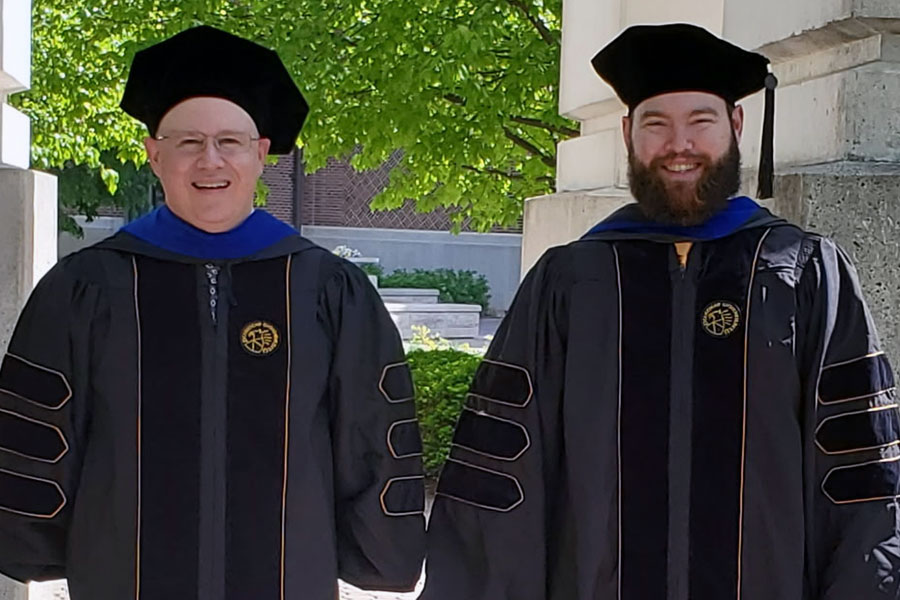
A Purdue University researcher and his former doctoral student have received a patent for technology that could significantly reduce the size and complexity of electromagnetic systems while improving their adaptability in changing environments.
Purdue School of Nuclear Engineering Professor Allen Garner and his former graduate student Andrew Fairbanks developed the concept through research supported by the Office of Naval Research. Their patent, “Electromagnetic Wave Generator Based on Non-Linear Composite Materials” (U.S. Patent No. 12,534,594), was issued Jan. 27, 2026, and is assigned to the Purdue Research Foundation.
The innovation addresses a common engineering challenge in advanced systems: reducing size, weight, power and cost while maintaining performance. In practical terms, the Purdue design simplifies how radiofrequency (RF) signals are generated, making systems easier to deploy and modify.
Traditional systems rely on multiple steps: high voltage is first sent through a pulse-forming network, which then feeds a nonlinear transmission line that generates the RF output. The Purdue design removes one of those steps, allowing a single component to perform multiple functions.
“What Andrew came up with was a way to eliminate the pulse-forming network,” Garner said. “It gets rid of a whole part of the system.”
At the core of the invention is a specially engineered transmission line containing a composite material made of nonlinear dielectric and magnetic components. These materials respond differently depending on the strength of the electrical signal, allowing the system to both store energy and release it rapidly. When energy from a DC source is stored and then quickly discharged, the system produces a burst of RF energy—eliminating the need for a separate pulse generator. That design can improve portability and reduce engineering constraints, particularly those involved in matching multiple components across a system.
The work builds on Garner’s earlier research in advanced composite materials designed to shield against electromagnetic interference. These materials combine the light weight of plastic with the electromagnetic behavior of metal, enabling more efficient control of electromagnetic signals.
In practical terms, the technology also allows for flexibility in how systems are used. Operators could swap transmission lines with identical shapes but different internal materials to change system performance. To the user, the hardware would appear the same, but its output could be adjusted to meet different conditions.
That flexibility could be especially valuable in dynamic environments, Garner said. “If I’m onboard a ship in a high-threat environment and, suddenly, we find out that we need to have a different EM signature on our output, I can just take out one line and put in another without major hardware changes,” Garner said.
Potential applications for the technology include defense systems that use RF signals to disrupt or disable electronics, as well as lower-power uses in communications, automotive systems, and emerging biomedical technologies such as noninvasive treatments and advanced sterilization.
The patented work grew out of Fairbanks’ doctoral research, completed about five years ago. He now works at Naval Surface Warfare Center Dahlgren Division.
For Garner, the patent represents both a technical milestone and an example of how long-term research can translate into practical innovation. By reducing system complexity while increasing portability and adaptability, the work points to a more flexible future for electromagnetic wave technologies. Garner and Fairbanks disclosed the innovation to the Purdue Innovates Office of Technology Commercialization, which filed a patent application to protect the intellectual property and is now managing it while pursuing licensing opportunities with industry partners.