
Wu selected as a Fulbright Scholar to Poland.
Professor Wenzhuo Wu receives numerous research-related distinctions, highlighting the potential of his work in global applications.
Over the past semester, Professor Wenzhuo Wu has received a number of distinctions regarding the work he has done at Purdue. Among these include being named a Fulbright Scholar, winning the AI Fusion Award, and earning support from the Task Innovation Fund. Each of these distinctions highlight Wu’s ambition and resolve in the field of Industrial Engineering.
Wu was one of only 9 Purdue faculty members to be named a United States Fulbright Scholar. With nine awardees, this sets a new record for Purdue Fulbright Scholars, reinforcing the institution as a top producer and global leader of scholarly excellence. This program facilitates educational and cultural exchange of information internationally, by providing fellowships for hundreds of scholars to go to and from the United States.
As an opportunity for awardees to inspire abroad, the Fulbright Scholarship encourages its recipients to develop their skills, deepen their connections, gain international insight, and return to their home country and share their experiences with students and colleagues. With the world teeming with knowledge, Fulbrighters like Wu are able to innovate and contribute to solving common challenges in communities around the world.
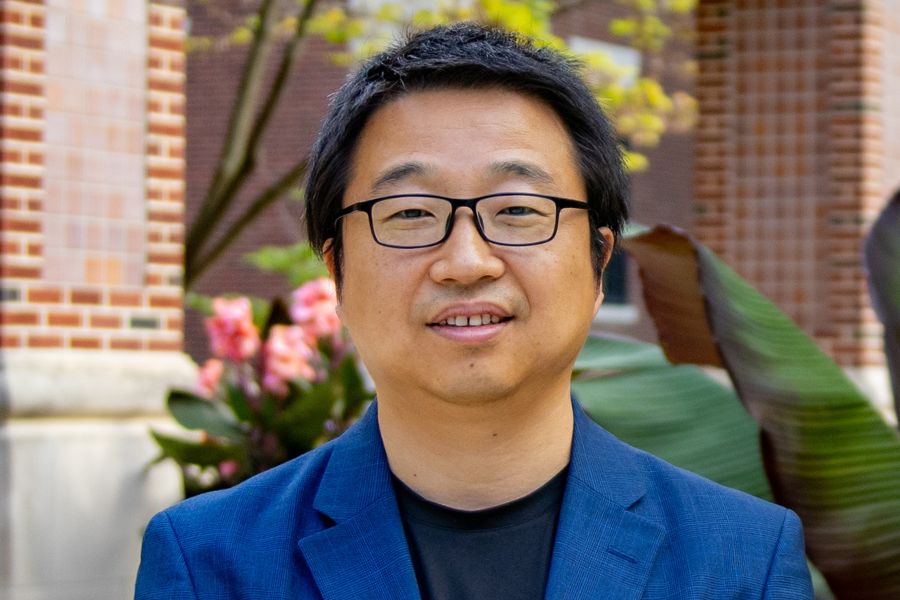
Wu was also named a winner of the AI Fusion Award. This grant is given to Purdue researchers that are fostering interdisciplinary collaboration and innovation through AI applications. With input from Purdue’s Institute for Physical Artificial Intelligence, one of seven grants was awarded to Wu’s team, focused on developing wearable technology for plants.
At first glance, this vein of research may seem confusing. However, the potential for integrating AI technology with our crops is exactly what Wu seeks to uncover. Just like human beings track their health and statistics through watches, wearable plant tech can map biochemical stress signals related to nutrient deficiency and drought. By combining AI-powered analysis with real-world data, Wu and his team can model how the plants are expected to be affected by the detected stresses. These “digital twins” help farmers and researchers alike determine the best agriculture strategy to lead to plant recovery.
“This approach is designed to scale from a single plant in the greenhouse to entire plots in the field and across staple crops, laying a foundation for more resilient, resource-efficient agriculture in a changing climate,” says Wu. The global potential for this AI-powered technology is monumental, and with the AI Fusion grant, it is certain that Wu and his team will continue to develop a solution.
In addition to his work with wearable plant technology, Wu has also received a grant through the Trask Innovation Fund for his research in optimizing semiconductors. He has developed a solution-based method to produce 2D tellurene: an ultra-thin semiconductor material that holds unprecedented computing capabilities. However, a current limitation of this product is that it is not yet scalable to industrial application. Wu hopes to overcome this manufacturing issue, so that the 2D tellurene can be used to its full potential, and foster progress towards energy-efficient electronics usage.
Wu is an incredibly decorated member of our Purdue faculty. As a pioneer of AI applications in technology, his impact is not limited to this campus, but has the potential to contribute to fields of thought globally. Whether it be advancing agriculture to optimizing technology, the numerous grants and awards Wu has received will aid his efforts toward research.