
Claire Woo and Young-Jun Son win Best Poster Award for context-aware robot navigation research
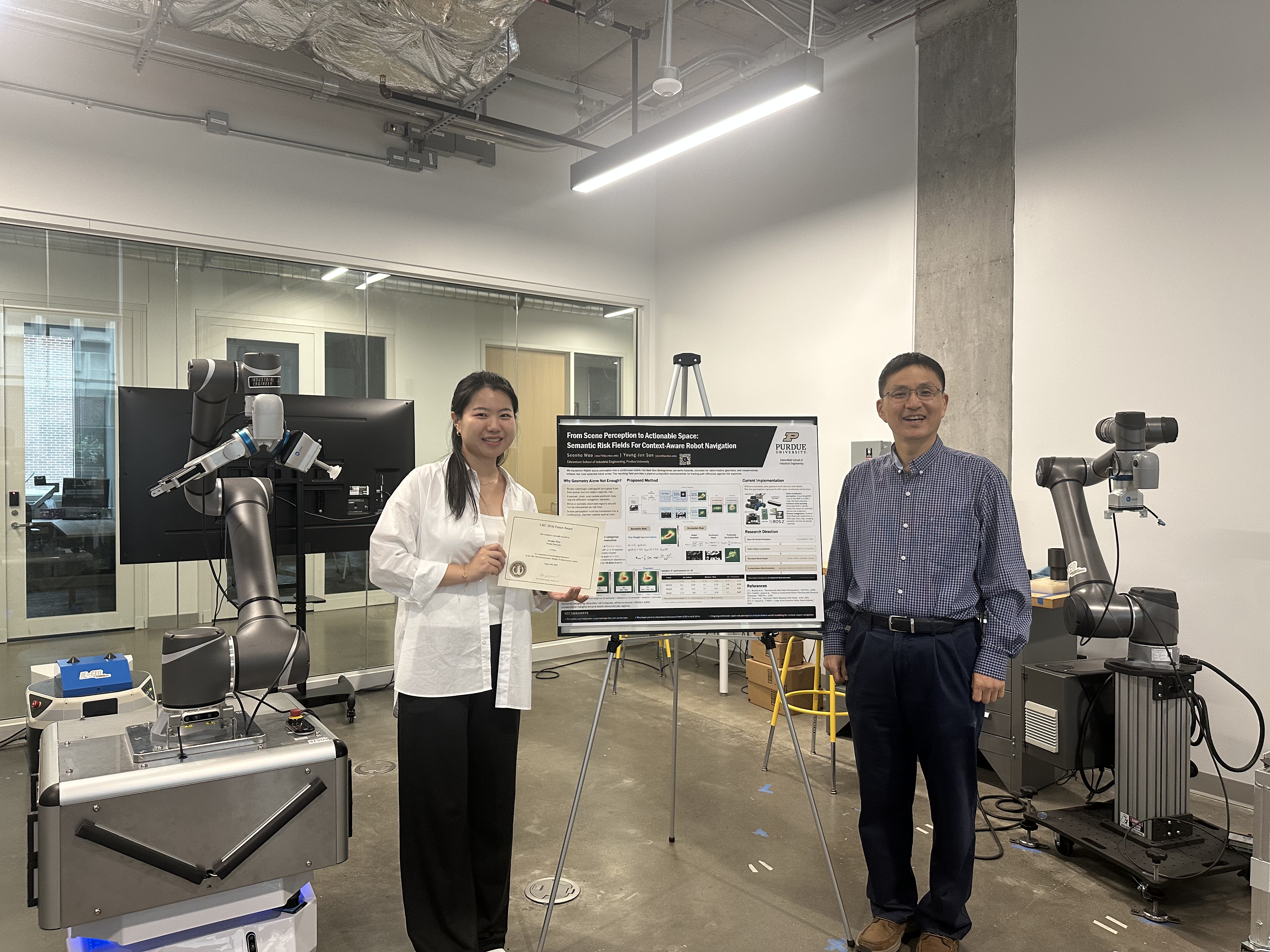
PhD student Claire Woo and Young-Jun Son, the James J. Solberg Head and Ransburg Professor of Industrial Engineering, received the Best Poster Award in the “Infrastructure, Mobility & Robots” poster session at the 39th U.S.–Korea Conference on Science, Technology, and Entrepreneurship (UKC 2026).
The session was held Aug. 7 during the conference at ChampionsGate, Florida.
The award recognized research based on Woo's doctoral work under Son’s supervision. Their poster, “From Scene Perception to Actionable Space: Semantic Risk Fields for Context-Aware Robot Navigation,” presents a context-aware perception and risk-mapping framework designed to help autonomous mobile robots (AMRs) navigate dynamic industrial environments.
In factories and warehouses, AMRs increasingly share space with human workers, forklifts and other robots. In these environments, safe and efficient navigation requires more than simply detecting obstacles. A robot must also account for what nearby objects are, how they are moving and interacting, and how the surrounding space is typically used.
“An object’s location alone does not tell a robot how much risk it actually poses,” Woo said. “We want robots to reason about which risks are relevant in context and how those risks may evolve, then use that information to balance risk reduction with efficient navigation.”
The system transforms visual observations into a map of navigation risk. Rather than treating every detected object simply as an obstacle, it considers what the object is, how it behaves, its interactions with nearby objects and prior activity in the space to determine how much risk it may pose.
The system combines several capabilities:
- Open-vocabulary object detection and segmentation: Recognizes a broad range of objects without being restricted to a predefined list of object classes.
- Multiview sensing: Combines cameras mounted on the robot with fixed cameras in the environment to observe and track people, robots and other objects from multiple viewpoints.
- Context-aware risk reasoning: Evaluates what objects are, where they are, how they move and interact with nearby objects, and how the space has been used over time to estimate current and potential future navigation risks.
- Real-time risk mapping: converts these observations into a continuously updated risk map, in which areas with higher predicted danger receive higher navigation costs. The map is integrated directly with ROS 2 (Robot Operating System), an open-source framework for integrating and communicating between robot software components, and Nav2, its widely used navigation framework for path planning and motion control, which allows the robot to choose safer routes in real time.
- Simulation and robot evaluation: Uses dynamic warehouse scenarios with moving human workers and other AMRs developed in NVIDIA Isaac Sim, a robotics simulation platform for creating physically based virtual environments and testing robot perception and navigation systems. The approach was evaluated using a ROSMaster X3 ground mobile robot in those environments.
The approach allows the robot's planner to account for contextual risk when selecting a route. The broader goal is not simply to make robots more cautious, but to help them make more informed navigation decisions by prioritizing contextually relevant risks. By distinguishing situations that require additional caution from those that do not, the system can reduce navigation risk while maintaining efficient movement through shared industrial spaces.
Source/Writer: Seonho "Claire" Woo
Editor: Dave Montgomery
Related links: https://ukc2026.ksea.org/