
Purdue MARS Lab Earns 10 Papers Accepted to Prestigious Robotics Conference
The Purdue MARS Lab, headed by Assistant Professor Yu She, along with its collaborators, had 10 papers accepted to the IEEE/RSJ International Conference on Intelligent Robots and Systems (IROS). As one of the largest and most influential robotics research conferences worldwide, IROS 2026 had a paper acceptance rate of 36% in 2026, indicating a highly competitive selection process.
In search of the latest advances in intelligent robots and systems, IROS brings together researchers from universities, industry, and research institutions worldwide. In 2025 alone, the conference received over 5000 submissions from 66 unique countries and regions. It is a major international venue for researchers working on intelligent robots, smart machines, and emerging robotics technologies. In addition to papers submitted directly to IROS, the conference also features selected IEEE Transactions on Robotics (T-RO) papers that are eligible for presentation at IROS through IEEE RAS’s journal-to-conference presentation process. As one of the flagship journals in robotics, it also maintains a high degree of prestige, in which 2 of the 10 Purdue MARS Lab papers were accepted into.
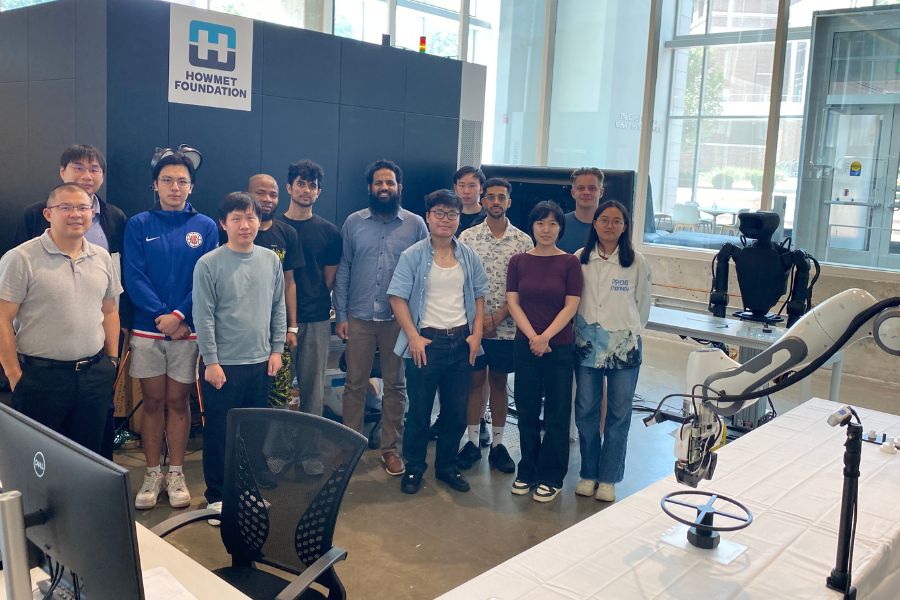 MARS Lab team members pose with robotics equipment in the Build at Scale Lab
“We are very excited to have 10 papers accepted to IROS 2026. IROS is one of the major international conferences in robotics, so this recognition is very meaningful for our group. These papers reflect the hard work, creativity, persistence, and wonderful collaboration of our students, postdocs, and collaborators. They also represent the Purdue MARS Lab’s continued efforts to advance tactile sensing, contact-aware manipulation, robot learning, and intelligent robotic systems that can better interact with the physical world,” says Dr. She.
The 42 contributors for these papers include post-doctorate, PhD, master’s, undergraduate, and visiting students, all a part of the Purdue MARS Lab. Among them are also 18 non-MARS Lab collaborators, illustrating the scale of student involvement and the incredible lab and research efforts taken on by this group. Being chosen for this conference illustrates the potential for real-world application of these students’ work, a product of their relentless ambition and dedication to their research.
The papers cover several research directions, including tactile sensing, contact-aware manipulation, robot learning, bimanual manipulation, loco-manipulation, and robot-assisted surgical sensing. Not only is the team developing individual robot components, but the collaborators must also understand how sensing, control, learning, human interaction, and system-level decision making combine into their final solution. This systems perspective is central to the field of Industrial Engineering, which emphasizes the integration, optimization, and operation of complex systems. Having this background is essential to ensuring robots can work reliably beyond the lab, and into the real world.
For students looking to apply their systems mindset outside the classroom, they can get involved by reaching out to faculty and research labs, participating in robotics projects, and building hands-on experience. In the MARS Lab, though students may have varying levels of experience from high school to postdoctoral researchers, they all share a common curiosity, motivation, and willingness to learn. Those characteristics are what allowed Dr. She’s team to earn their spot at one of the most important international venues for robotics research. As such, their representation at IROS 2026 cements the innovative efforts being made through the Purdue MARS Lab.