
PhD candidate named Trailblazers in Engineering Fellow
Congratulations to Kamelia Sepanloo on being selected as a 2026 Trailblazers in Engineering (TBE) Fellow, an honor recognizing emerging engineers whose research demonstrates innovation, interdisciplinary leadership, and meaningful societal impact.
As a PhD candidate in Industrial Engineering at Purdue University, working under the guidance of Dr. Young-Jun Son, Kamelia Sepanloo is advancing the future of healthcare training through the development of a multimodal AI-driven extended reality framework for adaptive training in high-acuity clinical environments.
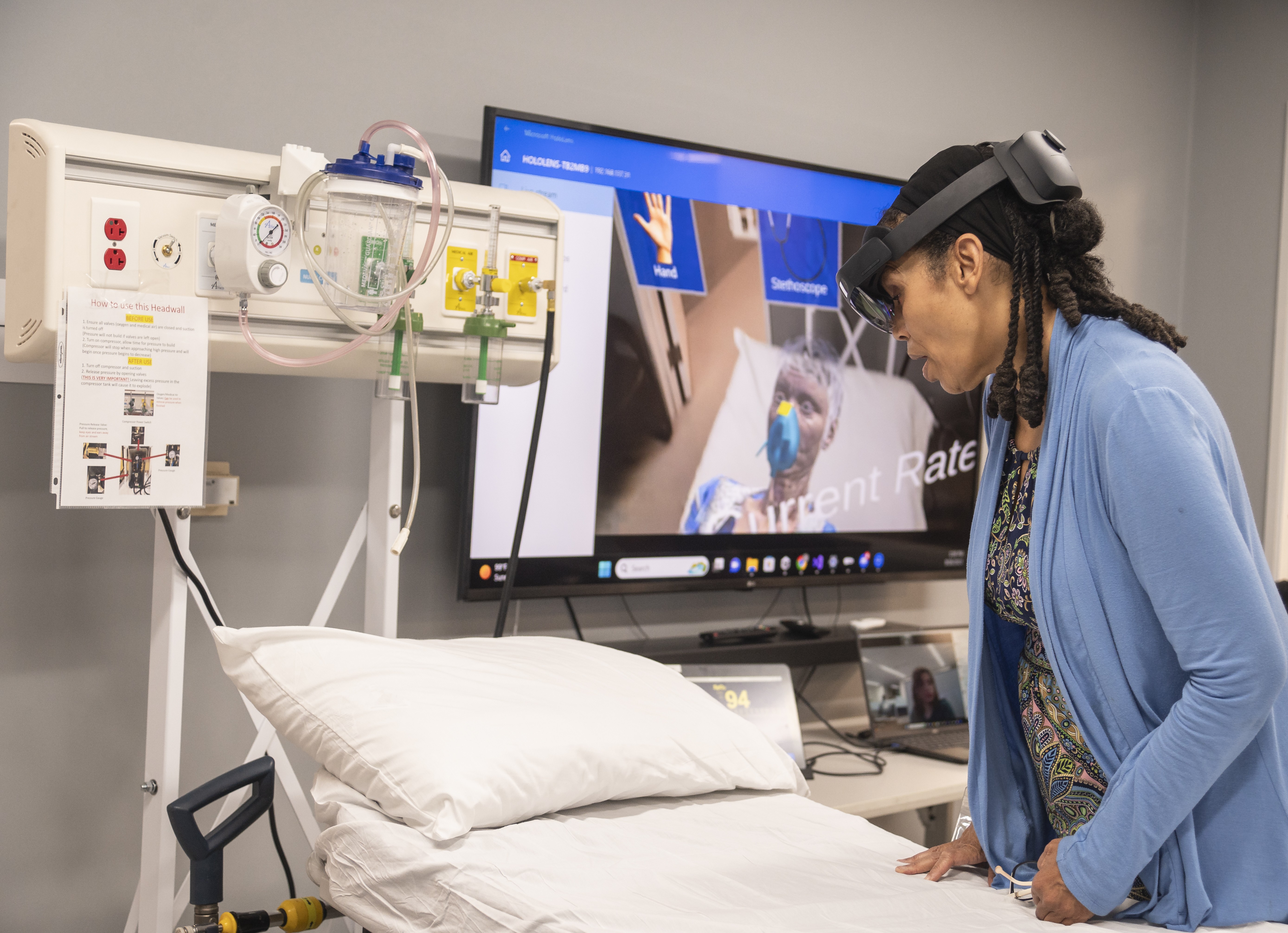
A nurse demonstrates an AI-enhanced mixed reality training environment used to simulate high-acuity clinical scenarios, incorporating immersive visualization and responsive digital patients.
Her research addresses a critical challenge in healthcare education: preparing clinicians to make high-stakes decisions under time pressure and stress. The framework integrates immersive technologies, physiological sensing, and adaptive artificial intelligence across both mixed reality and virtual reality environments using devices such as the Microsoft HoloLens 2 and Meta Quest Pro. Within these environments, learners interact with digital patients and responsive medical equipment in realistic clinical scenarios designed to replicate the complexity and pressure of real-world healthcare settings.
A key innovation of the system is the integration of a conversational AI model embedded within the digital patient, enabling natural, context-aware dialogue that enhances realism and learner engagement. To support adaptive training, Kamelia developed a framework that uses a fine-tuned transformer-based large language model to process multimodal data streams and estimate learners cognitive load and stress levels in real time.

Kamelia Sepanloo, PhD candidate in Industrial Engineering at Purdue University, focuses on AI-driven extended reality systems to improve healthcare education, workforce preparedness, and patient safety.
The framework enables comprehensive multimodal analysis through the collection and fusion of physiological signals, eye-tracking metrics, conversation transcripts, behavioral logs, and self-reported survey responses. This integrated approach allows the system to identify patterns associated with stress, cognitive load, and decision-making during clinical care.
By combining artificial intelligence, cognitive engineering, immersive simulation, and multimodal analytics, Kamelias work contributes to the development of intelligent training systems that can improve healthcare workforce preparedness, learner support, and patient safety. Her research exemplifies the transformative role engineering can play in addressing complex challenges in healthcare and education.
Related links and publications:
-
Sepanloo, K., Shevelev, D., Islam, M.T. et al. Improving nursing education through an AI-enhanced mixed reality training platform: development and pilot evaluation. Education Tech Research Dev 73, 1835"1863 (2025). https://doi.org/10.1007/s11423-025-10473-2
-
Sepanloo, K., Shevelev, D., Son, Y.-J., Aras, S., & Hinton, J. E. (2025). Assessing Physiological Stress Responses in Student Nurses Using Mixed Reality Training. Sensors, 25(10), 3222. https://doi.org/10.3390/s25103222
-
Sepanloo, K., Chen, Y., Shevelev, D., et al. (2023). A multi-sensor integrated with augmented reality system for precise nursing education and analysis. IISE Annual Conference Proceedings, 1"6.