
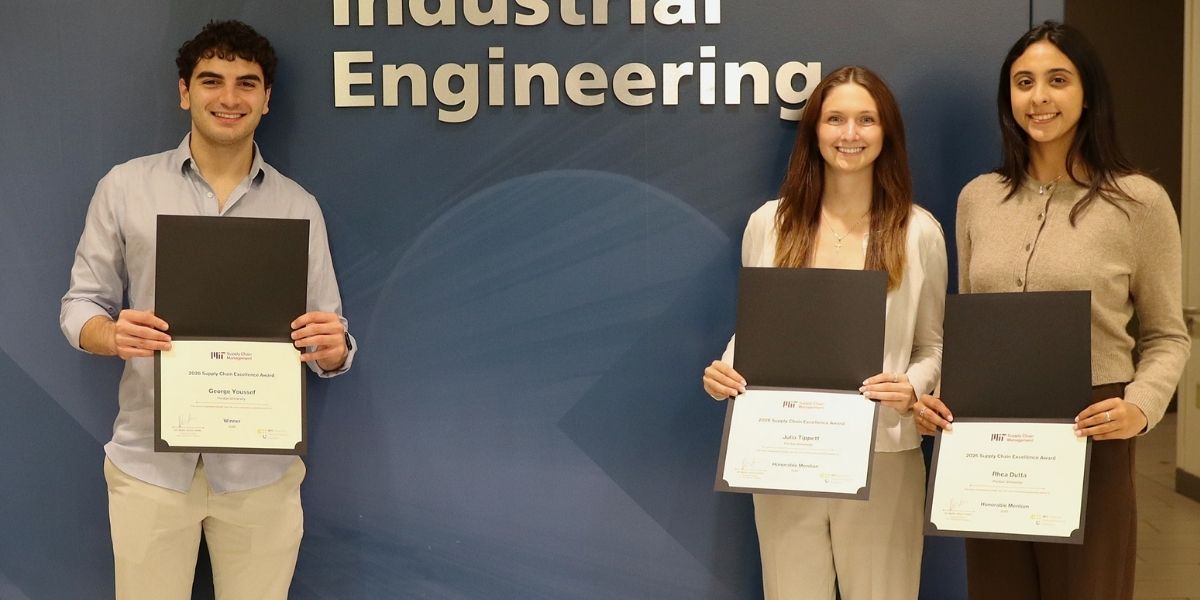
Three students involved in the MIT Supply Chain Excellence Award
George Youssef is awarded the MIT Supply Chain Excellence Award, with Julia Tippett and Rhea Dutta being named honorable mentions in this highly competitive application pool.
This past month, three Purdue seniors were honored by the MIT Supply Chain Excellence Award. George Youssef was a recipient of the MIT fellowship towards their Supply Chain Graduate Program. Two more students, Julia Tippett and Rhea Dutta were deemed Honorable Mentions from a highly competitive pool of applicants. Candidates, chosen from a small group of partner universities, are evaluated across several categories, including academic performance, extracurricular and leadership involvements, supply chain passions, and a personal statement essay. These factors culminate in a direct interview with the awards team to share more about themselves and their future aims.
The benefits of this award are not just limited to its financial support. Rather, the direct connection it provides to MIT’s SCALE (Global Manufacturing and Supply Chain Leadership) Network, as well as the links to leading companies and cutting-edge research are unmatched in the supply chain sphere. Not only that, but the opportunities for career advancement are unlimited when students are distinguished with this title. Chosen for their contributions in the field of supply chain, the award serves as a strong signal of a student’s future potential, recognizing those who have demonstrated both technical excellence and leadership early in their careers.
George Youssef details how his industry experience through Purdue has developed the foundation he needed to earn this award. With internships in sourcing and supply management, he was able to observe how analytical insights translate into decisions involving risk, quality, and long-term resilience across complex supplier networks. Beyond that, Youssef's involvement in healthcare research expanded his understanding of supply chain. Its role in access, equity, and efficiency held a potential for real-world impact that could be observed on a global scale. These hands-on experiences were crucial in developing an understanding of how these systems are not just theoretical models, but can have material industry impact.
However, Youssef's path to supply chain was not linear. Initially, his plan was to attend a four-year university, graduate, and return to help his family’s store. Little did he know that after transferring to Purdue, he would find his passion for systems thinking. Purdue’s coursework introduced him to supply chain systems as dynamic networks of people, resources, and information. His fascination only grew as he learned more about how these systems operated under imperfect and uncertain situations. Purdue engineering further nurtured Youssef's analytical and problems-solving skills by providing a technical foundation and opportunities for experiential learning. This academic interest soon became the trajectory for his career interest in applying systems thinking to create a broader societal impact, ultimately motivating Youssef to pursue opportunities like the MIT Supply Chain Excellence Award.
Like Youssef, both Julia Tippett and Rhea Dutta hold unique paths towards their zeal for industrial engineering and supply chain. For Tippett, her interest began as early as high school, where she developed a passion for logic, design, and structured problem solving applied to real-world systems. At Purdue, this evolved into a focus on supply chain, where Tippett explored how upstream decisions can impact an entire network. Using the knowledge gained through technical coursework and applied projects, Tippett earned the skills necessary to solve complex operational problems, particularly in her internships with Procter & Gamble.
“These experiences strengthened my ability to lead teams, communicate effectively, and challenge assumptions when solving complex problems. They also allowed me to apply technical concepts in real-world settings, bridging the gap between academic theory and practical implementation,” says Tippett. After several internships with Procter & Gamble in transportation and warehousing, Tippett saw firsthand how data-driven insights support decision making, risk mitigation, and reduced costs. She plans to continue her engineering journey with Procter & Gamble following graduation as a warehouse planning process engineer.
Where Tippett’s interest in industrial engineering began in high school, Rhea Dutta found her passion during the college application process. In search of a degree that combined technical engineering with business principles, industrial engineering was the perfect intersection of the two. Supply chain in particular allowed her to be involved in a complete lifecycle, from manufacturing, shipping, and analytic processes. Dutta’s involvement in research across multiple schools at Purdue has broadened her perspective, shaping her into a well-rounded and collaborative individual.
“I believe that everything will fit together eventually, even if it doesn't appear to do so in the moment,” says Dutta. “Industrial Engineering is a very versatile field, and Purdue is a school that has a lot of unique experiences to offer!” As a student in the Honors College, Dutta has also had access to a variety of other opportunities, connecting her to a larger industrial network. When attending the Women Impacting Supply Chain Excellence (WISE) Symposium, she was able to interact with distinguished speakers, peers, and industry leaders, further reaffirming her passion for supply chain. She plans to continue her professional journey after graduation, working as a process engineer at Procter & Gamble.
All three of these incredible seniors share experiences at Purdue that have allowed them to take the next giant leap. As recipients and honorable mentions of the MIT Supply Chain Excellence Award, this accomplishment is a culmination of the persistent effort and dedication they put in, alongside the support of their family, professors, peers, and mentors. Youssef, Tippett, and Dutta put themselves in positions to be challenged, and grow from. In the end, it was not a matter of ease or difficulty. Rather, every action they took was a test of their ability to overcome fear and uncertainty. This very skill is bound to take them far in their professional and academic careers.