
PhD Student Myeongkyu Lee selected to attend Rising Stars Workshop.
Hosted by the University of Michigan, Georgia Tech, and Stanford, PhD student Myeongkyu Lee was selected with a full scholarship to attend the Rising Stars Workshop this past month.
This past month, Myeongkyu Lee was selected to attend the Rising Stars Workshop, a conference for doctoral students and postdoctoral researchers. Hosted jointly by the University of Michigan, Stanford, and Georgia Tech, this workshop serves to recognize the potential of individuals pursuing academic careers. After submitting a detailed application of his research interests, methodological skills, and future career plans, Lee also received a full sponsorship to the event.
While in attendance, Lee was able to share his research with many leaders and professionals in the Industrial Engineering Field. His study, titled ‘To trust or not to trust: The effects of presenting inconsistently reliable automated vehicle confidence information on drivers’ attitude, behavior, and cognition’ explores the decision making and cognition of human drivers in automated vehicles. In a rapidly advancing world that integrates autonomous technologies, Lee recognizes that these systems are not infallible. In fact, many have begun to incorporate “confidence displays”, which communicate the system’s capability to navigate a particular situation. However, those displays may not be completely accurate either, creating a human predicament: to trust, or not to trust?
To examine a driver’s decision making process, Lee conducted a driving simulator study where participants experienced 12 scenarios involving obstacle avoidance. When it came to the vehicle’s confidence display regarding ability to navigate the presented situation, Lee manually manipulated the information to test his hypothesis. Sometimes the system would correctly state it could confidently handle the obstacle, other times it displayed high confidence but failed. By observing drivers’ takeover decisions and utilizing eye-tracking to monitor their gaze behaviors, Lee analyzed how they process and rely on this information in real-time. His work aims to inform the development of safer technologies, through understanding human cognition and limitations.
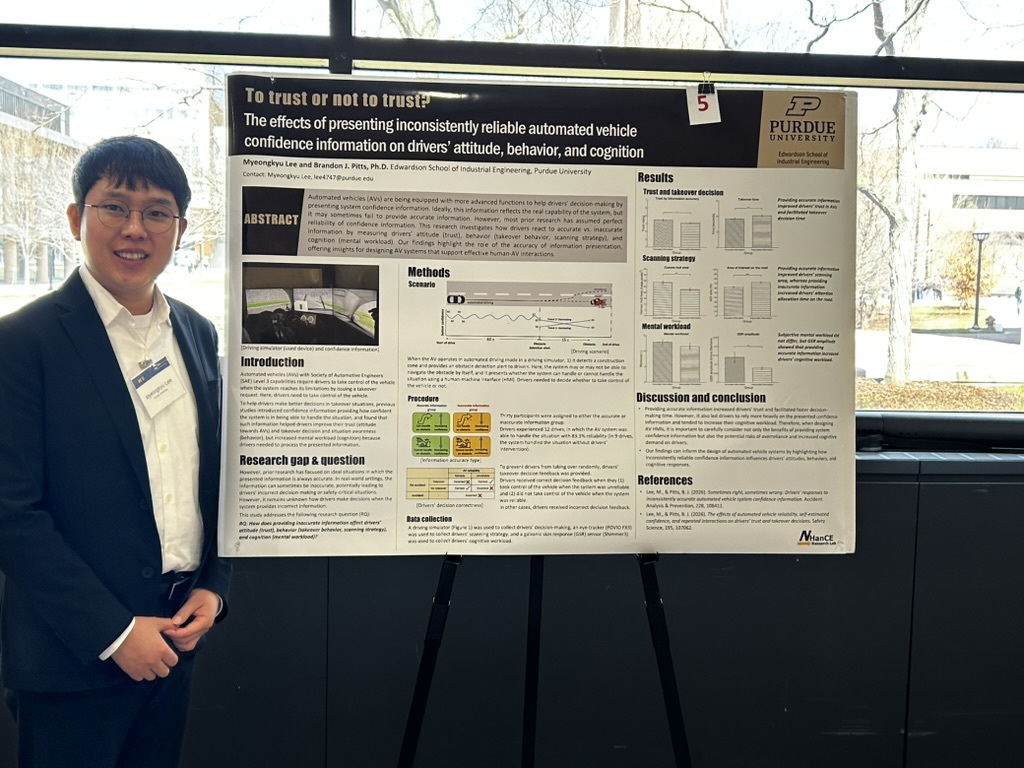
Lee’s motivation for this line of research is derived from his unique background. After earning his bachelor’s and master’s degree in Automotive Engineering, Lee served for 21 months as a driver in South Korea’s mandatory military service. From there, Lee’s focus expanded from not just the vehicle itself, but to the passengers within it. This experience inspired him to study human factors. For his PhD, Lee transitioned into studying the automated vehicles domain, with his research driven by the rapid evolution of this technology, and the new challenges they present. When presenting his findings at the Rising Stars Workshop, Lee gained opportunities for both academic exposure and career development. Interacting with his peers broadened his perspective on the diverse methodologies within Industrial Engineering. Not only that, but Lee was able to attend invaluable seminars and learn more about the faculty job market, a path he plans to take on soon.
The classes, resources, and support that Purdue IE has to offer have prepared Lee for his incredible achievements. Courses focused on cognitive work analysis and ergonomics were essential to developing measurement methodologies for his research. Additionally, the state-of-the-art equipment, esteemed faculty here at Purdue, and the NHanCE lab (PI: Dr. Brandon J. Pitts) made it possible to conduct high-quality human-subject experiments, and develop a rigorous simulator for his research.
“The most attractive aspect of Industrial Engineering is that we are on the front lines of solving complex, real-world problems, whether those involve manufacturing, systems optimization, or human-centered design,” says Lee. Identifying the problem you are passionate about solving, as well as the tools to solve them, can help students early on in navigating their academic and professional career paths.