
Liwei Jiang earns prestigious junior faculty award at INFORMS
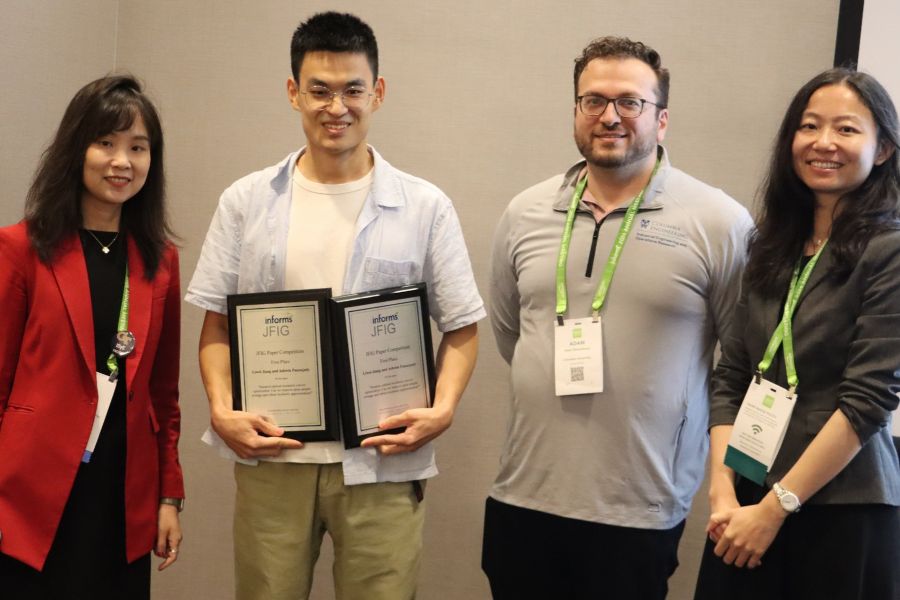
Jiang and collaborator Ashwin Pananjady win first place in the highly competitive INFORMS Junior Faculty Interest Group (JFIG) paper competition.
Imagine using a simple model to predict electricity demand from temperature. Even when historical measurements contain noise or error, such a model can help energy providers anticipate demand and plan their operations. This example illustrates the kind of problem studied by Liwei Jiang, an assistant professor in Purdue’s Edwardson School of Industrial Engineering, and Ashwin Pananjady of Georgia Tech. Their paper, “Instance-optimal stochastic convex optimization: Can we improve upon sample-average and robust stochastic approximation?”, examines how accurately optimization problems can be solved using limited, noisy data and how that accuracy depends on the difficulty of the particular problem.
Established methods have strong theoretical foundations, but some of their guarantees describe what happens only as the amount of data becomes very large. Jiang and Pananjady show that, with limited data, these methods can leave considerable room for improvement. Building on a technique known as variance reduction, they developed a method that can produce more accurate solutions than standard approaches using the same amount of data. They also establish that the proposed method nearly attains the best achievable accuracy.
These findings contribute to a broader effort to make better use of data and computational resources. Collecting data can be expensive, while processing it requires computing power and energy. As industries increasingly rely on AI and other methods that process large amounts of data, these costs make efficiency an important goal. Developing algorithms that use available resources more effectively could help address those demands.
Applying the findings to practical engineering problems will require further investigation. “A useful next step would be to test the methods on real datasets and understand how sensitive they are to implementation details. We would also need to examine how well the mathematical assumptions fit a particular application,” Jiang says. The work provides a theoretical foundation for that next stage: understanding what can be achieved with limited data and developing efficient methods to approach those limits.