
Professor Barrett Caldwell Discusses Life on the Moon
As we prepare to send more people and hardware into space, there is a growing desire to establish standards between members in the space industry. Professor Caldwell discusses how Industrial Engineering aids in that preparation.
How do we prepare for life on the moon? What essentials do we have to address before even considering the possibility of long-term development on its surface?
From establishing a common timezone on the lunar surface to standardizing equipment, Barrett Caldwell presents the ultimate to-do list for life on the moon. As a professor in the Edwardson School of Industrial Engineering, with a joint Appointment in Aeronautics and Astronautics, Caldwell has always had a keen interest in developing systems for human explorations of space. Where people might have been more focused on the development of rockets and satellites, he noticed something that they missed: the logistics of the whole operation.
The space industry encompasses more than just Aero-Astro majors; Industrial Engineers are needed to coordinate the logistics, components, supply chains, optimizations, and beyond. None of which can be completed without addressing the “human” side of space exploration. However, many developers often made the incorrect assumption that everyone they were designing for would be like them. This flaw completely disregarded the variety of human behavior and performance that existed among space industry professionals. To close this gap in awareness, Caldwell earned his second undergraduate degree, as well as his graduate degrees in social psychology and sociology, understanding how groups and teams of people interact well together.

Mission Control, Johson Space Center - Photo: Barrett Caldwell
“One of the first things that you notice is that [people] are not the same,” says Caldwell. “You need to understand the variety of capabilities and skills and strengths and build on those effectively rather than just saying, oh, well, there's a right way to be and everything else is wrong.”
In an effort to broaden student understanding of the space industry, Caldwell is leading the effort to implement Purdue’s Space Engineering Certificate. This program aims to address gaps in Earth technology and the moon’s. Currently, we have satellites that support our global positioning system, with technologies to standardize time and establish clear communication methods. Yet so far, none of that exists for the moon.
As we send more people and hardware into space, there must be a way for all entities to coordinate with each other efficiently. Caldwell is working alongside individuals in the entertainment industry to digitally engineer standard protocols when it comes to life on the moon. Despite the risk of sharing major tech secrets with competitors, each and every one must address the same issues of surviving the moon’s vacuum, managing its regolith, enabling communication, and everything in between. By working together, all involved sectors can co-develop solutions at a faster rate, while also promoting interoperability in the long term.
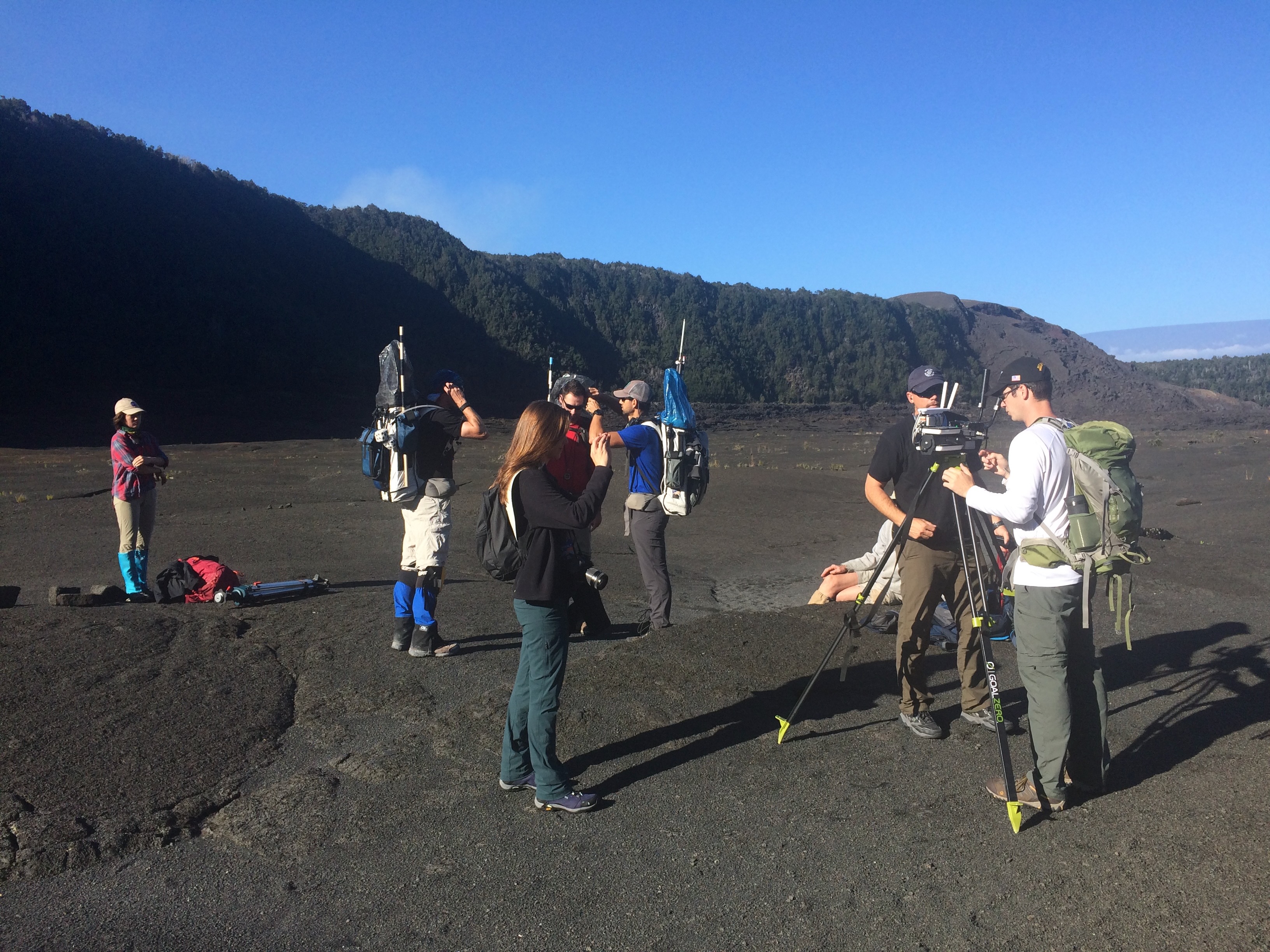
Analog expedition at Hawai'i Volcanoes National Park - Photo: Barrett Caldwell
Thanks to IEs here on Earth, we’ve been able to reach common ground on tech necessities such as outlets, connectors, and communication frequency. Though it took us over 500 years to achieve, these small things often go underappreciated for the great deal of convenience they bring. As we turn our attention to the moon, creating that convenience presents a problem waiting to be solved.