
Research Team Receives Best Poster Award at Associated Schools of Construction Conference
Johnson Adetooto, advised by Behzad Esmaeili, collaborated with Purdue researchers Seonho Woo and Young-Jun Son, along with Myounghoon Jeon, on the award-winning poster titled “Neuro-and Psychophysiological Responses to Fear and Social Influence during Pre-Evacuation Decision-Making.”
This past April, Johnson Adetooto, a PhD student, received the best poster award at the 2026 Associated Schools of Construction Conference. This event, hosted by California Polytechnic State University, brings together educators, researchers, students, and industry partners to share work that advances the field of construction. In earning this award, Adetooto had to give an in-person poster presentation to 4 faculty reviewers before he was recognized as the highest-rated poster. Not only did it draw from the field of industrial engineering, but it also incorporated civil engineering, human factors, and data-driven methods.
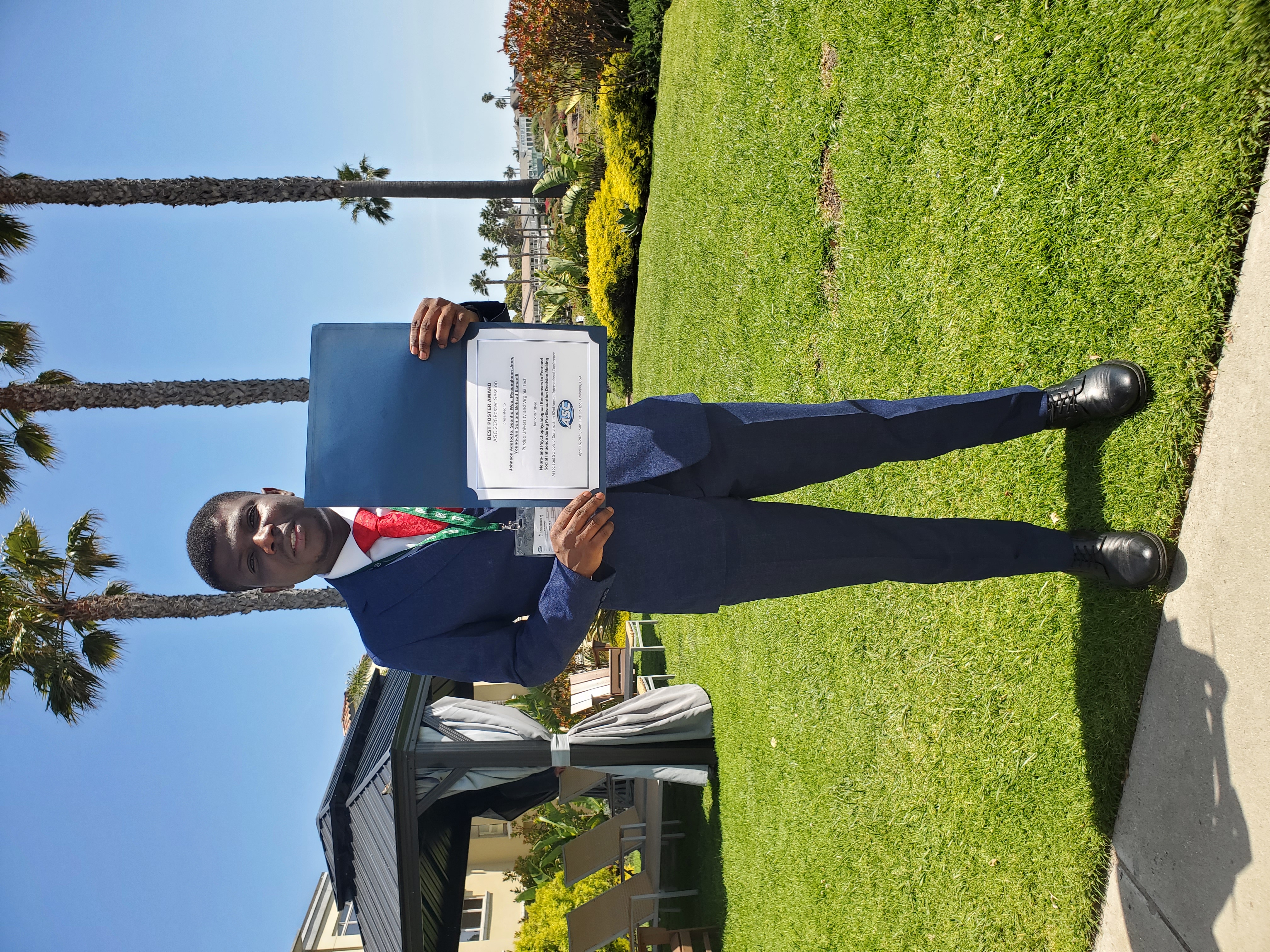
Adetooto with the 2026 Associated Schools of Construction Conference Best Poster Award
Adetooto’s poster, titled "Neuro- and Psychophysiological Responses to Fear and Social Influence during Pre-Evacuation Decision-Making” focuses on pre-evacuation decision-making during emergencies. It aims to address limitations in current evacuation models which do not directly address the pre-evacuation stage. This stage is critical, as the highest potential for delays occur before people take protective action. Adetooto’s work studies how fear, social influence, attention, and physiological responses shape those early decisions. Where most evacuation models only begin to unfold after people evacuate, this research explores how people process risk before evacuation begins, and how those decisions can shape emergency response in the procedure itself.
In doing so, Adetooto and his team use multimodal sensing methods, including eye-tracking, functional near-infrared spectroscopy (fNIRS), and electrodermal activity, to understand how people behave during emergency scenarios. Their goal is to develop predictive and explainable safety models to support evacuation planning, safety training, and real-time decision-making. Currently, safety systems assume that people will respond immediately and rationally once a hazard appears. But in practice, people experience delays, uncertainty, or underestimate risks. In developing ways to anticipate behavior during emergencies, Adetooto’s work has the potential to save lives. The research supports more realistic evacuation models and emergency communication, centered around how we expect people to respond during critical conditions.
From attending this conference, Adetooto was not only given the opportunity to present his work to a broader audience, but also benefit in earnest conversations with other faculty, students, and researchers. All of which share a deep passion for construction education, project management, safety, and emerging technologies.
Upon receiving his award, Adetooto felt both grateful and encouraged. “For me, the award was not only personal. It confirmed that our team's effort to connect human factors and data-driven modeling addresses a problem that matters for built-environment safety,” says Adetooto. This research effort was achieved in coordination with scholars from both Purdue and Virginia Tech. This included Purdue advisor Professor Behzad Esmaeili, along with Professor Young-Jun Son, Professor Myounghoon Jeon at Virginia Tech, and Seonho Woo.
In addition to the team’s collaboration, Adetooto also attests to the support Purdue provides. Specifically, Purdue Industrial Engineering has built an interdisciplinary environment where safety, human factors, systems thinking, data-driven modeling, and engineering practice come together. Having that foundation is essential for a study in pre-evacuation decisions; it is not only an engineering problem, but a human decision-making problem as well.
By taking advantage of mentorship and collaboration resources, Adetooto has been able to frame his work in a way that connects human behavior, multimodal sensing, explainable AI, and safety system design. Industrial engineering nurtures a distinctive ability to work across people, systems, data, and decision-making. This combination is powerful when applied to problems where the outcome affects safety, lives, and communities. Adetooto hopes to use this skillset to his fullest, by making an impact on lives by better engineering design. In the end, we are only remembered by what we have done.
Related Links:
https://journals.sagepub.com/doi/10.1177/10711813251369363