
Rising Sophomore Tayseer Abdeljaber makes top 27 of AI Venture Velocity Challenge
Hosted by Texas A&M, this challenge invites students to develop their startup concepts into fruition. For Abdeljaber, his venture was BusFactor.
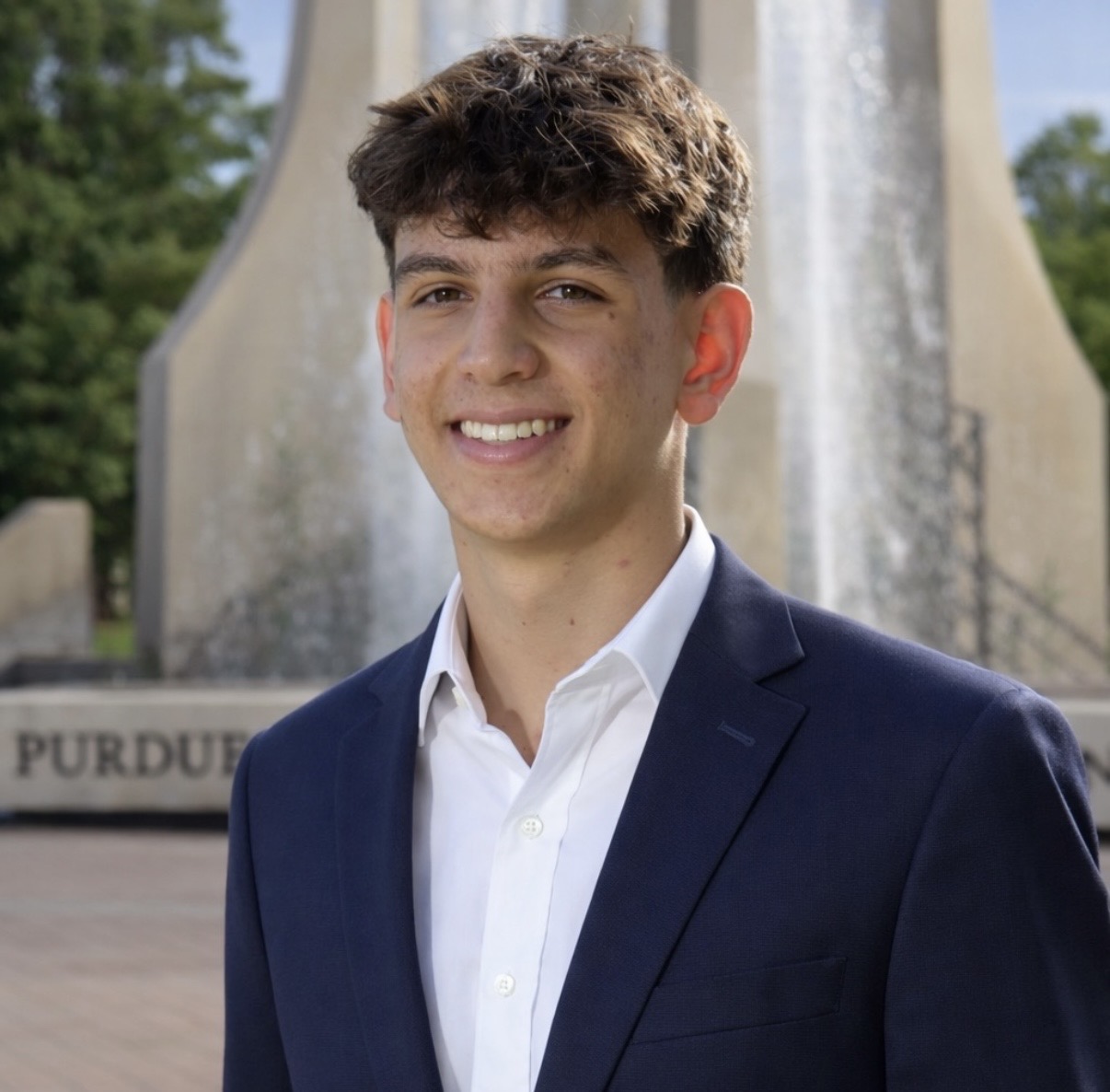
Purdue Industrial Engineering’s Tayseer Abdeljaber has made it to the top 27 in the AI Venture Velocity Challenge. Hosted by Texas A&M, 531 teams were initially selected to participate in this AI-based startup competition. The starting stages consist of submitting your venture, then going through a series of experimental rounds in which competitors must demonstrate real evidence and learning, beyond just a pitch deck.
Over the past few months, Abdeljaber has built his venture, BusFactor, from the ground up. Its primary focus is to find the people an organization can’t afford to lose. By analyzing a company’s metadata to determine how teams communicate and work, BusFactor can determine who are the key individuals holding projects together, and how to best protect that knowledge before it walks out the door. This tool is especially useful in mergers and acquisitions, but generally any environment in which teams are experiencing significant changes.
Throughout the challenge timeline, participants spent weeks running real experiments, engaging in customer conversations, testing prototypes, pricing research, and most importantly: documenting your own and your company’s growth. However, the test process presented a real challenge to Abdeljaber: how was he supposed to gather evidence as proof his algorithm worked? To do so, he ran simulations of organizations of varying sizes. In each, he would plant certain key people and measure how well the system caught critical parties. Once his results performed well enough, Abdeljaber validated the network analysis by testing it on the public Enron email dataset. This iterative procedure allowed BusFactor to grow from a mere concept into a fully functioning build.
In spite of its observable success, Abdeljaber has more ideas he hopes to implement. Though currently BusFactor does not use sensitive company content in its AI system, he aims to develop an option that integrates the algorithm with a client’s own AI model. This ensures companies never have to send data anywhere, opening up more avenues for BusFactor’s application. Additionally, beyond public datasets, his next step is to validate BusFactor on real organizations through live pilots.
As an incoming sophomore, Abdeljaber has not taken many of the core IE courses yet. However, opportunities at Purdue such as Build Purdue and Anvil provided the community to actively build, instead of just thinking about it. Having peers to provide honest input was essential in moving BusFactor into something he could test and validate.
“Build real things before you feel ready, and get them in front of real people as soon as you can. Most of what I've learned came from putting something out and watching how people reacted, not from planning,” says Abdeljaber. For him, learning the basics of engineering provided the foundation to see systems, people, and processes as things able to be improved upon. Having that mindset, combined with a willingness to build and test relentlessly, is what turns an idea into reality.