
Smart Work Zones
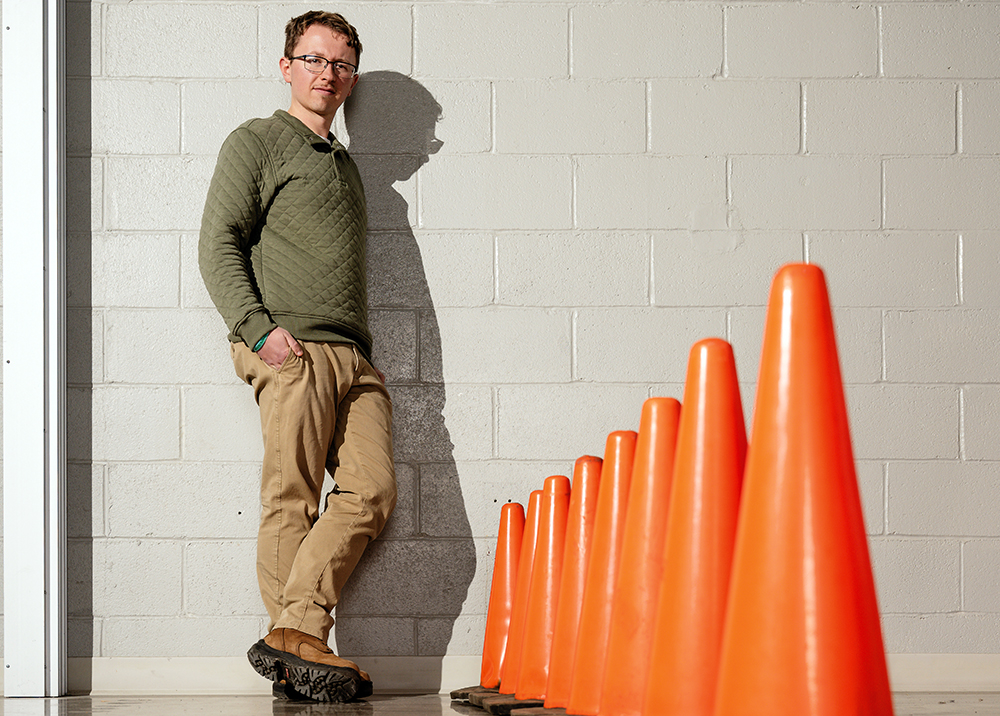
Digital twin system uses real-time data and AI to keep road crews safe when seconds matter most
Highway work zones are among the most dangerous places to work in the country. Drivers speed through narrowed lanes, barriers are minimal and construction crews often stand mere feet from live traffic. For many workers, the difference between a normal day and a life-altering injury can be a single second.
An interdisciplinary research team co-led by Sogand Hasanzadeh, assistant professor of civil and construction engineering, is working to change that. Through the SMART Work Zone Project, funded by the U.S. Department of Transportation’s SMART Grant program, the research group is developing an intelligent, adaptive safety ecosystem designed to predict instrusion risk in real time and warn workers before a vehicle enters the construction site.
“Highway workzone safety systems have traditionally been reactive,” Hasanzadeh said. “We want to shift the entire culture to one that is predictive and proactive. With the right sensing and analytics, we can recognize danger before workers are put in harm’s way.”
The Purdue team includes professors Yiheng Feng, Behzad Esmaeili and Lu Su as well as representatives from the Indiana Department of Transportation.
Building an intelligent work zone
The research integrates cameras, LiDAR, radar, GPS devices and AI-driven analytics into an interconnected digital twin system that constantly monitors work zones. These sensors track workers, vehicles, lane shifts and barriers — any element that could influence risk. The data streams into a cloud-based digital twin of the jobsite, where an AI model evaluates patterns and flags high-risk driver behavior, such as a late lane change, excess speeding or a drifting vehicle, in real time.
When the system detects a high-risk scenario, it triggers an immediate warning to drivers through sirens and customized messages while sirens and flashing lights simultaneously alert workers.
“In some intrusion cases, workers may have only one second to react, which is basically no time at all,” said Nathan Weston, an undergraduate research assistant on the project. “If our system can give three or four seconds instead of one, that’s potentially lifesaving.”
Weston, a senior construction engineering major from New Salisbury, Indiana, has been central to developing the worker-tracking and predictive components of the system. He created a wearable GPS device that transmits worker positions to the digital twin and he collaborated with postdoctoral researcher Woei-Chyi Chang (MSECE ’25, PhD CE ’25) to design an AI model that can fill in gaps when the signal temporarily drops.
“Losing track of a worker for even two seconds could matter,” he said. “So we trained a model to estimate short-term movement and keep the system situationally aware.”
The project is being piloted in partnership with the INDOT and Kiewit Corporation in Dallas. During field testing, Weston experienced real-world work zone conditions, standing only a few feet from cars traveling far too fast for the environment.
“Seeing vehicles cut through cones at close range really clarified how important this work is,” he adds.
Changing safety culture on America's highways
While the underlying technology is complex, Hasanzadeh emphasizes that the project’s purpose is human-centered.
“This research isn’t about automation replacing people,” she said. “It’s about using intelligent systems to protect the people doing essential, hands-on work. Our objective is simple: every worker should go home safely.”
She also stresses that the system is designed to be location-based, not person-based — reducing concerns about privacy or individual tracking for construction workers. Alerts focus on where danger is occurring, not on which worker is being monitored.
The work stands out internationally. Very few research groups are integrating sensing, AI prediction and digital twins into a single safety platform for highway construction.
“We’re building something that could genuinely change how our industry approaches safety,” Weston said.
Majoring in construction engineering while earning a minor in AI and machine learning has given Weston a rare intersection of skills. The project has deepened both.
“Research helps you take classroom theory and apply it,” he said. “Being trusted with real responsibility for this research project has made my entire Purdue experience stronger.”
Weston plans to continue in Hasanzadeh’s lab as a graduate student, helping develop the next phase of the system.
As tests expand and the technology matures, the team sees vast potential for safer highway workzones, better-protected crews and a shift toward an occupational culture where risk is anticipated, not endured.
“Predicting danger before it happens is no longer theoretical,” Hasanzadeh said. “It’s becoming part of how we keep America’s infrastructure workforce safe.”