
Hair Care Not as Harmless as it Seems
Common heat-based styling routines release dangerous nanoparticles
A typical morning hair care routine can expose you to as much immediate nanoparticle pollution as standing in dense highway traffic, report Purdue engineers.
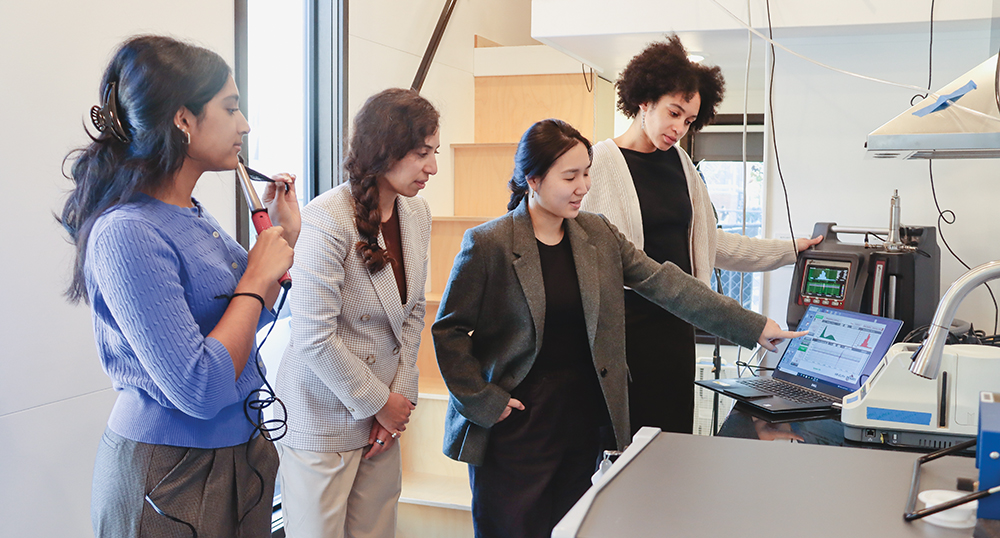
A research team led by Nusrat Jung, an assistant professor in the Lyles School of Civil and Construction Engineering, and PhD student Jianghui Liu found that a 10- to 20-minute heat-based hair care routine exposes a person to upward of 10 billion nanoparticles that are directly deposited into their lungs. These particles can lead to serious health risks such as respiratory stress, lung inflammation and cognitive decline.
“This is really quite concerning,” Jung said. “The number of nanoparticles inhaled from using typical, store-bought hair care products in conjunction with heated styling tools was far greater than we ever anticipated.”
Until this study, Jung said, no real-time measurements on nanoparticle formation during heat-based hair styling had been conducted in full-scale residential settings. Their research addresses this gap by examining temporal changes in indoor nanoparticle number concentrations and size distributions during realistic heat-based hair styling routines.
“By providing a detailed characterization of indoor nanoparticle emissions during these personal care routines, our research lays the groundwork for future investigations into their impact on indoor atmospheric chemistry and inhalation toxicity,” Jung said. “Studies of this kind have not been done before, so until now, the public has had little understanding of the potential health risks posed by their everyday hair care routines.”
What makes these hair care products so harmful, Liu said, is when they are combined with large amounts of heat from styling appliances such as curling irons and straighteners. When combined with heat exceeding 300 degrees Fahrenheit, the chemicals not only rapidly release into the air but also lead to the formation of substantial numbers of new airborne nanoparticles.
“Atmospheric nanoparticle formation was especially responsive to these heat applications,” Liu said. “Heat is the main driver — cyclic siloxanes and other low-volatility ingredients volatilize, nucleate and grow into new nanoparticles, most of them smaller than 100 nanometers.”
Undergraduate student researcher Rashmika Manipati said the research has been eye-opening and has impacted her own hair care routine.
“You never would think something that has been accepted as both safe and common for so long could be so potentially hazardous,” Manipati said. “What the research is revealing is something everyone needs to be aware of.”
As for how to avoid putting oneself at risk of inhaling mixtures of airborne nanoparticles and volatile chemicals, Jung and Liu said the best course of action is simply to avoid using such products — particularly in combination with heating devices. If that is not possible, Jung recommends reducing exposure by using bathroom exhaust fans for better room ventilation.
“If you must use hair care products, limit their use and ensure the space is well ventilated,” Liu said. “Even without heating appliances, better ventilation can reduce exposure to volatile chemicals, such as D5 siloxane, in these products.”
To more fully capture the complete nanoparticle formation and growth process, Jung said future studies should integrate nano mobility particle sizing instruments capable of detecting particles down to a single nanometer. The chemical composition of these particles should also be evaluated.
“By addressing these research gaps, future studies can provide a more holistic understanding of the emissions and exposures associated with heat-based hair styling, contributing to improved indoor air pollution assessments and mitigation strategies,” Jung said.