
Beneath the Surface
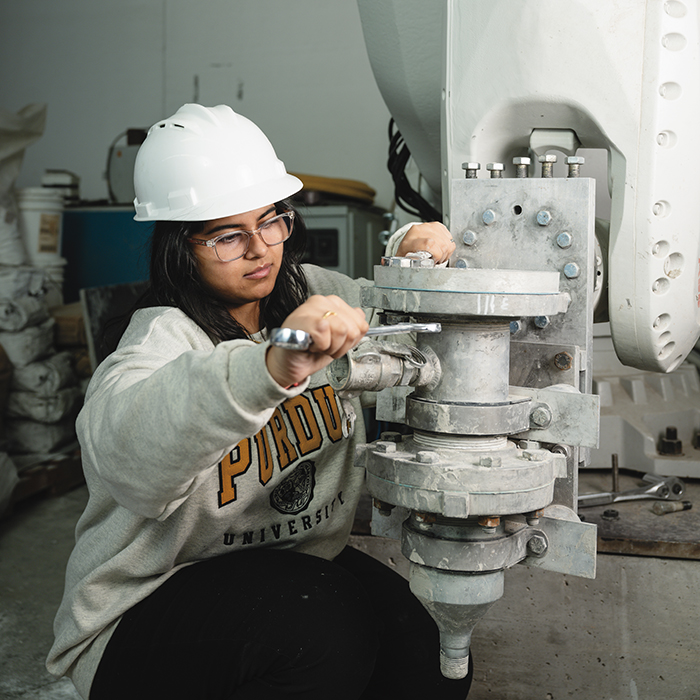
Undergraduate researcher Riya Raj helps Purdue engineers push 3D concrete printing into new underwater frontiers
When Riya Raj (BSCE ’25) talks about how much she’s learned about research at Purdue, her enthusiasm is unmistakable. She still laughs about the day steel fibers jammed a concrete-printing hose in the Bowen Laboratory for Large-Scale Civil Engineering Research. The failed experiment for her 3D Printing for Infrastructure Applications course forced her project team to rethink its approach. Moments like that — equal parts messy and illuminating — are what pulled her deeper into the world of 3D concrete printing.
Her curiosity led her to an undergraduate research position with a group exploring whether structural materials can be 3D-printed underwater. The research team is co-led by Jan Olek, the James H. and Carol H. Cure Professor in Civil Engineering; Jeffrey Youngblood, professor of materials engineering; and Pablo Zavattieri, the Jerry M. and Lynda T. Engelhardt Professor in Civil Engineering. Raj worked on the project under the mentorship of graduate researchers David Cubillos and Xinyu Lu.
Together, they’re aiming to demonstrate that durable structures can be printed on the bottom of the ocean without relying on traditional concrete.
“We’re not only testing how to 3D-print structures underwater,” Raj said. “We’re also experimenting with mixtures that use about 90 percent seafloor materials.”
The team mixes clay, sand and epoxy into pastes thick enough to hold their shape when extruded. Raj designed and 3D-printed custom molds at the Bechtel Innovation Design Center to hold the sticky mixes until they harden and can be used for flexural testing at Hampton Hall.
Each sample is loaded into a materials testing machine that presses down until the material bends or cracks, helping the team understand whether a particular mixture behaves in a ductile or brittle manner. The data reveals which formulations can withstand underwater forces, pressure and long-term degradation.
“We have a goal to test around 500 samples,” Raj said. “It’s a lot of samples, but each one tells us something new.”
Once a mixture shows promise after flexural testing, the team takes it to Bowen Lab to conduct an extrusion test. In this next phase, a large format 3D concrete printer is programmed to create bioinspired architected structures that could one day be used to build and repair underwater infrastructure such as pipelines and bridges.
Why print underwater?
Subsea infrastructure is more extensive — and more vulnerable — than most people realize. Communication cables, sometimes stretching thousands of miles, run along ocean floors and are encased in protective tunnels. When those tunnels degrade or crack, repairs require costly vessels, specialized divers and significant safety risks.
“Being able to print directly on the ocean floor using local materials could make repairs safer and much more efficient,” Raj said.
The Purdue team has already tested small-scale underwater printing setups, submerging a nozzle to extrude material into controlled containers. Future systems could be mounted on a vessel, printing through a conduit onto the seafloor.
The challenge isn’t just the environment — it’s geometry. There’s a need to build structures like arches and overhangs that are difficult even for conventional 3D printers.
“We’re trying to prove that more complex shapes can be printed underwater too,” she said.
When inspiration struck
Raj’s entry into 3D concrete printing began with that infrastructure applications class taught by Olek, Youngblood and Zavattieri. What struck her wasn’t only the technology but the biological inspiration behind it — the helicoidal structure found in the shell of the mantis shrimp, a recurring theme in Zavattieri’s work.
“I loved that connection between biology and civil engineering,” Raj said. “It made me want to learn more.”
Working in the Bowen Lab during that class introduced Raj to real-world 3D printing challenges. It sparked a desire to go further, eventually leading her to the underwater printing project.
Olek sees undergraduate involvement as essential. “Students like Riya bring perspectives shaped by diverse academic paths and personal experiences, and that diversity is what drives creativity and innovation in our research,” he said. “Their unique viewpoints allow us to approach complex engineering problems in ways we might not otherwise consider.”
Raj graduated in December and is pursuing a career in engineering mechanics and infrastructure. She’s been interviewing with companies performing advanced materials and structural testing — roles that closely mirror the work she’s done in Zavattieri’s lab.
“This project showed me how much I love structural mechanics,” she said. “I want to do work that has real purpose, whether that’s rebuilding after natural disasters or improving the way we design materials.”