
Graduate seminar highlights digital twin technology for Purdue’s nuclear research reactor
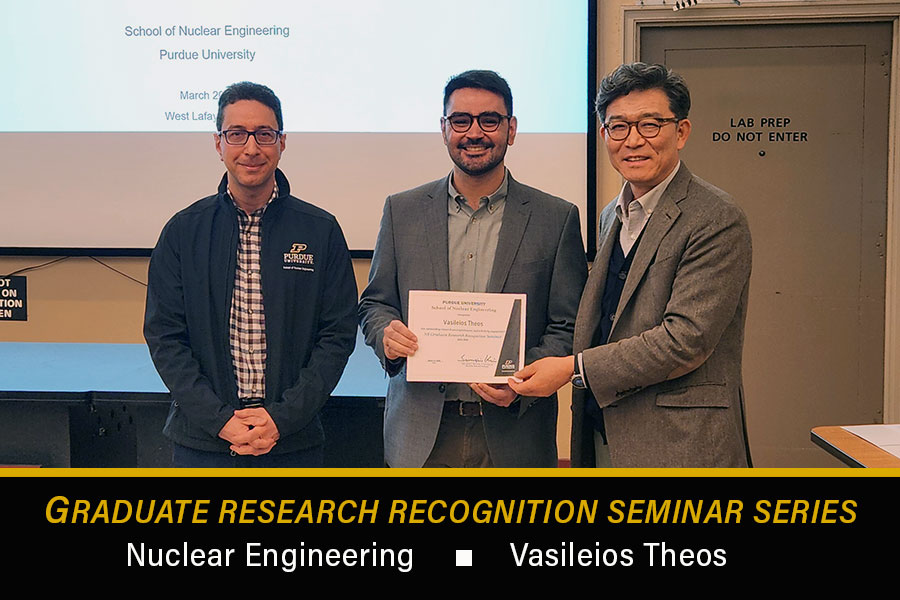
Advanced modeling and real-time data integration were the focus of a recent Purdue University School of Nuclear Engineering seminar, where a graduate student presented an experimentally validated high fidelity digital twin of the university’s nuclear reactor.
Vasileios Theos, a PhD candidate in nuclear engineering, delivered “Overview of the PUR-1 Digital Twin” on March 11 as part of the department’s Graduate Research Recognition Seminar series, which showcases student-led work at the forefront of nuclear engineering innovation. Each semester, one student is selected to present.
Theos’ work centers on a high-fidelity digital twin of the Purdue University Reactor (PUR-1), a platform that combines physics-based and data-driven models with live reactor data to simulate and predict reactor behavior in real-time. It integrates neutronics, thermal-hydraulics, communication, and instrumentation models, enabling real-time monitoring, diagnostics and predictive analysis.
“This type of platform allows us to better understand how the reactor behaves under a wide range of conditions without directly impacting operations,” Theos said.
Theos explained that the digital twin also serves as a cyber-physical testbed for emerging research areas, including autonomous reactor control, anomaly detection, and advanced instrumentation systems. By linking directly with the PUR-1 data acquisition system, the platform allows researchers to test new operation strategies in a laboratory-controlled environment. In addition to research applications, the system supports operator training and workforce development by creating realistic, simulation-based scenarios for students and researchers.
Advised by Stylianos Chatzidakis, assistant professor of nuclear engineering and associate reactor director, Theos holds a bachelor’s degree in mechanical engineering from the National Technical University of Athens and a master’s degree in nuclear engineering from Purdue University. His research spans digital twins, multiphysics simulation, reactor cybersecurity, and machine learning–based modeling, with a focus on validation and uncertainty quantification.