
When Blue is Green
AI and algae power a new future for sustainable seafood
As the U.S. imports most of the seafood it consumes, Purdue researchers are working to change that. Amanda Lopez-Savage, a recent PhD graduate of the School of Sustainability Engineering and Environmental Engineering, and Zhi (George) Zhou, associate professor of civil and construction engineering, are leading the “When Blue is Green” (BiG) project, an ambitious effort to expand domestic seafood production through innovative aquaponics systems.
By developing zero-waste, grid-independent and economically viable production models, the team aims to strengthen regional seafood supplies, reduce the nation’s $17 billion seafood trade deficit and lessen the environmental impact of food production. Working with partners across the entire blue food supply chain, the researchers are building the evidence needed to make sustainable, U.S.-grown seafood more competitive and accessible.
Central to their research is the creative integration of machine learning and a patented biomimicry technique to enhance algal lipid productivity.
“By optimizing cultivation through predictive modeling and leveraging viral lysis for efficient lipid extraction, we unlock algae’s potential as a sustainable source of high-value products, including feed ingredients, specialty chemicals and human food supplements,” Zhou said. “Furthermore, our approach facilitates nutrient recovery, allowing for the direct integration of these processes into aquaponics systems to advance circularity.”
Their approach also facilitates nutrient recovery by integrating these innovations directly into aquaponics systems, promoting a circular, sustainable model.
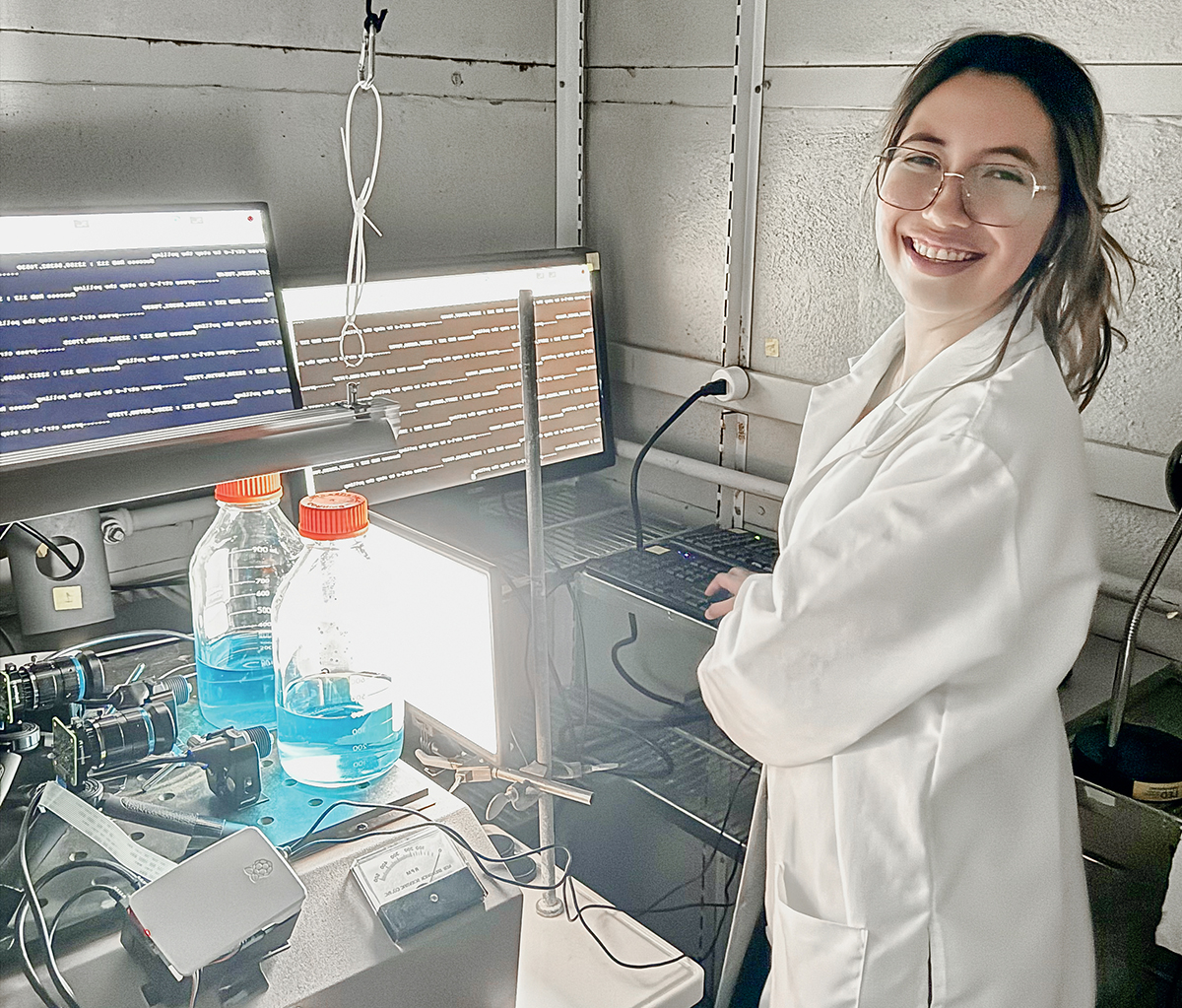
What sets their work apart is a holistic, data-driven “digital-biological” framework that bridges two of the biggest hurdles in algal biofuel production: upstream cultivation and downstream extraction. Their machine-learning random forest models accurately predict the optimal environmental drivers to maximize lipid output, while the biological approach — using the PBCV-1 virus for viral lysis — triggers algae to accumulate valuable lipids without expensive chemicals or harsh stressors. By integrating these strategies, Lopez and Zhou have developed a highly efficient, sustainable and cost-effective production cycle that overcomes traditional, energy-intensive bottlenecks.
The concept of viral lysis, a naturally occurring biomimetic process, has proven to be a significant enhancement to engineering systems, while machine learning and artificial intelligence (AI) — modeled after the human brain — have transformed the approach to complex scientific questions. They believe that the full potential of AI in this field is only beginning to be realized.
“In my PhD research, I explored how AI can be applied to close the gap between what we can predict, what we can optimize and what we can ultimately control during bioprocessing,” Lopez said. “Although AI may be the missing analytical layer between biological complexity and control, integrating it into the dynamic and unpredictable reality of living unicellular systems in the laboratory is challenging and remains largely unexplored. To address this knowledge gap, I developed a unified framework using AI as the central engine for discovery, optimization, inference and anticipation during microalgal bioprocessing.”
Lopez’s work at the intersection of AI and sustainable biofuel production led to three significant innovations: a machine learning model that streamlines lipid production predictions in algal cultures; a highly efficient technology that uses unsupervised learning and fluorescence imaging to boost microalgal lipid reserves by 165%; and an AI-powered optical sensor that enables real-time, cost-effective monitoring of lipid biosynthesis and metabolic stress for intelligent bioreactor control.
Together, these three projects have opened new avenues in experimental biology and computational intelligence, signaling a transformative era for sustainable bioprocessing and the future of blue foods. With their innovative work, Lopez and Zhou are laying out the foundation for intelligent, efficient and environmentally responsible bioreactor systems — offering real hope for a more sustainable food future.