
Small Particles, Big Impact
New granular technologies could advance seismic isolation and shock absorption
Research into functionalizing granular materials for vibration control has the potential to have impact throughout the engineering field.
From the development of a highly dissipative granular material to the design of granular metamaterials capable of filtering vibrations in specific frequency ranges, Marika Santagata, professor of civil and construction engineering, said “the potential applications are wide-ranging.”
The “engineered particles” conceived to increase energy dissipation are formed by a rigid core encapsulated in a soft shell. “This particle-scale design explores the idea that mediation of particle contacts by a soft lossy phase can enhance dissipation under dynamic excitation,” said PhD student Kike Garzon-Sabogal, who developed the methodology to manufacture the particles in the lab.
Experiments performed by Garzon-Sabogal show an increase in the small strain damping ratio by as much as an order of magnitude. The research team envisions potential applications in shock absorption and seismic isolation.
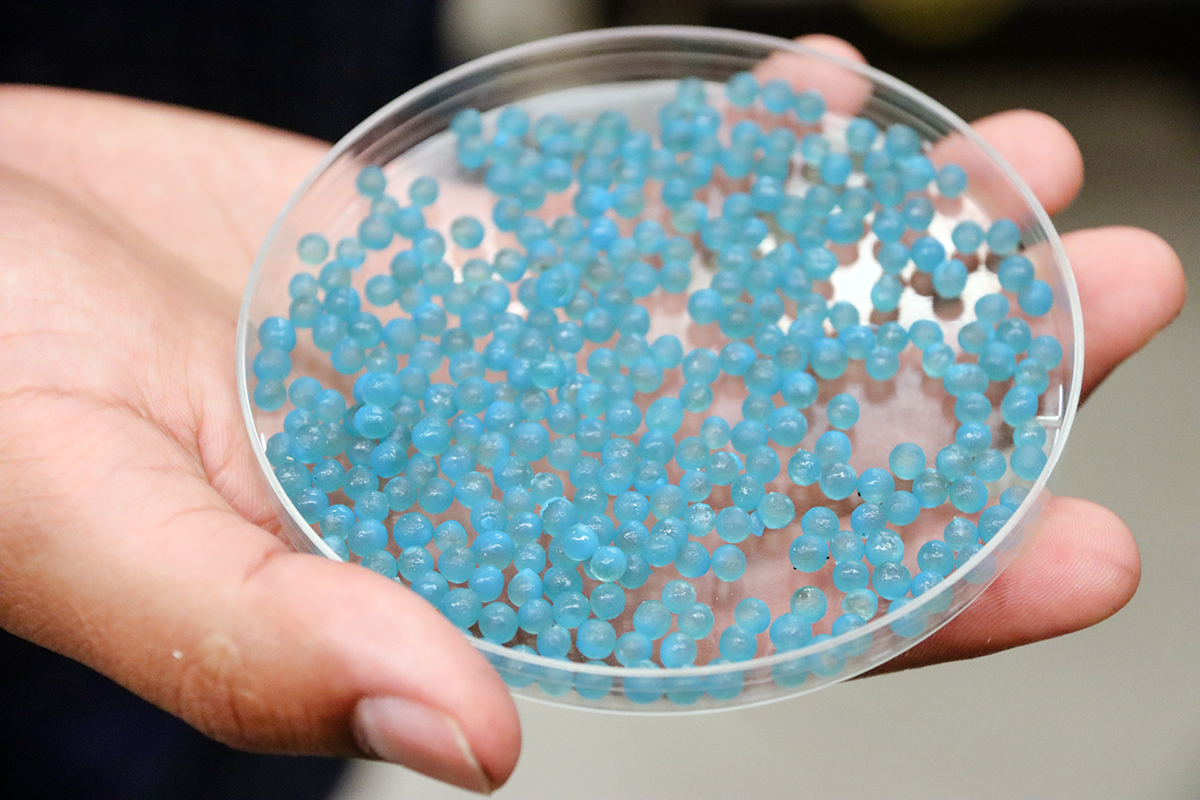
Equally promising is the group’s work on granular metamaterials formed by layers of randomly packed grains organized in a periodic structure, Santagata said.
“While other researchers have previously used discrete granular elements for filtering vibrations, we believe this work provides the first experimental evidence of the potential for using bulk granular materials, including those of geologic origin, which geotechnical engineers are most familiar with,” Santagata said. “The architecture of the layers and the contrast in their properties allow us to precisely define the range of frequencies that are filtered, with further tuning enabled by controlling the level of confinement.”
Santagata said the research also produced advancements in methods for testing granular materials. In particular, a new approach was developed that extends the capabilities of conventional resonant column testing by enabling the analysis of off-resonance data and enforcing control over the vibrations applied to test specimens.
“This represents a true paradigm shift in resonant column testing,” said Santagata, who credits Professor Emeritus Vince Drnevich for working alongside her and her team.
Santagata said the new method will eventually be incorporated in an American Society for Testing and Materials standard.
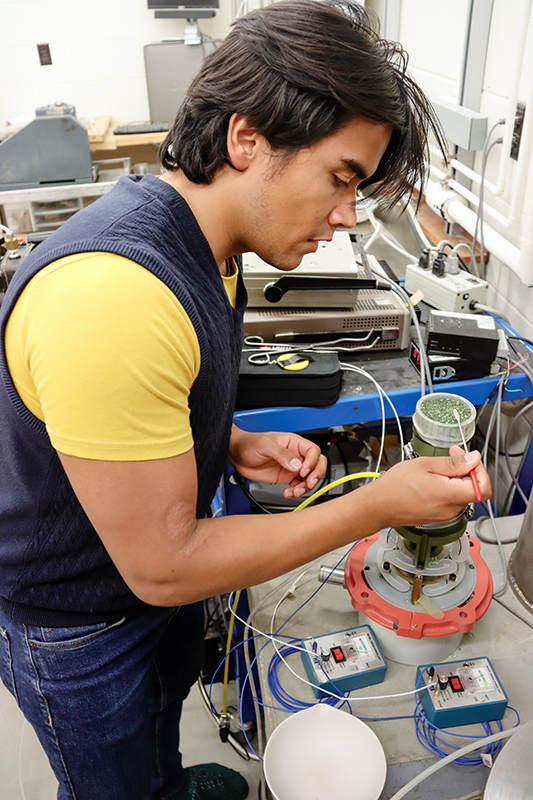
Purdue Civil Engineering PhD student Kike Garzon-Sabogal prepares a batch of granular material particles for testing.