
Protecting the Panama Canal
Bioinspired barrier would reduce saltwater intrusion while maintaining vessel traffic
A Purdue invention seeks to preserve one of the world’s most vital waterways.
Since 2024, Pablo Zavattieri, the Jerry M. and Lynda T. Engelhardt Professor in Civil Engineering, has been developing a 3D-printed barrier for the Panama Canal.
The novel structure is designed to hold back saltwater intrusion while safeguarding freshwater supplies for local communities.
The idea emerged in 2023, when Zavattieri and visiting researcher Nelson Pachao began discussing how architected materials and large-scale deployable structures could offer new engineering solutions to global challenges.
“One problem of interest is examining how climate change, increased water demand from Neopanamax traffic and declining freshwater availability in Gatun Lake have exacerbated the problem,” Zavattieri said. “These challenges threaten both human consumption of water and the number of daily transits in the canal, reducing revenue. We knew the canal was facing an increasingly difficult challenge. The question became whether we could rethink the problem from an engineering perspective.”
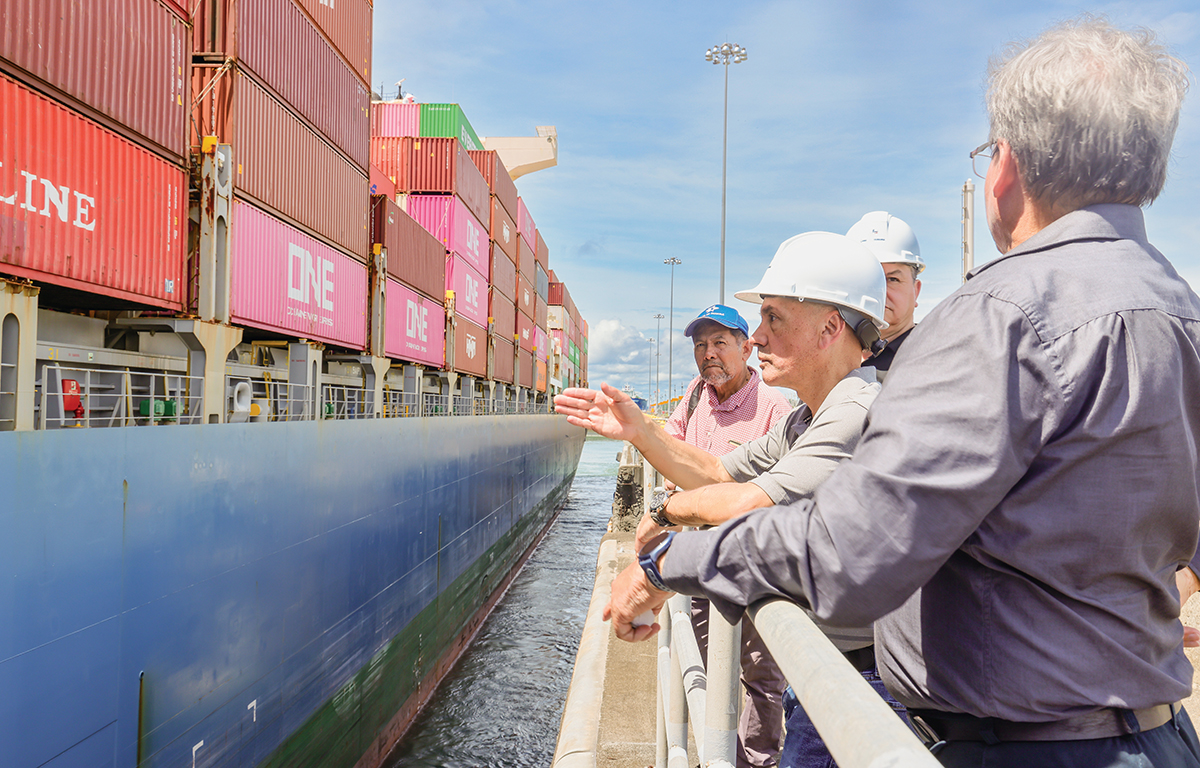
Zavattieri said Luis Alfaro (MSCE ’77, PhD ’80, CEAAA ’10), former vice president of the Panama Canal Authority (ACP), has served as a critical connection to the organization. Alfaro’s involvement has helped bridge Purdue research and Panamanian infrastructure priorities. Alfaro carefully reviewed the concept, provided valuable technical feedback and helped the team refine the idea while introducing it to key stakeholders within the ACP. Supported by the Lyles School, Zavattieri and Pachao presented their technology to ACP engineers and leadership in Panama, a move that sparked a formal partnership to test its feasibility.
The Purdue team is developing a 3D-printed/fabricated reconfigurable and navigable waterway barrier (RNWB) designed by Zavattieri and Pachao. Zavattieri describes the RNWB as an “underwater reconfigurable, flexible skin” inspired by nature that opens and closes like an aperture to minimize the mixing of saltwater from the Pacific Ocean into the freshwater Gatun Lake — the primary freshwater source in the area.
“In addition to the environmental benefits, this could also lead to greater canal capacity,” Zavattieri said. “The objective is simple, if we can reduce the amount of freshwater lost during droughts while maintaining navigation, then we can help the canal face one of its biggest challenges. The 2023 drought, and the conditions expected this year because of El Niño, make that challenge even more relevant.”
PhD student researcher Juan Fernando Cucuyame said the team is currently optimizing the model design for the RNBW, but early tests have been promising.
“We are always looking for ways to improve the build and work on new design iterations, but what we are seeing has been very encouraging,” Cucuyame said. “We are nearing a point where we can take our work out of the lab and test it in the field.”
To further aid in their research, Purdue awarded Zavattieri’s team a research grant through its Trask Innovation Fund to develop University-owned intellectual property for commercial use. Zavattieri said the Trask award will fund a six-month project to advance the RNWB by refining its design, fabricating a proof of concept and conducting controlled tests on campus.
Beyond the Panama Canal, Zavattieri has also begun discussions with the U.S. Army Corps of Engineers about potential applications of the technology to navigation locks in the United States, and with the California Department of Water Resources regarding saltwater intrusion challenges in the Sacramento-San Joaquin Delta.