
Holding Fast
Testing an innovative concrete anchor for offshore wind
The global energy sector is undergoing a significant transition as it shifts toward renewable energy. Researchers at Purdue’s Bowen Laboratory for Large-Scale Civil Engineering Research are advancing anchoring technology for offshore renewable infrastructure by developing and testing innovative materials and anchorage systems.
Renewable energy sources such as solar, wind and geothermal offer promise but require significant space, while hydroelectric dams can have major environmental and social impacts. Floating wind and solar farms are gaining momentum because they harness strong winds and sunlight over water without occupying valuable land. Their success, however, depends on durable anchoring systems.
A team led by Lyles School of Civil and Construction Engineering professors Akanshu Sharma, Jan Olek, Pablo Zavattieri and Jeffrey Youngblood and post-doctoral researcher Deepak Suthar is testing a concrete-based suction anchor as an alternative to traditional steel anchors. The research is being conducted in collaboration with Sperra, a Boulder, Colorado-based company that designs structural systems for energy projects in aquatic environments.
Concrete is abundant, resilient and more resistant to saltwater corrosion than steel, making it an attractive option for offshore applications.
“There’s increasing momentum to build wind and solar farms on large bodies of water, which sidesteps the need for land reclamation for major projects,” Suthar said. “These floating farms use open ocean, sea and lake surfaces to harness strong, consistent winds and unimpeded sunlight — eliminating the need for land and reducing their physical footprint.”
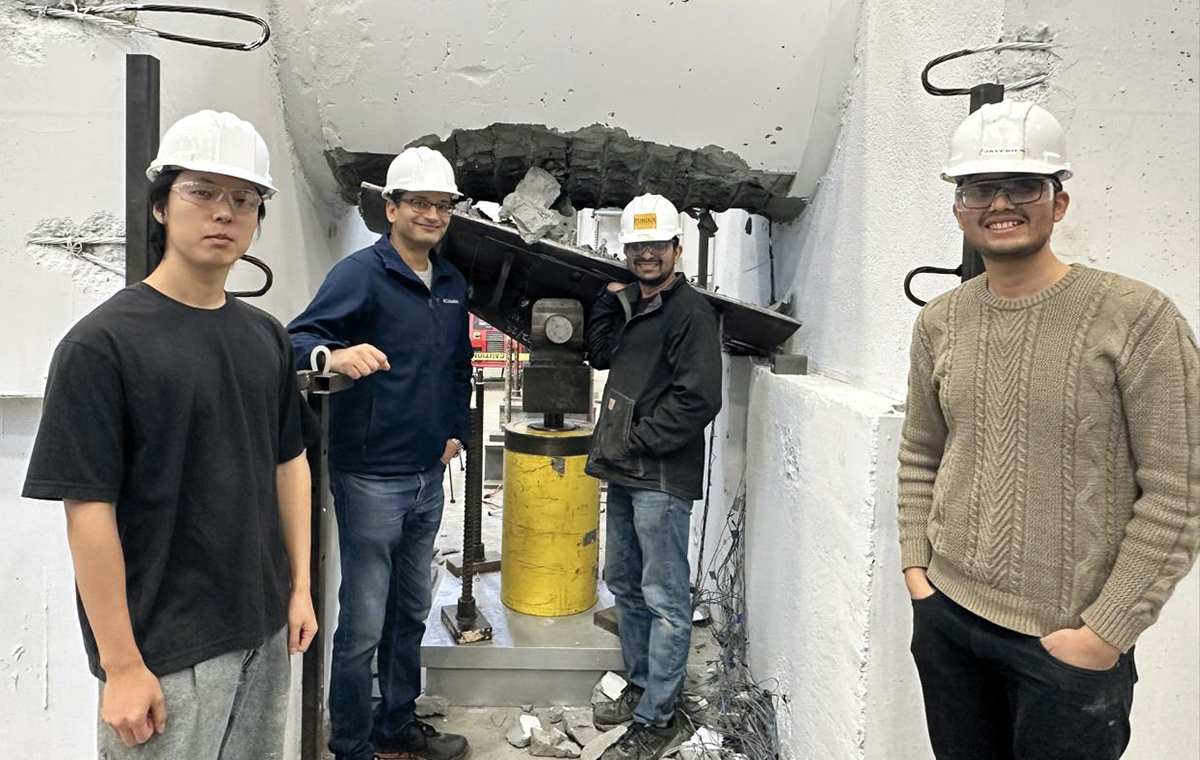
Purdue’s project centers on a 40%-scale concrete suction anchor developed with Sperra employees Taylor Marchment, Mason Bell and Alexander Mendez Chavez. Supported in part by the National Science Foundation, the team built a reinforced concrete test anchor measuring 60 inches wide, 12 inches thick and 12 feet long to replicate real-world conditions.
The anchor was tested under pullout loading until it failed through a concrete breakout mechanism as part of a broader research program investigating 3D concrete printing and automated construction methods for offshore infrastructure. The failure load closely matched predictions from computer models and previous small-scale tests, demonstrating that concrete suction anchors can perform effectively at scale while identifying opportunities to improve strength, optimize connections and simplify construction.
“This first-of-a-kind test on the concrete suction anchor is a testament to Bowen Lab’s capabilities as the leading lab for highest quality large-scale structural testing,” Sharma said. “Several challenges, including the circular geometry, scale of the specimen, complex 3D-printed concrete connections and ensuring safety during the test, were overcome through the commitment of the Purdue and Sperra teams. We look forward to continuing and furthering this exciting work.”
Next steps include developing more durable anchor designs, evaluating sustainable concrete mixtures and alternative reinforcement materials, and refining automated 3D-printing methods to speed construction. The team hopes those advances will further improve the performance and affordability of offshore renewable energy infrastructure.
“Collaborating with the Purdue University team on this NSF STTR Phase II project has been critical to validating the design and engineering of our concrete suction anchors,” said Jason Cotrell, founder and CEO of Sperra. “The successful structural test demonstrates the potential for robotic concrete manufacturing methods to support the development of durable, cost-effective offshore infrastructure.”