
Alumna Spotlight: Engineering Beyond Earth

Evaluating the seismic risk of lunar lava tubes on the moon
Juliana Spohr Pereira (MSCE ’17) is redefining the boundaries of civil engineering — both on Earth and beyond. With an unconventional academic path that bridges journalism and civil engineering, she brings a unique perspective to her research and communication.
Her educational journey began in Brazil, where she obtained degrees in both journalism and civil engineering. International experiences — like honing her English in Canada, studying dam safety in the Netherlands, researching flood mitigation in Spain and interning on bridge projects in Florida — have shaped her global outlook. Now, as a PhD student at Purdue, Pereira is on the cutting edge of extraterrestrial engineering, focusing on how we can safely inhabit the Moon by evaluating the seismic risks of lunar lava tubes.
Her decision to attend Purdue’s Lyles School of Civil and Construction Engineering was driven by the school’s global reputation, exceptional research facilities and renowned faculty. After earning the Science without Borders scholarship from the Brazilian government, Pereira sought out a place that offered research opportunities beyond what was available at home.
“Purdue is known as the Cradle of Astronauts,” she said. “Where else could I work on the moon? I am incredibly grateful to have the support of the Purdue community and my amazing advisor, Antonio Bobet.”
Pereira also expressed gratitude for Pete Mitnick (BSCE '77) whose donations support her research endeavors, and to Scott Hinkel, senior director of development, who made this connection possible. Pereira’s expertise lies in geotechnical engineering. During her master’s degree, she investigated deep-pile foundations for major infrastructure projects. Now, she applies advanced knowledge of rock mechanics, numerical modeling and tunnel stability not just to terrestrial projects, but also to underground structures for space exploration.
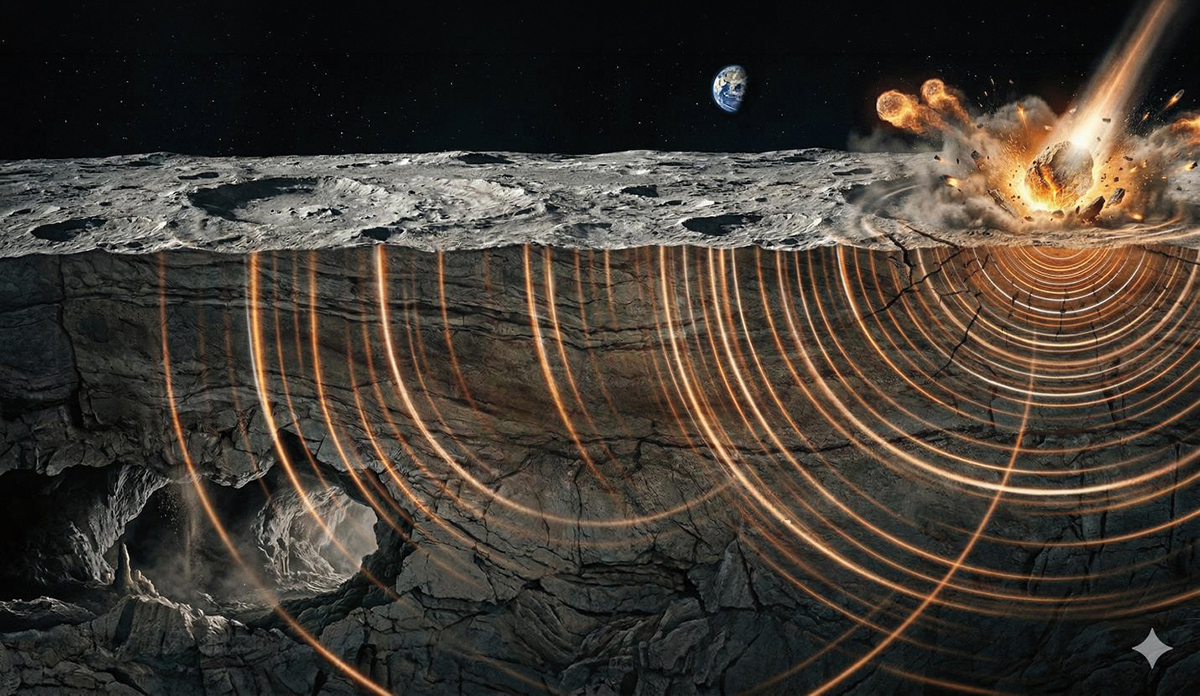
At the heart of Pereira’s research are lunar lava tubes — vast underground tunnels formed by ancient volcanic activity on the moon. These hidden spaces offer a promising solution for building permanent lunar habitats, as their rocky ceilings shield astronauts from harsh conditions such as radiation, meteorites and temperature extremes. Using sophisticated finite element analysis, Pereira models how these tunnels would withstand moonquakes and meteoroid strikes, helping ensure that future lunar settlers can live and work safely beneath the moon’s surface.
After extensively studying the effects of moonquakes, Pereira is now turning her attention to meteoroid impacts — another serious threat to lunar structures. By harnessing the iSALE shock physics code, she simulates the dramatic collisions and the seismic waves they unleash. This work will help define the safest tube dimensions and roof thicknesses, as well as the engineering reinforcements needed to make lunar settlements a reality.
Beyond her groundbreaking research, Pereira is passionate about mentoring the next generation of engineers. She believes in the power of combining technical prowess with communication skills — her background in journalism has been invaluable in making complex data accessible and effectively teaching and mentoring students.
She urges students to get involved early through research, internships and leadership roles, emphasizing that the greatest growth happens outside the classroom. Building strong professional networks, she says, is vital. The Women in Engineering program at Purdue provided a community where she could give back, mentoring over 80 students every year. Pereira’s dedication to both research and mentorship continues to inspire future engineers to pursue excellence, collaboration and service in their own careers.