
Driving Smarter Mass Transit
Intelligent intersections promise faster, safer and greener public transportation
Purdue researchers are preparing to take the next giant leap forward in American mass transit.
Yiheng Feng, associate professor of civil and construction engineering, is leading a research team working to deploy a multi-modal intelligent traffic signal system (MMITSS) in the Midwest. This system is designed to improve the efficiency, safety and reliability of signalized intersections by enabling real-time communication between vehicles, roadside infrastructure and traffic signal controllers through connected vehicle technology.
“We believe this will be a big step forward for mass transit in the United States,” Feng said. “Not only will this help to reduce transit time in implemented areas, but it will increase traffic safety and will have a positive environmental impact with reduced energy consumption.”
MMITSS is a transit signal priority (TSP) application that helps transit vehicles, such as buses and light rail, move more efficiently through signalized intersections by reducing unnecessary stops and delays. The software-defined solution works with different types of hardware devices that enable smarter and more responsive traffic signals.
“By improving travel time reliability and keeping buses on schedule, TSP enhances the overall transit experience and makes public transportation a more attractive option for commuters,” Feng said. “Increased transit ridership can help reduce traffic congestion, lower vehicle emissions and decrease energy consumption, supporting broader goals of sustainable and environmentally friendly transportation.”
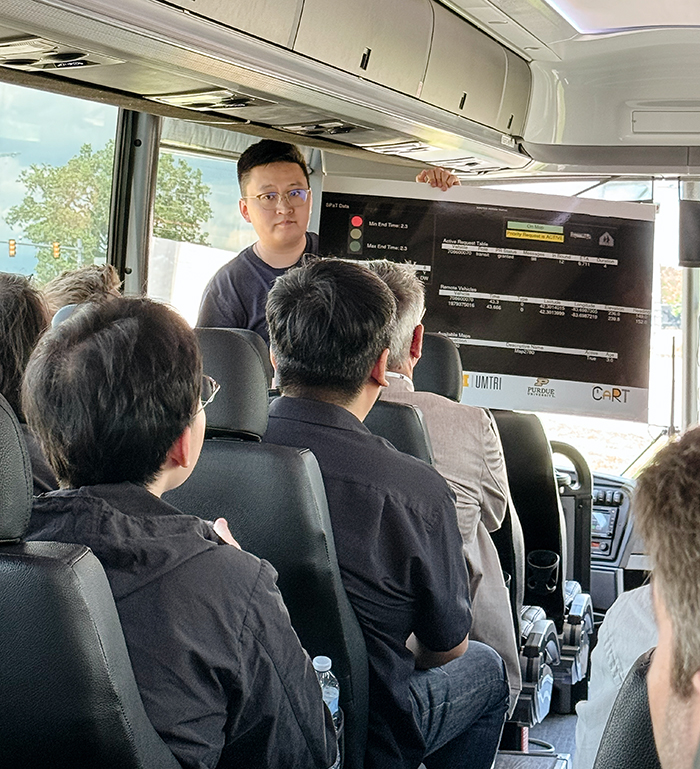
Purdue Civil Engineering PhD student Yilin Wang demonstrates the MMITSS system in Ann Arbor during the IEEE Intelligent Vehicle symposium.
Feng’s team has been testing the system in Ann Arbor, Michigan, on its bus system where his team reports positive results, particularly in efficiency.
“We have demonstrated that deploying MMITSS reduces both bus delays — even during rush hour — without negative impact on regular traffic,” said PhD student researcher Yilin Wang. “Through these deployments, we aim to dramatically improve transit systems and strengthen the capacity of urban public transportation to better serve the communities that depend on it.”
This fall, Feng’s team will further expand its research and implement the system in Detroit’s QLine — a 3.3-mile light rail system that runs through the city with 13 stops. Doctoral researcher Yumeng Bai notes that MMITSS will optimize the light rail system’s efficiency and schedule precision, making the service far more reliable for riders.
“The QLine project gives us a valuable opportunity to extend MMITSS beyond bus operations into a new transit setting, light rail service,” Bai said. “Through our demonstrations at ITS America, we showed how MMITSS can support smarter, real-time signal priority decisions in a complex urban corridor like downtown Detroit. This is a meaningful step toward improving schedule reliability and providing riders with a smoother and more dependable transit experience.”
The U.S. Department of Transportation supports this research through its Advanced Transportation and Congestion Management Technologies Deployment program, which funds both the Smart Intersection and Intelligent Woodward Corridor projects.