
Designing for Daylight
Researchers rethink classroom lighting for autistic students
Before an autistic child can process a teacher’s words, they must process the room itself. Light, sound, and layout dictate comfort and focus in ways researchers are only beginning to unlock.
A research team led by Thanos Tzempelikos, professor of civil and construction engineering and Herrick Labs faculty, is exploring one piece of that puzzle — the role of natural daylight in schools and autism-support facilities.
Funded by the National Science Foundation and conducted in partnership with Ball State University, the project brings together experts in architectural engineering, autism behavior and education to study how children respond to different lighting conditions.
“These kids have extreme sensitivity to environmental conditions, and that includes both artificial and natural light sources,” Tzempelikos said.
The challenge is that many schools serving autistic students keep blinds closed for much of the day to avoid overstimulation. While that approach may reduce immediate sensory triggers, it can also limit exposure to daylight, which plays a critical role in sleep, circadian rhythms and overall well-being.
“We want to understand what triggers negative behaviors with respect to daylight,” Tzempelikos said. “The goal is to improve some of these behaviors by controlling daylight in buildings instead of closing the blinds all the time.”
The three-year project seeks to answer three questions: whether daylight influences behavioral responses, whether researchers can predict those responses through computational modeling, and how those findings can be translated into practical design guidance for schools and caregivers.
From observation to design
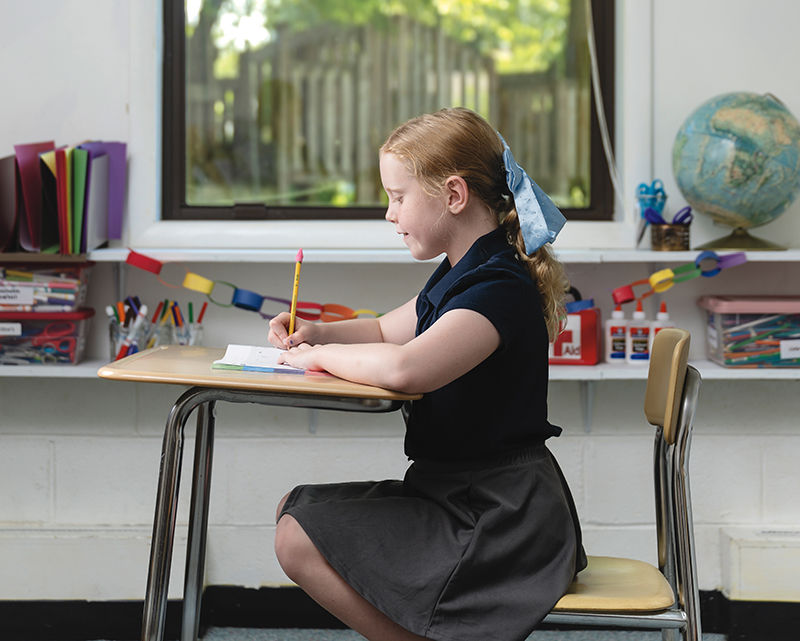
To gather data, researchers are conducting both controlled laboratory studies and observations in real classrooms. In the lab, children engage in familiar activities such as drawing, reading and puzzles while researchers adjust lighting conditions and monitor responses. Observers track behaviors such as blinking, repetitive movements and attention to windows to better understand how changing daylight conditions may influence behaviors, comfort and engagement. In schools, researchers observe students in their everyday learning environments.
“Conducting research in both settings is important because in the controlled experiments we understand the fundamental mechanisms,” Tzempelikos said. “In the classroom, we can observe children in their natural setting to see whether they display similar patterns of behavior.”
The project emerged from a gap Tzempelikos and his collaborators observed in both research and practice. While designers and educators have long recognized that autistic children may be sensitive to lighting conditions, little evidence exists to guide decisions about daylight in classrooms. In visits to schools, the research team found a wide range of approaches — some facilities kept blinds closed throughout the day, while others allowed direct sunlight into learning spaces with few controls.
Researchers hope the study will move the conversation beyond assumptions and provide data-driven recommendations that balance sensory comfort with the well-documented health benefits of daylight exposure.
Learning across disciplines
Postdoctoral researcher Sichen Lu (BSCE ’18, MSCE ’20, PhD ’25) said the project also demonstrates the value of interdisciplinary collaboration.
“Projects like this allow students to see how engineering research connects directly to people’s lives,” Lu said. “We worked closely with researchers at Ball State who study autism behavior, which gave us perspectives we would not normally encounter in a traditional engineering project.”
That collaboration required students to move beyond building performance and environmental measurements to consider human-centered outcomes.
“As graduate students, we learned how to communicate across disciplines and work with partners who approach problems from very different backgrounds,” Lu said. “Those experiences help prepare us for future research and industry careers where complex challenges rarely fit within a single field.”
Students on the team also learned about the realities of conducting community-based research. The project required partnerships with schools, autism-support facilities and families, along with months of data collection in both controlled and real-world settings.
“It was rewarding to see how many people were interested in helping make this work possible,” Lu said. “It showed us how research can bring together different expertise to solve problems that matter to communities.”
For Tzempelikos, that interdisciplinary approach reflects the broader mission of architectural engineering.
“Buildings are built for people,” he said. “We need to maintain a healthy, comfortable and efficient indoor environment for everyone.”
The first-of-its-kind study could help schools create spaces that better support learning, health and well-being — one window, and one beam of daylight, at a time.