
Demolition Drives Discovery
Rare full-scale bridge test improves future infrastructure safety and resilience
Sometimes the best way to make a bridge safer is to blow it up.
In the winter of 2025, Lyles School of Civil and Construction Engineering researchers had the rare opportunity to test a working bridge to the extreme. The team, led by Professor Robert Connor, worked with a contractor who installed explosive charges to the recently decommissioned Black Hawk Bridge to study how to evaluate and design stronger bridges in the future.
“There have only been a handful, maybe three in the U.S., of real-world tests at this scale,” said Connor, the Jack and Kay Hockema Professor in Civil Engineering and Director of Purdue’s Center for Aging Infrastructure (CAI) and the Steel Bridge Research, Inspection, Training and Engineering (S-BRITE) Center. “We almost exclusively have to rely on computer models when it comes to studying and predicting bridge failure — which are great tools, of course — but to actually learn in real-time and see exactly what happens to a working bridge when it receives major damage in specific areas is invaluable.”
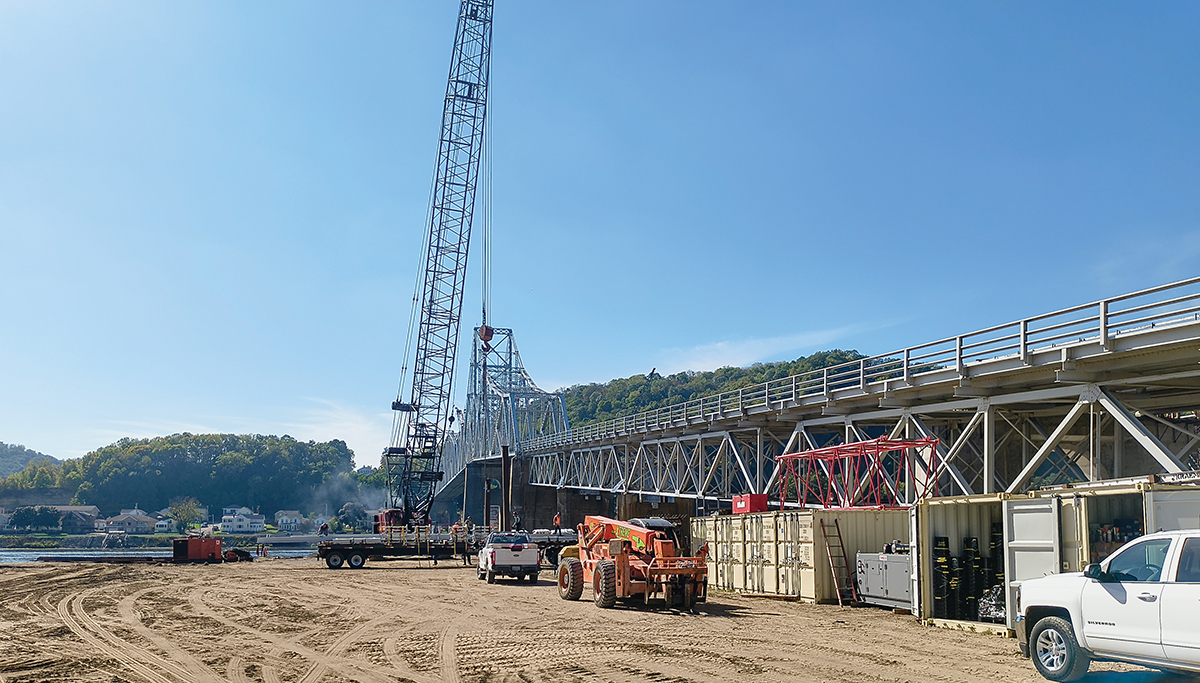
The Black Hawk Bridge was a historic structure that carried Iowa Highway 9 and Wisconsin Highway 82 traffic across the Mississippi River, connecting Lansing, Iowa, to Crawford County, Wisconsin. Constructed in 1931, the bridge spans 1,630 feet and is comprised of cantilever through truss main spans along with five steel truss approach spans and one multi-girder approach span.
Connor’s team first loaded one of the truss approach spans with a total of 125,000 pounds of sand to simulate active traffic weight, then installed explosive charges to create a controlled fracture on a tension diagonal member on the bridge’s south truss. To further explore the limits of the system’s redundancy, Connor’s team also removed additional members from the damaged south truss.
While the team is still reviewing the data, Chaz Kieffer III, PhD candidate and research engineer, said one major takeaway is that the bridge has proven to be far more redundant than what any simple hand calculation or computer model predicted.
“Standard engineering assumptions dictate that truss bridge members are nonredundant, meaning we should expect a total collapse or extreme displacements after failure of a primary tension member,” Kieffer said. “But the bridge performed far better than industry expectations would dictate. The bridge maintained its structural geometry with negligible deflection, providing clear evidence of the uncredited redundancy inherent to the overall system.”
In addition to gaining greater insight on the true strength of the bridge, Connor said this experiment also will greatly improve future computer models.
“Being able to use real-world, proven data to strengthen our computer models will be something civil engineers the world over can benefit from,” Connor said. “With this new calibration data, the industry will gain further confidence in the complex analytical models used for such evaluations. This will allow more widespread use of such tools and a better understanding of bridges under extreme conditions. The overall result is a more reliable and robust transportation system and a better use of limited resources, which is critical as infrastructure continues to age.”
The project was made possible through a highly successful collaboration between Purdue University, Kraemer North America, VEIT, Genesis Structures, the Iowa Department of Transportation and the Wisconsin Department of Transportation.