
MDE seniors showcase capstone innovation at 2026 CoE Design Expo
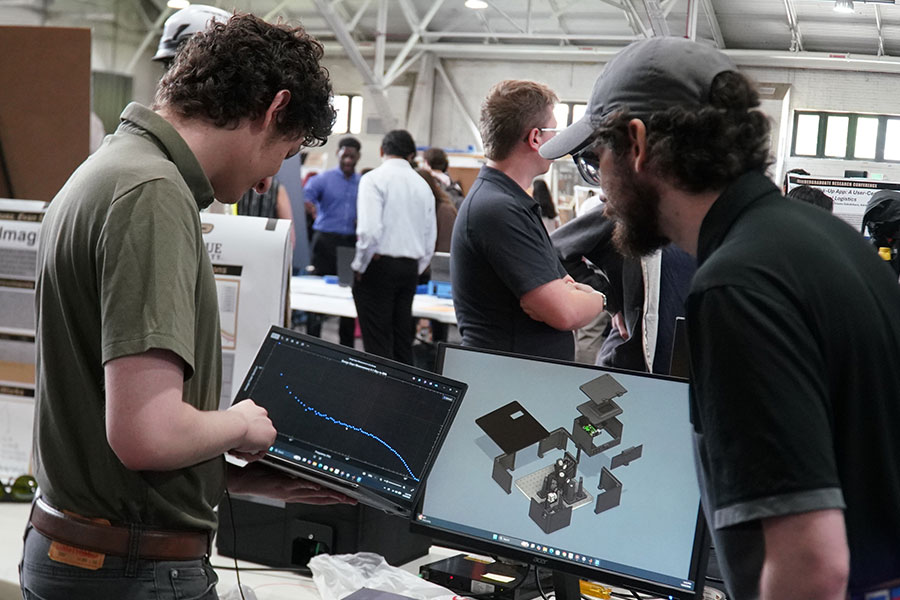
Multidisciplinary Engineering (MDE) students at Purdue University presented their senior capstone projects at the 2026 College of Engineering Design Expo, held in the Armory on Wednesday, August 29. The event highlighted a diverse range of student-led innovations, demonstrating the program’s emphasis on hands-on, multidisciplinary design and real-world problem solving.
Capstone Design is the culminating academic experience for MDE students. As a graduation requirement, students must complete an approved capstone course on Purdue’s West Lafayette campus with a grade of C- or higher. These projects challenge students to apply engineering principles in open-ended contexts, often involving industry partners, community stakeholders, or emerging global needs. MDE capstone projects are intentionally multidisciplinary, requiring collaboration across technical and non-technical domains. Students work in diverse teams to identify user needs, define design criteria, and develop solutions through research, prototyping, testing, and iteration. The result is a portfolio of work that reflects both technical depth and practical impact.
Featured projects from the 2026 Expo include:
Classroom CubeSat Learning System (Team STEMSats) — A low-cost, modular, CubeSat-inspired platform that brings hands-on space systems learning into K–12 classrooms. Using an Arduino-based core with interchangeable sensors, the system enables students to conduct mission-style activities such as data collection, analysis, and transmission in a scalable, classroom-ready format.
Animatronic Engineering Outreach Mascot (Team Purple) — An interactive, animatronic purple squirrel designed to serve as an ambassador for Purdue’s Multidisciplinary Engineering program. The system integrates motion, audio, and offline Q&A capabilities to engage visitors while demonstrating the integration of mechanical, electrical, and computing systems.
Portable Biodynamic Imaging System (Team Otics) — A compact imaging system that simplifies complex optical setups, allowing biologists to measure intracellular motion without specialized optics expertise. The design improves usability, alignment, and portability while maintaining accuracy for applications such as chemotherapy response prediction and IVF embryo selection.
Treble Clef Learning Game for Early Readers (Team REED) — An interactive educational toy designed to help young children, including those with dyslexia, learn to read treble clef notes. The system uses illuminated prompts and responsive feedback to create an engaging, accessible music-learning experience for early learners.
Adaptive Wheelchair Stability Strap System (Team Iterator-Inators) — A modular, adjustable strap system designed to improve stability, comfort, and performance for wheelchair basketball athletes. The system incorporates ratcheting waist belts, modular supports, and custom mounting components to enhance usability while remaining lightweight and cost-effective.
Each project reflects the defining attributes of the MDE Capstone Design Challenge: open-ended problem solving, multidisciplinary collaboration, and the development of evidence-based solutions. Students are expected to address complex design challenges by identifying stakeholders, working within constraints, and delivering functional, well-supported outcomes. The annual Design Expo provides students with an opportunity to present their work to faculty, industry representatives, and the broader community, underscoring Purdue’s commitment to preparing engineers for professional practice through experiential learning.
See MDE Capstone projects from previous years.