Lab and Facilities
Offices. Prof. Gomez and the lab’s graduate and undergraduate researchers have office space on the third floor of Seng-Liang Wang Hall at Purdue University. The proximity of the offices facilitates day-to-day interaction and mentoring. Every student is assigned a lab desktop or laptop and has access to Purdue’s community cluster resources.
Computational resources. The lab has (1) a six-node allocation on Purdue’s Bell community cluster, 768 cores and 1.5 TB of memory in total (each node has two 64-core AMD EPYC 7662 "Rome" processors and 256 GB of memory, connected by 100 Gbps HDR InfiniBand), with shared access to eight 1 TB high-memory nodes and four nodes with two AMD MI50 GPUs each; Bell is scheduled for decommissioning in October 2026 and replacement community-cluster capacity is planned; (2) a high-performance workstation (Dell Precision 7920 Tower) with dual Intel Xeon Gold 5220R processors (48 cores), 384 GB of memory, and an NVIDIA RTX A6000 GPU with 48 GB; (3) six dual-boot Ubuntu and Windows desktops for code development and data processing; and (4) a 14-inch MacBook Pro. The group develops software for Linux, Windows, and macOS. Purdue’s community clusters are maintained by system administrators who handle security patches, software installation, operating system upgrades, and hardware repair, and research support staff provide consultation and software support.
- Dell Precision 7920 Tower (1): dual Intel Xeon Gold 5220R (48 cores, 2.2 GHz, 4.0 GHz Turbo), 384 GB DDR4, 1 TB SSD and 1 TB SATA drives, NVIDIA RTX A6000 (48 GB) and NVIDIA Quadro P400 GPUs.
- Dell OptiPlex 7000 Tower (2): Intel Core i7-12700K (12 cores, 3.6 GHz), 64 GB DDR5, 1 TB NVMe SSD, NVIDIA GeForce RTX 3070 (8 GB).
- Dell Precision 3640 Tower (2): Intel Core i9-10900K (10 cores, 3.7 GHz), 32 GB or 64 GB DDR4, 1 TB SSD, AMD Radeon Pro W5500 (8 GB).
- Dell OptiPlex 5000 Tower (2): Intel Core i7-12700 (12 cores, 2.1–4.9 GHz), 32 GB DDR5, 512 GB SSD, AMD Radeon RX 640 (4 GB).
- 14-inch MacBook Pro (1): Apple M1 Max with 10-core CPU and 32-core GPU, 64 GB unified memory, 1 TB SSD.
Software. Electromagnetic field modeling: SimNIBS, SCIRun, and in-house electric field solvers. Head segmentation: FSL, ITK-SNAP, 3D Slicer, FreeSurfer, and SPM. Other: MATLAB/Simulink for general computation, simulation, data analysis, and visualization; office software (Microsoft Word, Excel, PowerPoint, EndNote); Adobe Creative Cloud; high-performance computing libraries (BLAS, LAPACK, FFTW); GNU and Intel compilers; and the software available through Purdue’s community clusters.
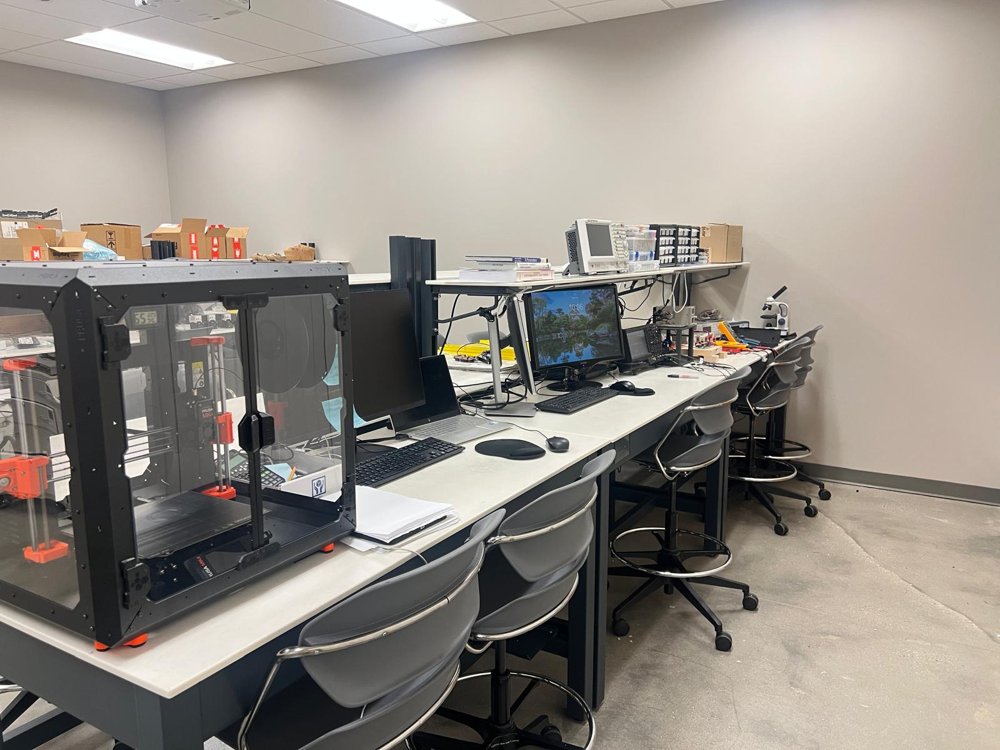
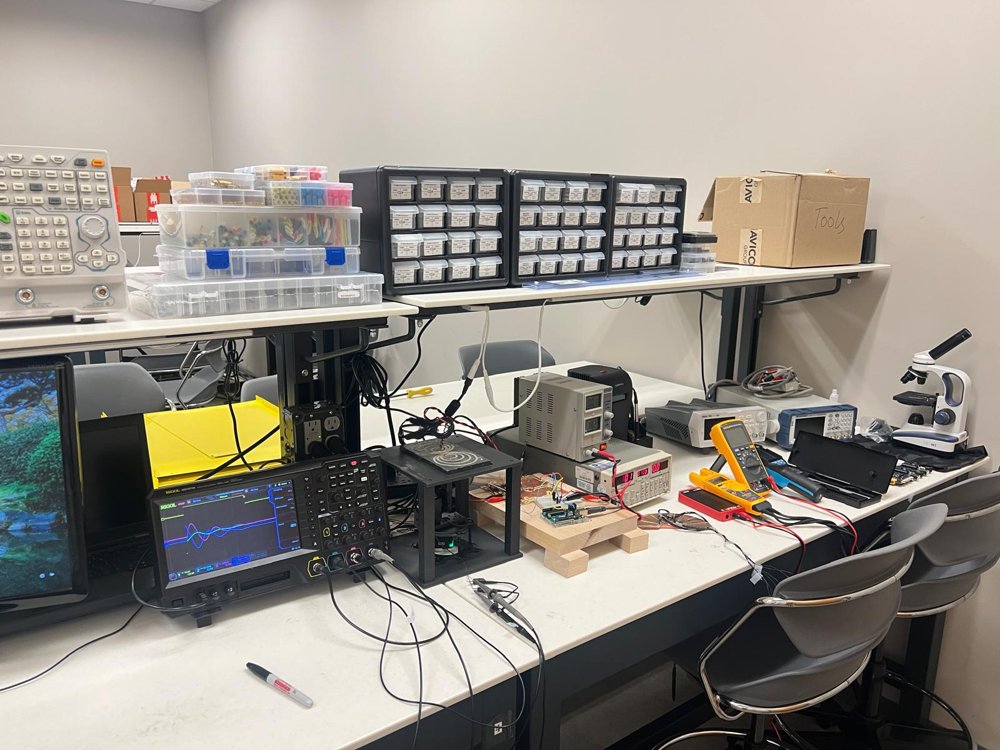
Laboratory. The Sublime Lab has a small laboratory for developing prototype brain stimulation devices and performing validation experiments. It exists primarily to enable closer collaboration with experimentalists and to validate device designs (see TMS system design and fabrication). Equipment includes:
- Stanford Research Systems PS350 high-voltage power supply (5 kV, 25 W).
- BK Precision 891 LCR meter (300 kHz).
- RIGOL DG852 function generator (35 MHz, 125 MSa/s).
- RIGOL MSO5104 digital oscilloscope (4 channels, 100 MHz).
- MX-5200 soldering and rework system, ANENG 621A smart multimeter, and Fluke T6-600 high-current sensor.
- VE-M1 microscope.
- V303-SU immersion ultrasound transducer (1 MHz, 0.50 in. element diameter).
- Servo-motor-driven spherical phantom probe for measuring the electric fields induced by magnetic coils.
- TMS coil drivers and coils, a 3D printer, a heat gun, lumped circuit elements (resistors, inductors, capacitors, operational amplifiers), standard hand and power tools, and safety equipment.