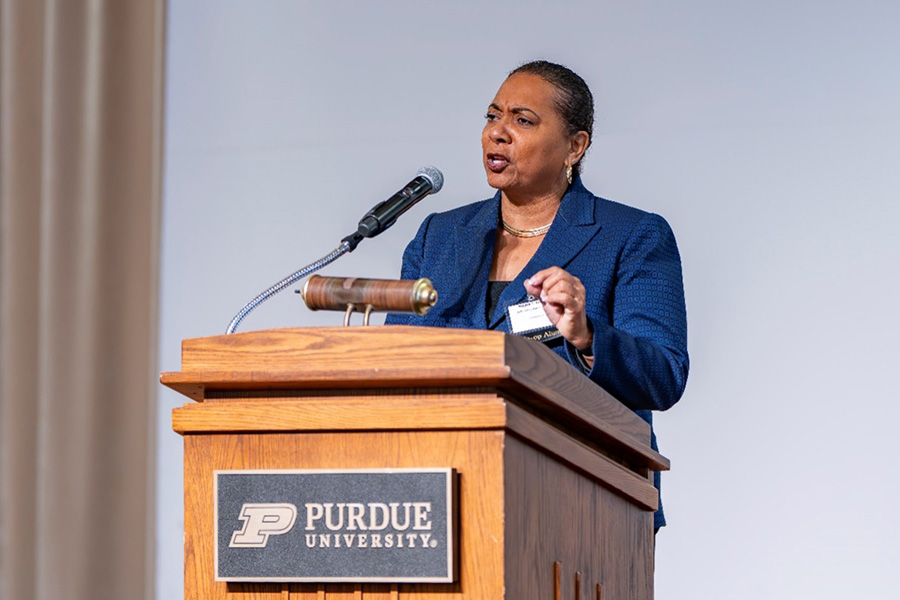
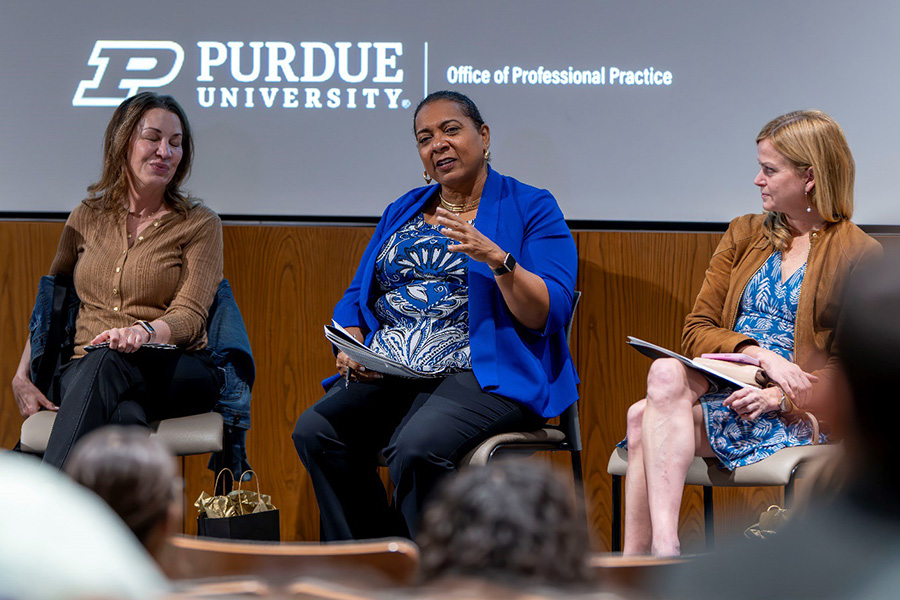
Angela Jenkins Inducted into 2025 Professional Practice Hall of Fame
“Prepare, learn, and then when life happens, be resilient and rise to the occasion.”
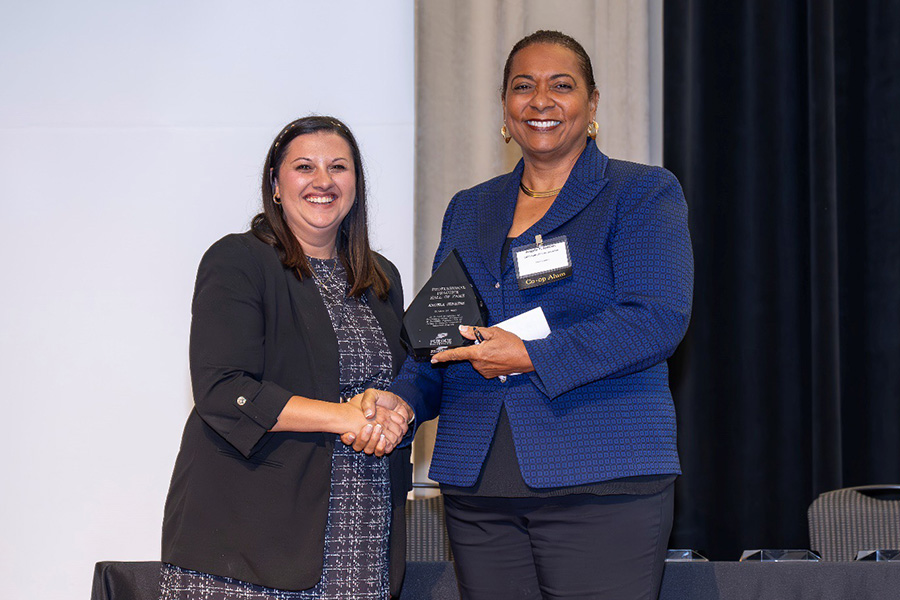
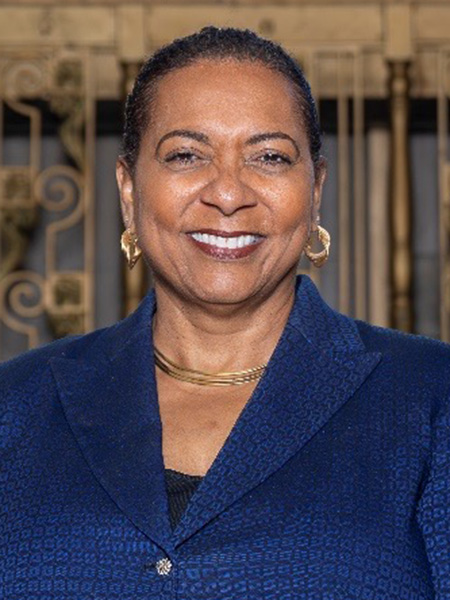
2025 Professional Practice Hall of Fame inductee Angela Jenkins shared this personal adage to encapsulate her career.
As a Purdue Engineering alumna, Angela Jenkins was nominated for the 2025 Professional Practice Hall of Fame by the School of Sustainability Engineering and Environmental Engineering (SEE), of which she was a founding member, and the School of Chemical Engineering from which she earned her Bachelor’s degree and was a co-op.
This year, eight alumni were honored by the Office of Professional Practice (OPP) for contributions to Purdue University's Cooperative Education Program with significant influence on OPP’s programs, “serving as ambassadors of the opportunities that experiential education grants.”
Angela Jenkins’ Professional Background
-
Angela’s Purdue influence began in 1988 when she earned a Purdue University B.S. in Chemical Engineering. One year later, she earned a Purdue M.S. in Environmental Engineering. Since graduating, Angela has served as a Mentoring Task Team Leader and Ethics Seminar presenter for Purdue Environmental and Ecological (EEE) courses. She is a member of the Purdue University President’s Council and has been part of the EEE External Advisory Council since 2015, serving as Chair and Chair Emeritus. She was also a member of the Purdue University Civil Engineering Industrial Advisory Board from 1997 to 2006, serving as Vice President for two years.
Angela shared that throughout her life, she has strived to continuously grow and be the best she could be: “I competed with myself to be my best throughout my life and career,” said Angela.
That personal commitment has led Angela to great success. One of her proudest memories is when she had the opportunity to pitch a solution to the EPA about how to handle a particular type of hazardous waste at superfund sites. It was a very difficult project, and the EPA had turned down numerous other proposals from major environmental companies, but liked Angela’s idea.
Angela’s immense professional impact includes roles with SABIC, Ascend Performance Materials, and DuPont. She has received more than 20 professional commendations, including recognition from the United States Department of Homeland Security, Board of Directors’ Safety awards, and multiple Governor’s Environmental Excellence Awards.
Prior to retiring from her more than 40-year career, Angela served as the Global Director of Environmental and Regulatory Affairs at RPM International, directing environmental, health, and safety strategies across six continents and improving program rigor for over 400 manufacturing plants around the world.
Angela is the founder and president of Jenkins EH&S Consulting, LLC, a nationwide EHS&S strategy and risk-management consulting firm established in 2017. During this time, Angela has guided Fortune-10 companies and startup clients to achieve world-class compliance and sustainability goals.
Angela Jenkins’ Inspiration
Angela believes that “life is about how you approach and overcome challenges.” Now retired, Angela is preparing to write a biographical fiction, based on her mother and her, and plans to start it by sharing how her mother taught her to “fight the good fight.”
Angela shared memories about growing up in a single parent home after her parents divorced. She helped her mom study to become a nurse, and saw her mother demonstrate the importance of hard work, resilience, and determination.
“My mother said I was born happy. I have found that there is strength in a good attitude. As someone who was often the youngest, only Black person, only woman, or only Black woman in the room in the classroom and at work, I routinely faced racism, sexism, and ageism, but I learned from my mother to be resilient, to keep striving and to excel beyond the limitations others tried to impose on me; to not let their limitations become my limitations. She said, “The day might come when all people will be paid equally and treated fairly, but in the interim, you still have to a life to live. Keep doing your very best and stay positive.”
Angela said, “I didn’t know it at the time, but we were very poor. I grew up in what is today among the poorest zip codes in Indiana (46803). Nonetheless, I was in the top 1% of academic performers in my 8th grade class of about 300 students, and that opened doors for me to attend one of the programs offered by Marion Blalock, Director of Minority Engineering Programs at Purdue. It was an Introduction to engineering program for minorities, and I attended it that following summer (1978). It was then that I learned what an engineer was and decided to become one. I continued to excel in school and was later accepted into Purdue and Princeton Universities for college. I chose Purdue because it was both closer to home and had a co-op program. My high school academic performance and leadership skills had opened doors for a co-op position that started the summer after high school. It was a Chemical Engineering Co-op position with Central Soya, Inc., and it continued through college. It changed my life by enabling me to earn the money to pay for my college education and giving me immense practical experience as the company was bought twice by other companies while I worked there as a co-op; and some projects, once led by full-time engineers, were given to the me after staff reductions.”
The circumstances that led to that co-op position were serendipitous. In early 1982, there was a devastating flood in Angela’s home town of Fort Wayne, flooding many homes; including Angela’s mother’s home. The family’s electric stove had not gotten wet, yet some of the cooking eyes were not working because they had been gnawed through by animals that had entered the home during rising flood waters. Angela did most of the cooking for the family so one day when her mother was at work, Angela disconnected the stove, took off its back panel, and applied what she learned in her 8th grade summer engineering program experience at Purdue to splice the electrical wires together and make the stove once again operational. This experience summarizes how Angela lived her life; learn, and then apply your learnings to solve real life problems. That is how she encourages others to approach their academic and professional journeys.
“People who can take what they learn in today’s classrooms, retain it, and then apply it to tomorrow’s problems, are invaluable. Back in 1982, I was just interested in getting the stove to work so I could cook food; but how I applied in 1982 what I learned at Purdue in 1978 to get the stove operational, impressed Central Soya so much that they offered me a co-op job the summer before I started college at Purdue. Today, I know as an engineer and leader, if a future engineering student, who had already been accepted at Purdue, came to me and shared how they used what they learned in an 8th grade summer engineering program to solve a real-world problem in their environment, especially 4 years later, I would hire them on the spot for a co-op position, too!”
Angela Jenkins’ Advice for Students & Future Environmental Engineers
Angela said she is humbled and honored by the 2025 Professional Practice Hall of Fame induction award. “It is both awesome and surreal!”
She believes that she has reached this point in her life and career because she has stood by key principles that she outlined early on.
“Even though I was a Chemical Engineering Co-op, I found during my co-op experience that my greatest satisfaction came when I was doing Environmental Engineering. To me, it felt like “noble work” and that energized me because even the bag lady and homeless man enjoy having clear air to breath and clean water to drink, and I felt like I was helping deliver that to them as well as to others.
To students and future environmental engineers, Angela shared seven important encouragements.
-
“Follow your passion. People who are passionate about their work enjoy their work more; plus, they are sought after by companies.”
-
“Look at things from different angles when trying to solve a problem. Seek feedback and seek to truly understand the other person’s opinions as much as you understand your own.”
-
“Position yourself to exceed expectations. Don’t be afraid of being the first to take on new challenges; unless you’re the lead dog, the view never changes.”
-
“Be an active learner throughout your life. Engineers solve society’s problems; to do this consistently, they must always be actively learning.”
-
A good solution is a holistic solution. Don’t create more problems with your “solution”; rather really solve a problem in its entirety.”
-
“Know when and how to leave a role. Do what you can to save a year’s salary. That way, if someone asks you do to something that is not aligned with your ethics and values, you can leave and still pay your bills while you seek other employment. To do this, you need to understand who you are and what you stand for. What are your ethics and values? Do you have the conviction to stand by them? In environmental engineering, standing by your ethics and values is crucial. To truly live your ethics, you must have both the ability and conviction to pay the price that they will cost you.”
-
“Seek good mentoring relationships. Listen to mentors. They can help you see further down the road.”
Angela Jenkins’ Cherished Mentors
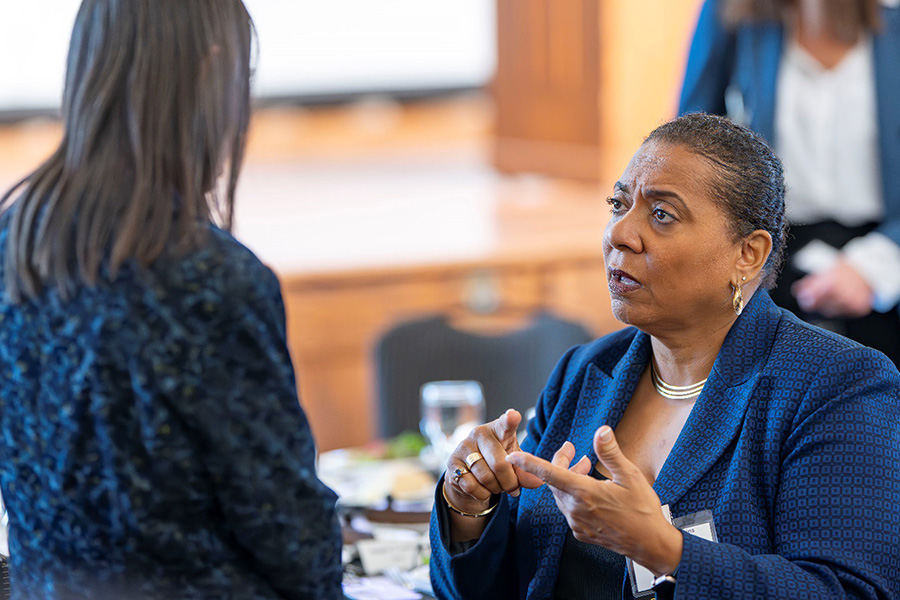
The advice to seek mentors and listen to your mentors is something that Angela has done her whole career. Angela had strong technical skills as a result of her education at Purdue and her life-long learning philosophy, nonetheless she sought mentors in technical and non-technical areas. She gave insight into the impact that three very significant mentors had on her life and what they taught her about targeted mentoring, work-life balance, leadership, and humanity.
“Deborah (Deb) Grubbe is one of the first people who comes to mind from my first year in DuPont. I met her through a DuPont Engineering network. She was one of those people that I could reach out to for advice throughout my career when I needed mentoring on a specific issue (“targeted mentoring”). We might not talk for years, yet we always could pick up wherever we left off. It seemed that she would show up in my life at important times and mentor me. She was incredible.”
Barbara Tompkins-Brown was one of Angela’s managers early in her career. Barbara was also a role model and mentor. From her, Angela learned about the importance of compassionate leadership and work-life balance.
“Barbara had remarkable work-life balance; she was a woman, engineer, Black, business leader, mother, wife, community leader and an incredible role model for me to have early in my career. Watching her, I came to more fully embrace, that like Barbara, I too could have it all. In addition to that, Barbara lead with a capability, presence, and compassion that I later emulated into my own management style. She was an incredible leader who thought outside-of-box to help and lead her team. During a critical time in my life when my grandmother was terminally ill, Barbara allowed me to take my paid “death in the family” time off to visit my grandmother before she passed. She didn’t have to do that, but the humanity she showed was priceless to my grandmother and me. Because of that, she became more than my manager; she became a person I would support in any way, even today.”
The theme of humanity remained important to Angela in her experience.
“When I was an Environmental Manager of DuPont’s largest site environmental group and John B. (JB) Taylor was my manager, I went through five major life-changing events in less than a year. Through this, he would just come by my office sometimes and just sit and listen. Sometimes mentors just listen; they don’t always have the answers or tell you what to do. Sometimes they are just sounding boards and ask the questions that help you find the path that works best for you. He was present. His presence was compassionate and human. He lived the example that said, “employees are still people; they have life going on every day”. He led by example that relationships and humanity matter.”
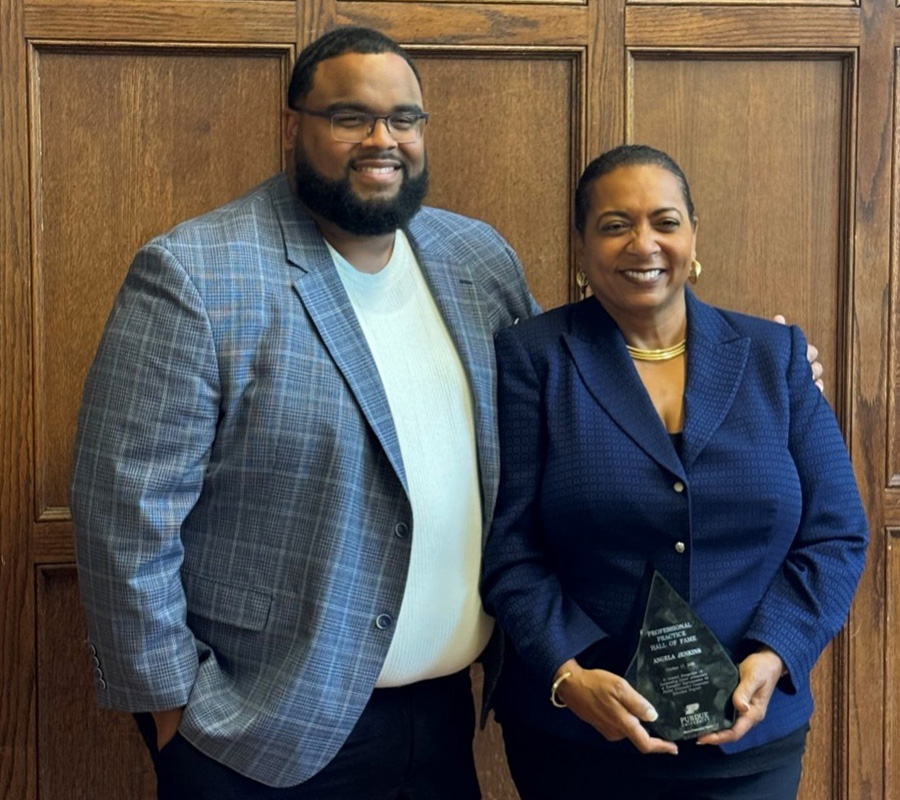
After being inducted into the 2025 Hall of Fame, Angela contacted JB to share the news. He was delighted for her and very proud, and this was not the only moment that came full circle. Angela’s son DeMarkus Kirby attended the Hall of Fame Induction event along with her. DeMarkus is a Summa Cum Laude engineering graduate (B.S. Industrial and Systems Engineering) of North Carolina Agricultural and Technical State University (N.C. A&T) and a manager (Swiffer Operations Senior Manager) at Proctor and Gamble. The pride that he demonstrated for both Angela’s career accomplishments and her journey in demanding roles while raising him as a single mother was a testament to the fact that, as Barbara Tompkins-Brown demonstrated, Angela really could have it all.
“When I divorced his father, I did not know what the journey of being a single mom of a young child with a demanding engineering career, with no immediate family in the area to help out, would mean for us; but together we found out,” said Angela.
“To see the pride in his eyes as I received my award was overwhelming. I choked up as I looked at him during my speech when I thanked him for his support throughout my journey as his mother, a single mom, a community volunteer, and an engineer and leader in management in major chemical companies with demanding roles that spanned the globe. I thought about our countless memories together… [and realized] it was all those little moments that came together to create a lifetime of meaning for having my son present at this award… The pride in his eyes, knowing the journey I had ... and that we have had ... to this achievement is beyond words…”
Purdue University Impact
Of all of the remarkable mentors Angela has worked with in her career, Purdue University was, perhaps, the most impactful.
While Angela was earning her degrees, the Head of the Environmental Engineering Department Dr. James Etzel consistently went the extra mile to encourage her.
“When I was in my senior year of Chemical Engineering, he contacted me to let me know that I was only 15 credits hours away from having enough credits for a Master’s degree in Environmental Engineering. I had no idea. He convinced me to go on to graduate school. I worked my way through graduate school by being a Teaching Assistant for CE350 and CE Senior design, and became the first Black woman in the history of Purdue to earn a Master’s degree in Environmental Engineering. After graduating, he continued to mentor me for many years while I worked in industry.”
“I love Purdue. I can’t think of my career without thinking of Purdue. Purdue changed my life.”
For more information about Purdue’s School of Sustainability Engineering and Environmental Engineering, please visit: https://engineering.purdue.edu/SEE.