
From Classroom to Community: Valentina Saenz Advances Sustainable Solutions Through EEE 47200
EEE 47200: Community-Engaged Engineering and Design, led by Dr. Lindsey Payne, utilizes a transdisciplinary approach in a real-world, client-based service-learning design experience to enable students to lead, design, and implement community-based urban water projects and gain skills that will empower them to meet the accelerating need for engineers who can balance environmental responsibility and social impact.
To celebrate a Spring of Giant Leaps, SEE is taking a deep dive into the impact of EEE 47200 with a series of features documenting the work of the class. Each feature will explore student reflections and showcase weekly progress as EEE 47200 travels outside of class to community partner sites to collaborate in the design process and improve the health of the Wabash River.
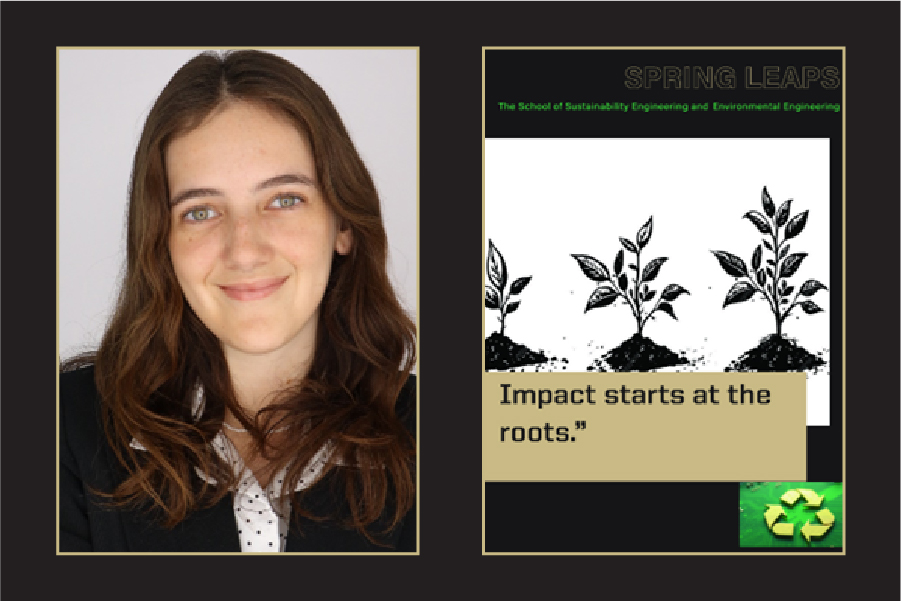
Valentina Saenz is one of twelve students taking EEE 47200 with Lindsey Payne this Spring. Saenz is an SEE international student originally from Peru who is currently a senior pursuing a bachelor's degree in Environmental and Ecological Engineering (EEE).
Saenz hopes to gain the opportunity to make a meaningful and long-lasting contribution to the environmental resilience and education of the Lafayette community, while also enhancing her communication and collaboration skills when working with stakeholders from diverse backgrounds and varying interests.
“One of my goals is to apply engineering-based decision-making to develop a final design that best meets the need of our project partners while balancing physical constraints, such as budget, space, and maintenance,” said Saenz.
Students in EEE 47200 are working in teams to accomplish course goals. Saenz is part of the team working with the St. Francis Early Learning Academy. As team roles become defined throughout this Spring semester, Valentina aims to take on a role that requires close collaboration with the team’s partners to work towards her goal of integrating client needs and priorities while creating a feasible and practical design that can be sustained for the long term.
“I hope to establish a close and respectful relationship with our community partners in order to have effective communication and collaboration,” Saenz shared.
“Ultimately, I hope to deliver a design and solution that meets their expectations, addresses the needs of the site, and is easily maintained, so it can provide lasting value for generations to come.”
Outside of this course, Saenz’s professional goals include working in environmental compliance within the industry sector.
She explained, “I am aware that this sector accounts for roughly 30% of total greenhouse gas emissions in the U.S., and I want to help reduce those emissions while supporting sustainable growth.”
EEE 47200 is helping Saenz gain the skills she needs to reach her professional goals in environmental engineering by providing outlets for real-world applications of concepts.
“My favorite part of the course so far has been engaging with our project partners in a design charrette. This experience has helped me gain a deeper understanding of the needs the project must address, as well as the limitations we will need to work within.”
On Feb 9 in Week Five of the course, EEE 472 students conducted design charrettes with Lafayette Parks and St. Francis Early Learning Academy to establish good rapport, trust, and a foundation for reciprocity.
“All engineering projects are about people and relationships,” said Lindsey Payne.
Consensus maps of potential projects and locations at each site were developed at the end of the sessions.
Saenz gave insight into the design charrette with St. Francis Early Learning Academy, sharing,
"On Monday, we had the opportunity to meet our project partners for the first time and participate in a design charrette. During this session, we asked questions to better understand the site’s stormwater management needs, as well as their expectations for the design solution. This was my first time engaging in an activity like this, and I believe it has helped me grow as a more well-rounded professional because it strengthened my ability to communicate with stakeholders, ask purposeful questions, and translate client needs into technical considerations.
Moving forward in my professional career, I plan to organize a design charrette at the start of a project that involves multiple stakeholders to ensure their input is able to guide the design process and solutions are able to more effectively serve the mission."
By the end of EEE 47200, Saenz hopes to look back and feel proud of the solution her team designed and implemented. She hopes that they are able to effectively serve their project partners and that the project can add lasting value, not only to the St. Francis Early Learning Academy community, but also to the Lafayette community as well.
When asked about the overall impact of SEE and the mission of sustainability, Saenz said that sustainability is essential to her.
“It reflects a commitment to protecting our future, supporting our communities, preserving plant and animal species, and safeguarding the natural beauty and opportunities the Earth provides. Environmental engineering is especially important because it offers a pathway for development and progress while minimizing negative impacts on Earth's environmental systems.”
Saenz expanded on the impact of SEE, adding,
“I value SEE’s commitment to developing caring, well-rounded, and highly skilled engineers. The school not only prepares its students technically, but also helps shape thoughtful, socially responsible individuals by leading through example. The faculty, and Dr. Payne in particular, foster meaningful relationships with the students, taking the time to get to know us as people - our goals, aspirations, and interests beyond academics…SEE emphasizes learning by doing, offering numerous core and elective courses that integrate hands-on projects and cross-collaboration, strengthening our technical competence and teamwork skills…joining SEE as an internation student, I've been met with a supportive and caring community. This program has given me everything I could've wished for. I've strongly developed transferrable skills for the workplace, and I've made valuable connections with faculty and my peers that I consider are for life. In SEE, I feel considered, valued, and overall, a great sense of belonging.”
Stay tuned for more impact updates from EEE 47200!
To learn more about the Purdue School of Sustainability Engineering and Environmental Engineering (SEE), visit: https://engineering.purdue.edu/SEE