
From Classroom to Community: Lillian Slack Cultivates Sustainable Impact Through Community-Engaged Engineering
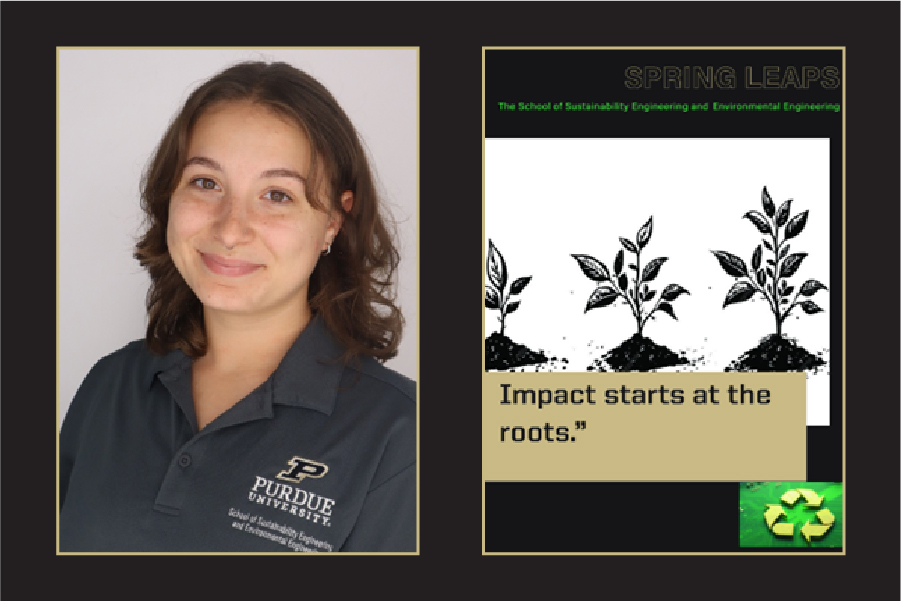
Inspiring a reciprocal spark of dedication to the earth is something that BSEEE senior Lillian Slack strives for both inside and outside of Dr. Lindsey Payne’s Spring 2026 EEE 47200: Community-Engaged Engineering and Design course.
“As someone who is passionate about our earth and seeing it thrive,” Slack shared, “I want to pass on knowledge and spark passion in our community partners, our volunteers, the local community members, and even the school kids getting to interact with our garden once it's finished.”
Lillian is on a team of six students working with community partner St. Francis Early Learning Academy to create a rain garden. Slack explained that the team has worked hard to share responsibility and alternate roles.
“We have shuffled our roles throughout the semester. In the beginning of the course, I was contributing by sharing my background knowledge on both the Catholic faith and on students below the age of 6. Our team is working with a Catholic Preschool, so having insight on both of these components was important for our team to ensure we were connecting and serving our partners as best we could.”
Communication has also been a strong skillset of Slack’s team.
“Once design begun, I became responsible for sketching the layout of the plants for the rain garden as a visual representation for our clients,” said Slack.
“We had many iterations, but through it all we had a working draft that helped us clearly communicate within our team and to our client, which really helped. Now that the team is shifting towards preparations for implementation, I have taken the role of recruiting and organizing our volunteers. This means making posters, organizing rides, and helping collaborate on the implementation plan to make sure communication between our team and our volunteers is clear.”
Slack has valued the problem-solving skills that EEE 47200 has helped her strengthen through the re-design process her team has navigated together. As the course nears completion, Lillian hopes to continue to expand her skills and achieve a finished project that will make the community proud.
Giving insight into the experience, Slack elaborated, “while we have had to redesign our garden countless times, I have enjoyed getting the experience of true iterations in a design, since in many other classes there is no time and opportunity to actually iterate with a design. It has been difficult, but ultimately worth it… [as we go forward,] I personally hope to gain real client experience along with design experience. I hope our garden implementation is successful, all plants go in the ground, our volunteers are organized well and learn something, and our partners are satisfied with our work… I hope more than anything that this rain garden causes others to think about how they can help their local landscapes and water systems.”
The reciprocal community building of EEE 47200 translates far beyond the course. After her upcoming graduation, Lillian plans to go into the Peace Corps to serve in the Philippines to conduct Coastal Resource Management work.
“My goal is to build a community there in order to make an impact.”
When asked about her connection with the SEE community, Slack celebrated her key takeaways from EEE 47200 and the friendship, respect, and core values that comprise SEE’s foundation.
“I feel I have learned so much, it would be hard to ask for more… Sustainability has always been a value I have had; it is a part of treating others with respect, to treat your shared space as something meant for everyone. So, in order to promote that idea, engineering is important. It is hard to find passion behind engineering without a purpose for it, and since I have found that passion, I see engineering as such an important tool to help sustainability grow… It is unique to get to study in college with so many classmates and professors that share values, passions, and even hobbies with you. It's hard to come into this major and not find a friend, and I believe that is because its mission is so strong and embodied within its students. Community is such an important part of sustainability and change, and it's so beautiful to get to be a part of that!”
To learn more about the Purdue School of Sustainability Engineering and Environmental Engineering (SEE), visit: https://engineering.purdue.edu/SEE