
From Classroom to Community: Hurin Hasnan Advances Sustainable Engineering Solutions
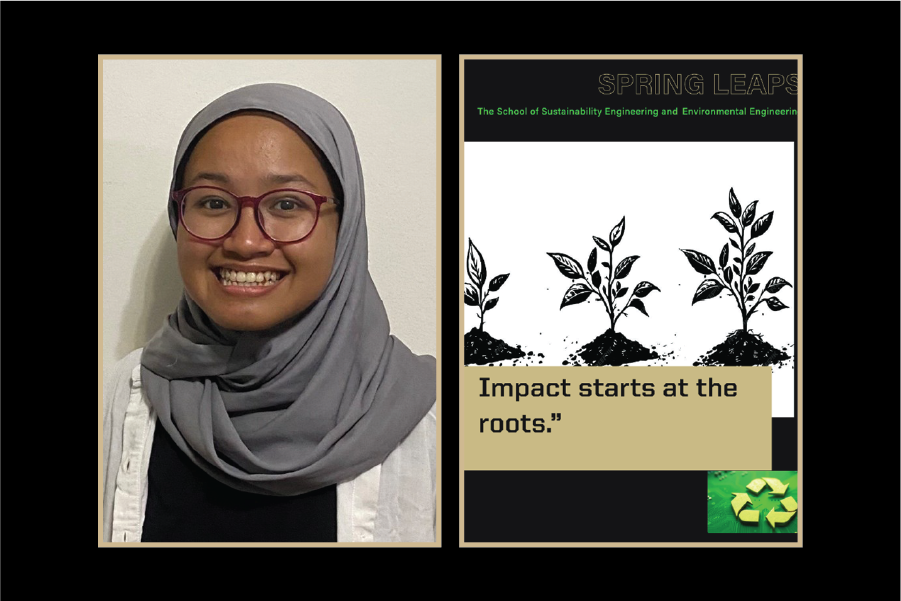
Purdue School of Sustainability Engineering and Environmental Engineering (SEE) students in EEE 47200, guided by Dr. Lindsey Payne, are currently working with two community partners (St. Francis Early Learning Academy and McCaw Park) to “demonstrate empathy and adaptability in working with teammates and stakeholders with varied skills, talents, abilities, and work strategies.”
“This [work] is the foundational basis of sustainability,” Hasnan added.
“It involves meeting the needs of today without compromising the needs of the future. Environmental engineers help immensely in remediating and reducing the impacts from existing systems, so they don't cause further damage to humans and the environment.”
Hasnan is a senior pursuing a Bachelors of Science in Environmental and Ecological Engineering. Through EEE 47200, she aspires to unlock critical consideration of the goals and constraints of communities being served through engineering projects.
“There are various trade-offs that we typically consider when designing engineering projects, but with the real-world stakes, the class serves as a challenge to meet our objectives for the class whilst also ensuring our project can serve the community effectively…My favorite part of the course so far is our time visiting the project site and thinking about the aspects we can leverage as well as the characteristics that may impact our project's design.”
Hasnan and her fellow classmates are taking Giant Leaps for Spring impact by working in teams to find innovative ways to collaborate with their community partners, rather than work for them, emphasizing the value of reciprocal partnerships. Hurin said that her team has been facilitating conversations about the project in a way that acknowledges climate change, while leaving space for consideration of stakeholders’ perspective.
Hasnan’s team is working with McCaw Park project manager Garrett Gaskins and approaching the project from various perspectives to promote the creative and innovative aspect of engineering design.
She added, “the teamwork that EEE472 nurtures sets it apart from other group projects that I have been a part of throughout college. EEE itself is a small major, and EEE472 consists of peers who enrolled in the class because we want to be there. This translates beautifully when teams are established because you can tell that everyone wants to contribute no matter the level of experience and knowledge. My team in particular consists of fellow classmates with backgrounds ranging from sustainable building design to involvement in local stormwater projects…”
Hasnan helps her team remain organized and professional by adding team assignments to their shared drive as they work on them, and proofreading and polishing the team documents. She said that the collective EEE 47200 process has motived her to always think about how the project not only enhances her own learning, but also what the community partner gets out of it, what opportunities there can be to expand the project, and how sustainability engineering and environmental engineering projects can impact the future.
“Consideration of the future is also a recurring theme in this class.”
Looking towards the future, Hurin aims to work in an environmental engineering role that focuses on either water/wastewater or air quality when she graduates. She said that environmental engineers tend to work in multiple areas, so that variety is very important to her. She wants to contribute to her local area by influencing and informing their urban planning and policies, and learn more about urban green infrastructure in smaller towns like Lafayette with the aspiration of spreading this knowledge and expertise to her own hometown in Malaysia.
As Hasnan plans for the remaining weeks of EEE 47200, her goals include successful installation of her team’s bioswale and rain garden with approval and guidance from their community partner.
“I hope our project lightens their mental load in thinking about project expansion. Our project site has several rain gardens and bioswale projects installed, so a successful extension to the existing projects in a way that is cohesive would meet the community partners' goals.”
Meeting the community partners’ goals in EEE 47200 is one vibrant component in SEE’s collective overall impact. Hurin shared that SEE's mission to understand how engineering projects impact and are impacted by the environment makes her highly value the program overall.
“It promotes circular thinking from production up to end-of-life and how certain resources can be returned to the use phase, thus reducing raw production needs. Coming from a country where manufacturing is one of the main contributors to our GDP, it is important to me that sustainable thinking is embedded into manufacturing practices.”
EEE 47200’s impact will expand even more as the teams further connect and extend academic knowledge to improve the health and wellness of the Lafayette community over the coming weeks.
To learn more about the Purdue School of Sustainability Engineering and Environmental Engineering (SEE), visit: https://engineering.purdue.edu/SEE