
First to Lead: Ehsan Vahidi Reflects on Being SEE’s First PhD Graduate
When Ehsan Vahidi arrived at Purdue University to pursue a doctoral degree in Environmental and Ecological Engineering (EEE), he joined a program that was just beginning to define itself. Today, more than a decade later, the program has evolved into a nationally recognized leader in interdisciplinary sustainability education. Along the way, Vahidi earned a distinction that will forever connect him to the program's history: he became the first PhD graduate of Purdue's EEE program.
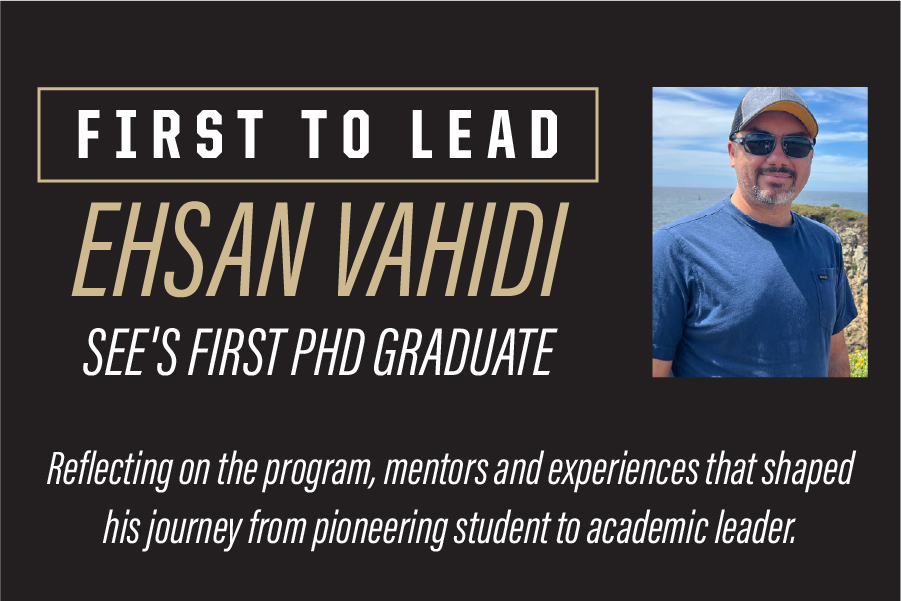
“It is truly an honor and something I am very proud of,” Vahidi said. “Being the first PhD graduate of Purdue's Environmental and Ecological Engineering program was both exciting and humbling.”
As one of the program's earliest students, Vahidi had a front-row seat to a new approach to engineering education. The EEE program challenged traditional disciplinary boundaries by integrating engineering, environmental science, systems thinking and life cycle assessment to address complex sustainability challenges.
“Looking back, I realize how visionary the program was and how well it prepared students to address some of the world's most pressing environmental and engineering challenges,” he said.
That forward-thinking foundation was a major reason Vahidi chose EEE over other engineering programs at Purdue. He was drawn to the opportunity to combine technical engineering expertise with a broader understanding of environmental, economic and societal impacts.
“I wanted to develop strong technical expertise while also understanding the broader environmental, economic and societal impacts of engineering decisions,” he said.
Equally important were the faculty members who helped shape the program and mentor its students. Vahidi credits professors Fu Zhao and John Sutherland with playing a pivotal role in his academic and professional development.
“The opportunity to learn from internationally recognized researchers such as Dr. Fu Zhao and Dr. John Sutherland was incredibly appealing,” Vahidi said. “Throughout my time at Purdue, they became exceptional mentors who shaped not only my research but also my perspective on academic leadership, interdisciplinary collaboration and building a successful career in academia.”
During his doctoral studies, Vahidi conducted research supported by the U.S. Department of Energy's Critical Materials Institute, an Energy Innovation Hub. His work focused on the sustainability assessment of critical minerals, an emerging field that would eventually become central to his career.
“At the time, I was among the first PhD students in the United States to focus on the life cycle sustainability of critical minerals and their supply chains,” he said.
The experience introduced him to the challenges of balancing environmental, economic and technical considerations in resource development. More importantly, it reinforced a systems-thinking mindset that continues to guide his work today.
“The systems-thinking approach and interdisciplinary training I received at Purdue became the foundation of my research philosophy,” he said.
Following graduation, Vahidi joined the Massachusetts Institute of Technology as a postdoctoral research associate, where he expanded his research into the environmental and economic sustainability of construction materials and infrastructure systems. The experience broadened his expertise and strengthened his ability to apply life cycle assessment and techno-economic analysis to real-world engineering problems.
In 2020, he joined the University of Nevada, Reno, where he currently serves as associate professor, John N. Butler Endowed Professor in Extractive Metallurgy and chair of the Department of Mining and Metallurgical Engineering. His research focuses on the sustainable extraction, processing, recycling and circular economy of critical minerals and battery materials, an area of growing national importance.
“The interdisciplinary perspective I gained through Purdue's EEE program continues to guide both my research and my leadership,” Vahidi said.
Although his career has been shaped by technical expertise and research accomplishments, Vahidi says one of the biggest lessons he learned came outside the laboratory.
“Graduate school is about much more than conducting research,” he said. “Building professional relationships, developing communication and leadership skills, and collaborating across disciplines are just as important as developing technical expertise.”
Looking back, he wishes he had devoted even more time to building connections across Purdue's campus and engaging with researchers from other disciplines. Those relationships, he says, often lead to the most valuable opportunities.
“One of the best decisions I made was maintaining many of the professional relationships I built at Purdue after graduation,” he said. “Those connections have continued to be invaluable throughout my career.”
For current School of Sustainability and Environmental Engineering students, Vahidi encourages them to fully embrace the opportunities available to them.
“Build a strong technical foundation, but remember that success in academia and industry requires much more than technical expertise,” he advised. “Invest in developing your communication, leadership, teamwork and project management skills, and don't hesitate to collaborate across disciplines.”
He also emphasizes the importance of networking, both within Purdue and beyond.
“Get to know faculty members beyond your research group, connect with fellow students and alumni, and actively engage with researchers at conferences and professional meetings,” he said. “The professional relationships you build during graduate school often become one of your greatest assets throughout your career.”
As SEE celebrates two decades of impact, Vahidi's story highlights the vision that helped launch the program and the lasting influence it continues to have on students and alumni. From becoming the first EEE PhD graduate to leading research on critical materials and sustainable supply chains, his journey reflects the interdisciplinary spirit at the heart of SEE.
“What began as an innovative new program has developed into a nationally recognized graduate program,” Vahidi said. “Seeing the success of those who followed makes me proud to have been part of the program's early history.”