
Building Bridges Through Sustainability
From Brazil to Purdue, one SEE doctoral student found a place to connect architecture, sustainability and engineering. Along the way, she discovered the confidence to bring new perspectives to research while helping shape more resilient communities.
After earning degrees in architecture, urban planning and sustainability in Brazil, Camila Catherine de Morais Cassundé wanted to expand her understanding of how communities, infrastructure and the environment intersect. Purdue's School of Sustainability Engineering and Environmental Engineering offered exactly that opportunity.
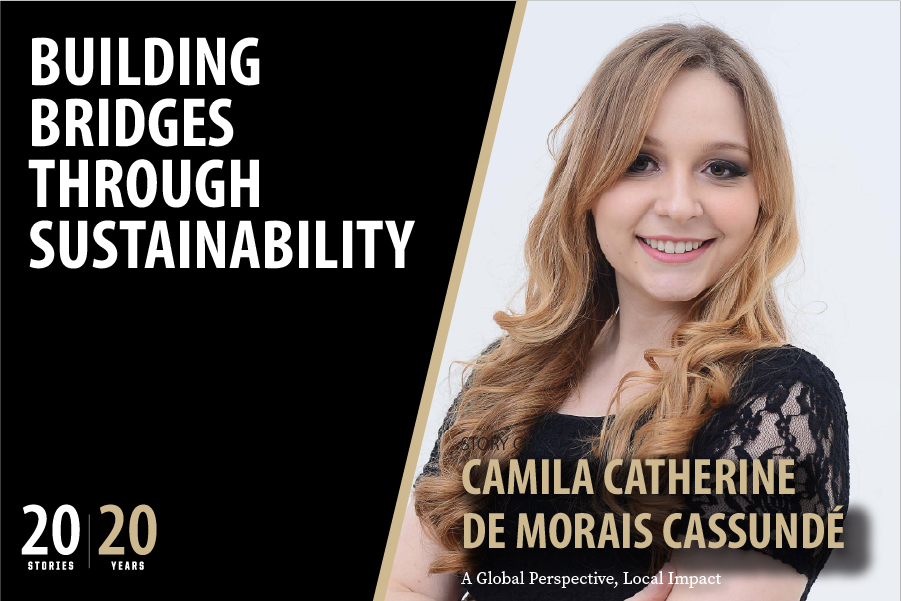
"Purdue's interdisciplinary SEE program was a great fit because it allowed me to connect my background in architecture with environmental sustainability and real-world community needs," she said.
Her path to SEE was shaped by experiences across multiple countries and cultures. Studying and working in France alongside peers from 42 countries highlighted the value of collaboration, while time in Japan reinforced the importance of community-centered solutions. Together, those experiences transformed the way she approaches sustainability.
"These experiences have led me to approach sustainability not only as a technical challenge but also as a cultural one," she said.
Those experiences also demonstrated that sustainability challenges rarely have a single solution. Different communities bring different perspectives, priorities and needs, making collaboration essential. Learning to listen to and learn from people with different backgrounds became one of the most valuable lessons of her journey.
At Purdue, joining Professor John W. Sutherland's research group allowed her to strengthen her expertise in life cycle assessment while contributing a unique perspective shaped by the built environment. Working alongside researchers from a variety of disciplines reinforced the importance of connecting technical knowledge with broader societal and environmental considerations.
One of the most meaningful moments came after completing her first research paper at SEE.
"I felt really proud and happy because it showed me I was capable of learning completely new skills," she said.
Just as importantly, she realized her experiences in architecture, planning and sustainability brought a perspective that could broaden how others think about environmental challenges.
That confidence has become one of the most valuable outcomes of her SEE journey. Along with technical knowledge, she gained a stronger sense of belonging and a clearer vision for how she wants to contribute to more sustainable and resilient communities.
She also came to appreciate the value of interdisciplinary collaboration. Bringing together expertise from engineering, planning, design and sustainability creates opportunities to develop solutions that are both technically sound and responsive to community needs.
As SEE celebrates 20 years, she hopes future students leave with that same confidence.
"I hope the next generation of students gains not only strong technical and research skills, but also the confidence to see themselves as belonging in this field," she said.
For her, SEE's legacy is not only found in research and innovation, but in creating a place where people with different backgrounds can come together, learn from one another and help build a more sustainable future.