Control of Shock-Wave/Boundary-Layer Interactions by Bleed for External and Mixed Compression Inlets
Funded by NASA Ames, NASA Glenn; students: Tom Hahn, Mark Rimlinger, Yu-Liang Lin, Mark Stephens, Andrew Flores, Dave Benson, E-Jieh Teh
Our focus is on understanding the nature of shock-wave/boundary-layer interactions and their control through bleed.
Contributions made include:
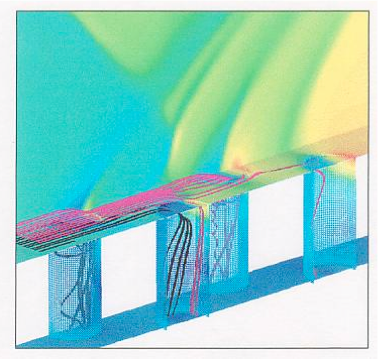
- Developed and validated CFD tools to study details of shock-wave/boundary-layer interactions with bleed in which flow through each bleed hole or slot is resolved.
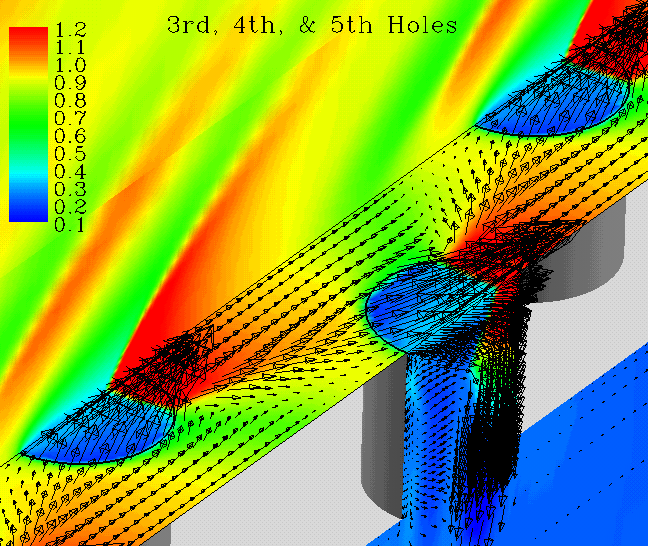
- Discovered and quantified the structure of “barrier shocks” (a name that we coined) and the mechanism that created it when bleeding a supersonic boundary layer.
- Developed design concepts that utilize the “barrier shocks” to control shock-induced flow separations in inlet bleed systems.
- Performed CFD studies to understand shock-wave/boundary-layer interactions with bleed as a function of hole arrangement, hole inclination, incident shock position, and plenum back pressure, including passive bleed and bleed through micro holes.
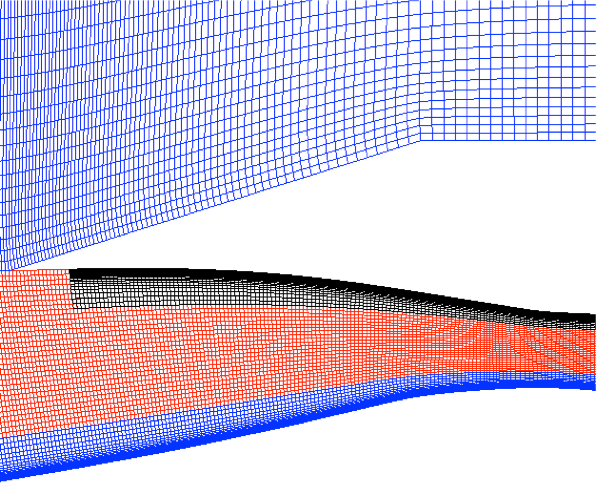
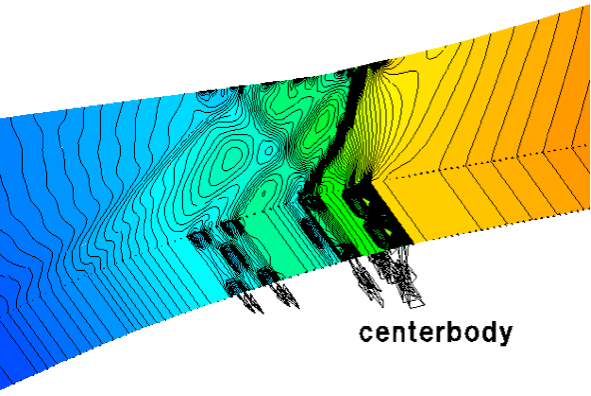
- Developed and evaluated boundary conditions for the bleed region that account for the physics of the bleed process but do not require the bleed holes or plenum to be resolved. The evaluation was accomplished by comparing predictions from bleed boundary conditions with CFD solutions that resolved the flow through each bleed hole into the plenum and experimental data when they exist.