"Navier Stokes" Solvers
Funded by NASA Ames, NASA Lewis/Glenn, ALCOA (electrodeposition), ANYSIS (multiphase flow), Ford (IC engine flows), NSF (sprays & liquid atomization)
Students: Erlendur Steinthorrson, Joe Li, Adnan Karadag, Arindam Dasgupta, Asghar Afshari; colleagues: Farhad Jaberi and Glenn Sinclair). This research is important because it determines the accuracy of the computed solutions, the efficiency with which they can be obtained, and the range of problems that can be studied by CFD.
Contributions made include:
- Developed a flux-vector splitting algorithm for conservation equations cast in chain-rule conservation-law form for spatial domains that deform in time and for PDEs that cannot be cast in strong conservation-law form (e.g., multi-fluid models of multiphase flows).
- Developed a finite-volume algorithm based on the AUSM scheme for chemically reacting flows that can handle extremely low Mach number compressible flows (pre-conditioning was found to be not needed).
- Developed a noniterative implicit algorithm for tracking particles in mixed Lagrangian-Eulerian formulations, which enables much larger time-step sizes to be used.
- Developed an approximate factorization method for PDEs with source terms, where the approximate factorization is a minimum for time-accurate simulations.
- Developed a predictor-corrector method to stabilize three-factored schemes such as the Beam-Warming approximate-factorization method.
- Developed an efficient LU factorization method for the “full” compressible Navier-Stokes equations in which the viscous terms are also factored.
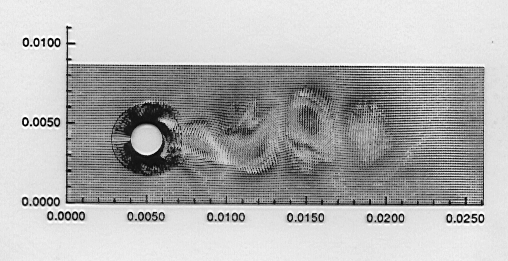
- Developed and validated several codes for computing two- and three-dimensional flows that can be compressible or incompressible, laminar or turbulent, reacting or nonreacting, steady or unsteady, and single- or multi-phase, including an algorithm and a code (developed in 1994) for the direct simulation of particle-particle interactions in which the flow around each moving particle can be resolved.
- Discovered and performed asymptotic analysis to verify stress and pressure singularities induced by steady flows of viscous incompressible fluids, where solution quality decreases as grid resolution increases.
Current research is on hybrid methods for computing turbulent flows with focus on inflow boundary conditions for LES and boundary conditions at the interface between LES and RANS.