Gas Turbine Heat Transfer and Aerodynamics
Funded by NASA Lewis, Pratt & Whitney, Siemens-Westinghouse, Solar Turbines, NSF, Exa and DOE; students: Erlendur Steinthorrson, Mark Stephens, Yu-Liang Lin, Michael Gu, Xingkai Chi, Sangkwon Na, Bin Zhu, Leo Li, Kenny Hu, Chien-Shing Lee, Saiprashanth Gomatam Ramachandran, Christelle Wanko, Srisudarshan Krishna Sathyanarayanan, Zach Stratton
Turbine efficiency increases with turbine inlet temperature. The temperatures sought today far exceed allowable material temperatures for strength and durability. Thus, effective and efficient cooling is needed for all components that come in contact with the hot gases to maintain structural integrity and reasonable service life.
Contributions made include:
- Developed and validated CFD tools for studying three-dimensional (3-D) flow and heat transfer involved in internal and film cooling of turbine blades/vanes.
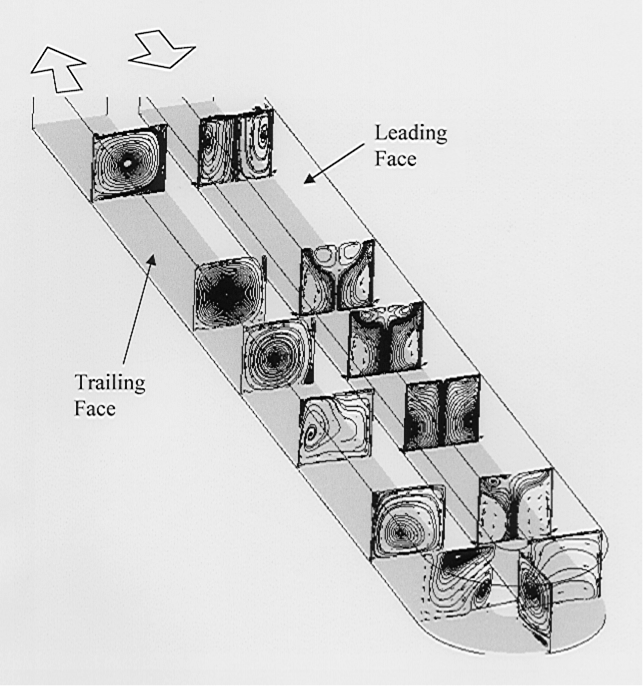
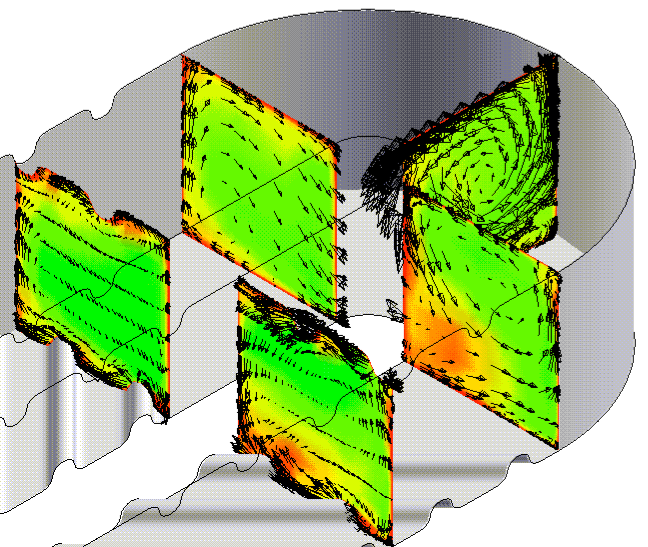
- Performed CFD studies that showed how the 3-D flow induced by heat-transfer enhancement devices (square and rounded ribs, 90 degree and inclined ribs, hemispherical concavities, pin fins, and pedestals) affect surface heat transfer in rotating and non-rotating ducts (the first to do simulations of this type that resolve the turbulent flow in the near-wall region with a low-Reynolds number turbulence model (SST) in1993 and the first to describe the flow mechanisms induced by centrifugal buoyancy in 1996).
- Performed CFD studies that showed how secondary flows formed by Coriolis force in a rotating duct interact with secondary flows formed by inclined ribs and 180-degree bends and streamwise flow separation from centrifugal buoyancy (1996).
- Performed CFD studies that showed the mechanism by which film cooling of the turbine-airfoil leading edge by rows of compound-angle holes could produce hot spots (1997) and developed a design to eliminate hot spot on the blades’ leading edges that is used in one company’s aircraft engines.
- Developed a number of design concepts to improve film-cooling effectiveness for the leading edge and the main body of the turbine airfoil (trench, strut in film-cooling holes, upstream ramp, flow aligned blockers (patented), and momentum-preserving W-shaped shape holes (patented)).
- The first to perform CFD studies that showed the mechanisms responsible for reducing secondary flows in nozzle guide vanes by contouring the endwall from the combustor to the first-stage stator.
- Develop a method to reduce secondary flows in a blade passage by blade-surface contouring (among the first to work on fillets about the leading edge) and by inlet swirl (first to do swirl).
- Developed a design of experiment technique based on the Biot number analogy to enable experimental studies of cooling designs to be conducted at near room temperatures and near atmospheric pressures to reveal temperature distributions in turbine materials at realistic turbine operating conditions.
- Showed the effects of local Biot number distribution on temperature distribution in turbine materials with cooling on one side and external heat transfer from the hot gases on the other side and how hot spots could form.
Current research incudes:
- Understand and quantify uncertainty issues that arise from errors in experimental and computational methods as well as from reduced-order methods for systems-level analysis.
- Understand and formulate meaningful dimensionless parameters to connect measurements made under laboratory conditions (i.e., in a scaled-up model operating near room temperature and pressure and low rotational speeds) to engine-relevant conditions (i.e., “small” actual configuration operating under high temperature, pressure, and rotational speeds) for turbine cooling.
- Turbine cooling during transient operations.