
NASA Environmentally Responsible Aviation (ERA) Project
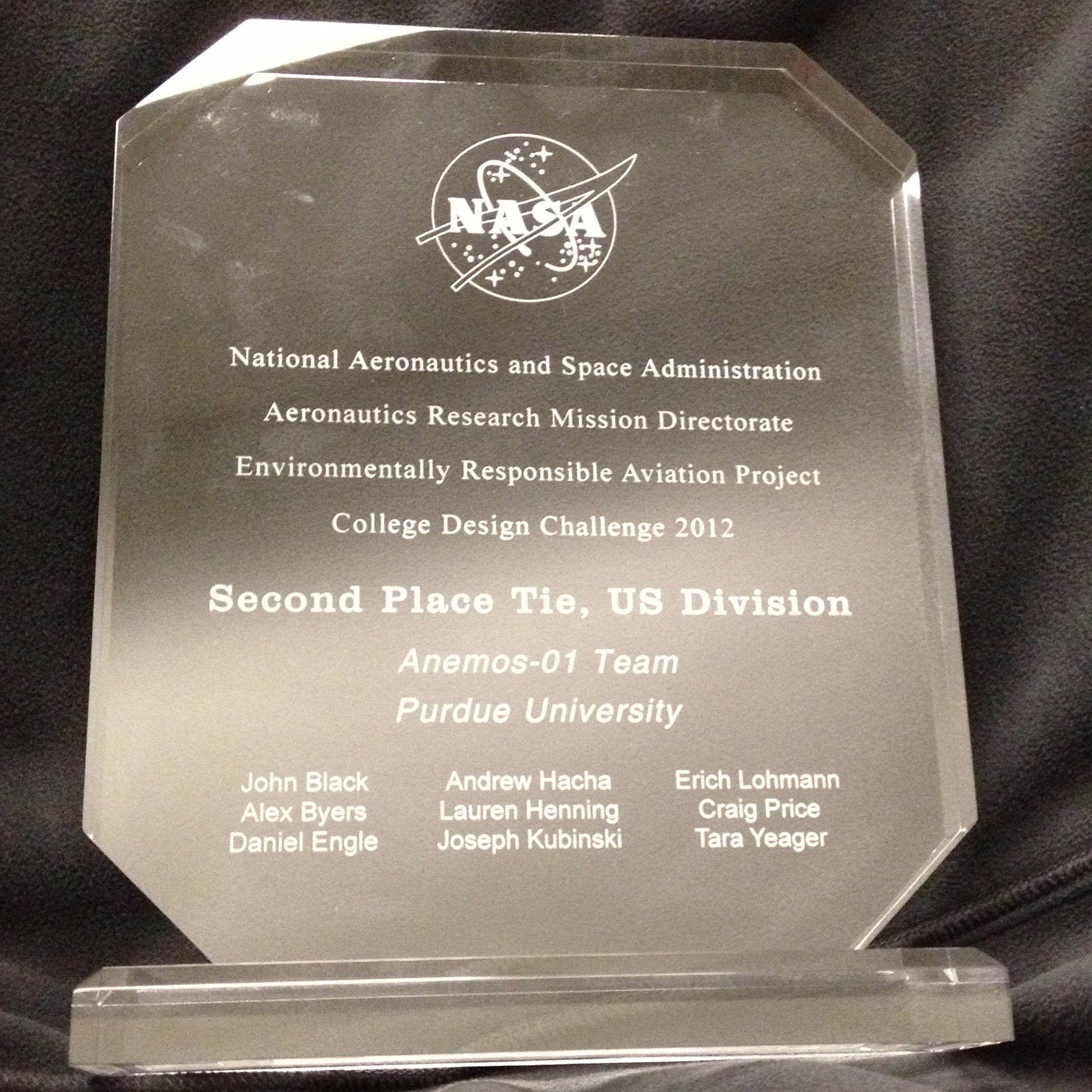
A nine student team from Purdue’s School of Aeronautics and Astronautics tied for second place in the College Design Challenge 2012 Environmentally Responsible Aviation (ERA) Project. NASA’s Aeronautics Research Mission Directorate created the ERA Project to explore and document the feasibility, benefits and technical risk of vehicle concepts and enabling technologies that will reduce the impact of aviation on the environment.
Dr. William Crossley’s Spring semester 2012 AAE 451 (Aircraft Design) class used the NASA competition as the topic for the student aircraft design project. As a result, teams in the class had the opportunity to enter the aircraft designs they generated in this NASA competition.
Members of AAE 451 “Aeolus Industries” team included John Black, Alex Byers, Daniel Engle, Andrew Hacha, Lauren Henning, Joseph Kubinski, Erich Lohmann, Craig Price and Tara Yeager. In addition to the plaque which is now on display in the School’s trophy cases in ARMS 3300, the team won a monetary award for their achievement.
Dr. William Crossley said, “I am incredibly proud that the "Aeolus Industries" team's design earned second place in this NASA competition. I think that it speaks to the quality of work that Purdue Aeronautics and Astronautics students can do in a one semester senior aircraft design course.”
The "Aeolus Industries" team worked hard to identify a set of technologies and choose an aircraft configuration that would meet a set of very aggressive targets for reducing CO2 emissions, NOx emissions and airport noise from a freighter or cargo transport aircraft. To do this, the team needed to develop an approach that could find a closed aircraft design that performed a set of design missions, while meeting constraints on performance. They needed to account for aerodynamics, propulsion, structures, and stability and control.
Team member John H. Black said, “When we heard that we received second place, the whole team was really excited. We had put many, many hours into this project and we are really happy to have our work acknowledged. Personally, I feel lucky to have worked with such great people during this project as each team member was an invaluable part of our success. I believe the advice and education received here from Professor Crossley, as well as all of our previous professors, provided us with the skills and knowledge that lead us to achieve what we did.”
The class had support from colleagues at Boeing Commercial Aircraft and Lockheed Martin Advanced Development Programs (the Skunk works), who acted as design review panelists. The panelists were tough on the students to ensure rigor of their designs and design process, and were also quite impressed with the amount and quality of work they did in one semester.