
Neil A. Armstrong BSAE'55, DEA'67, HDR'70, OAE'99, 1930 - 2012
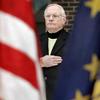 In 1969, a graduate of the School of Aeronautics and Astronautics at Purdue University became the first man to walk on the moon and arguably the most famous man in the world.
Neil Alden Armstrong was born in Ohio on 5 Aug 1930. His father worked for the state government and the family was constantly on the move as he took up new positions.
Armstrong took his first flight aged six with his father and formed a passion for aeronautics that would last all his life. His hero was Charles Lindbergh, and by the age of 16 he could fly before he could drive.
Armstrong entered Purdue in September 1947 in freshman engineering but he withdrew in January 1949, after three semesters, for military duty. He was a Naval aviator from 1949 to 1952 and flew 78 combat mission in the Korean War. He returned to Purdue in aeronautical engineering in September 1952 and he received his BSAE in January 1955. Already a decorated war hero, Armstrong became a test pilot for the National Advisory Committee on Aeronautics, NASA’s forerunner.
In 1962, John F Kennedy had promised to have a man on the moon by the end of the decade. During an earlier Gemini 8 mission, Armstrong had managed to correct a spinning space capsule and save the lives of himself and his co-pilot. He was famously shy, but his flying skills made him the natural commander of Apollo 11.
By 1969, the team was ready to fulfill Kennedy's promise. In a spacecraft which had control systems with less than a thousandth of the computing power of a modern laptop, Armstrong and his colleagues Buzz Aldrin and Michael Collins made for the moon.
More than 500 million watched every moment of Apollo 11's arrival on the lunar surface on 20 July. After steering to avoid large rocks, Armstrong had only 20 seconds of fuel left when he finally landed the module safely between boulders. From inside the capsule, he reported back to an emotional Mission Control in Houston that "the Eagle has landed".
And as he disembarked from his lunar nest, he uttered his carefully prepared phrase, that what he was making was "one small step for man, one giant leap for mankind". He was sure that he said "a man" and the "a" was intended but no one could hear it. Regardless, that phrase has gone down in history.
Instead, they watched awe-struck as, with Aldrin at his side, Armstrong planted an American flag on the Sea of Tranquility. Back on Earth, the crew received global adulation and honor, and was feted like movie stars wherever they went. But, after the initial publicity round, Armstrong refused to cash in on his singular celebrity.
The man who was revered as a hero by the American public and awarded the Presidential Medal of Freedom for his work, shunned the limelight and the prospective fortune that came with it. Instead, he lived in the seclusion of his Ohio farmhouse, taught engineering at the University of Cincinnati and later went into business.
Many students who come to Purdue, come because of Neil Armstrong. He inspired them to dream and then Purdue enabled them to accomplish their dreams. No one has walked on the moon since 1972, but, the millions around the world who sat glued to their television sets in July 1969 saw their most fantastic dreams made real. For them, the shy man from Ohio opened a fresh frontier and there will be no forgetting Neil Armstrong and his awe-inspiring achievement.