
Scientists Evaluate Martian Moon Sample to Detect Possibility of Life on Red Planet
A mission to a Martian moon could return with alien life, according to experts at Purdue, but don’t expect the invasion scenario presented by summer blockbusters like Men in Black 3 or Prometheus.
“We are talking little green microbes, not little green men,” says Jay Melosh, a distinguished professor of earth, atmospheric, and planetary sciences and physics and aerospace engineering at Purdue. “A sample from the moon Phobos, which is much easier to reach than the Red Planet itself, would almost surely contain Martian material blasted off from large asteroid impacts. If life on Mars exists or existed within the last 10 million years, a mission to Phobos could yield our first evidence of life beyond Earth.”
DETERMINING THE POSSIBILITIES
Melosh led a team chosen by NASA’s Planetary Protection Office to evaluate if a sample from Phobos could contain enough recent material from Mars to include viable Martian organisms. The study was commissioned to prepare for the failed 2011 Russian Phobos-Grunt mission, but there is continued international interest in a Phobos mission, he says. It will likely be a recurring topic as NASA reformulates its Mars Exploration Program.
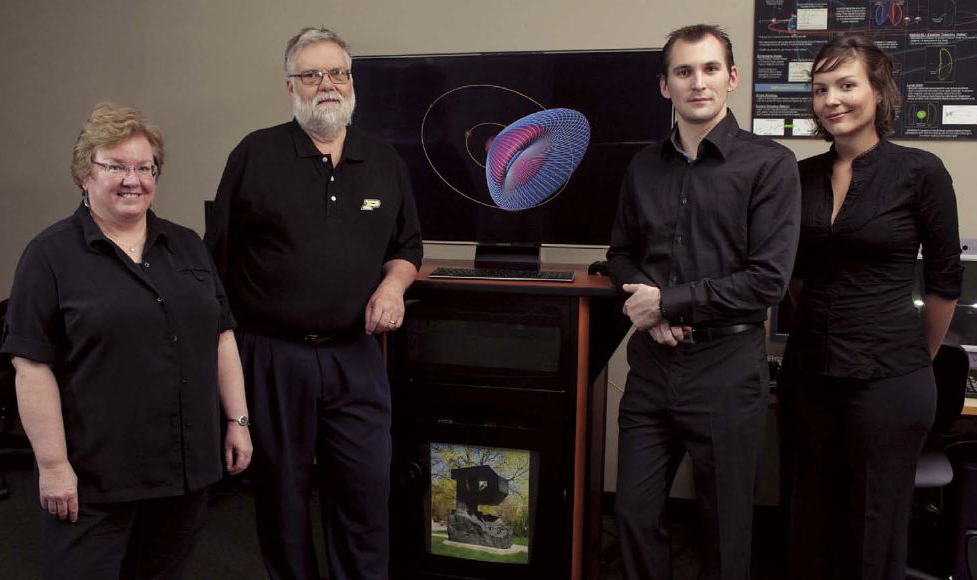
Melosh collaborated with Kathleen Howell, the Hsu Lo Professor of Aeronautical and Astronautical Engineering, and graduate students Loic Chappaz and Mar Vaquero on the project.
The researchers combined their expertise in impact cratering and orbital mechanics to determine how much material was displaced by particular asteroid impacts and whether individual particles would land on Phobos, the closer of the two Martian moons.
SMALL BUT MIGHTY
The team concluded that a 200-gram sample scooped from the surface of Phobos could contain, on average, about one-tenth of a milligram of Mars surface material launched in the past 10 million years and 50 billion individual particles from Mars. The same sample could contain as much as 50 milligrams of Mars surface material from the past 3.5 billion years.
“It is not outside the realm of possibility that a sample could contain a dormant organism that might wake up when exposed to more favorable conditions on Earth,” Melosh says. “I participated in a study that found that living microbes can survive launch from impacts on rock, and other studies have shown some microscopic organisms can tolerate a lot of cosmic radiation.”
This possibility has been a consideration for some time, and Michael Crichton’s The Andromeda Strain brought it to public consciousness in 1969. However, the movie scenario of a fatal contamination is unlikely, Melosh says.
“Approximately one ton of Martian material lands on Earth every year,” he says. “There is a lot more swapping back and forth of material within our solar system than people realize. In fact, we may owe our existence to life on Mars.”
Photo caption
NASA’s Planetary Protection Office chose a team of Purdue University researchers to evaluate if a sample from the moon Phobos could contain enough material from Mars to include viable Martian organisms. The Purdue team stands with an image of possible particle trajectories from an asteroid impact. Standing from left are Professors Kathleen Howell and Jay Melosh, and graduate students Loic Chappaz and Mar Vaquero.
Written by Elizabeth K. Gardner (this article appeared in November/December 2012 edition of the Purdue Alumnus Association Newsletter)