
Focal and deep transcranial magnetic stimulation coil design and hardware
Background. Transcranial magnetic stimulation (TMS) is a noninvasive brain stimulation technique used in research and in the clinic. Existing TMS coils are limited in the precision of their spatial targeting (focality), especially for deeper targets, and the figure-8 coil introduced in the 1980s has remained the standard focal design for decades.
Objective. Design, build, and validate TMS coils that achieve the optimal trade-off between the depth and focality of the induced electric field and the energy required to drive the coil.
Approach. A multi-objective optimization determines coil windings that minimize the volume of brain tissue exposed to a suprathreshold electric field while reaching a target at a specified depth and respecting limits on peak electric field and coil energy. Spherical and MRI-derived head models are used to map the fundamental depth–focality trade-off and the focality–energy trade-off for specific target depths. The optimized windings were then physically realized and characterized through simulation, robotic electric field measurements, and human motor-mapping experiments.
Main results. Across target depths of 1.0 to 3.4 cm from the brain surface, the suprathreshold volume can be reduced by 42% to 55% relative to existing TMS coil designs, and the volume of a figure-8 coil can be reduced by 36%, 44%, or 46% for matched, doubled, or quadrupled energy. For matched focality and energy, the stimulation depth of a figure-8 coil can be increased by 22%. The realized coils achieve more compact brain electric field distributions than conventional figure-8 coils at clinically relevant depths, while revealing practical trade-offs in scalp electric field spread, heating, energy loss, and positioning.
Significance. These coils are the first to improve focality at any fixed stimulation depth over the figure-8 coil, and the results likely represent the fundamental physical limit of the depth–focality trade-off. Their experimental validation shows that computational coil optimization can translate into human stimulation devices. Earlier work in this line includes a numerically optimized active shield and single-source multicoil designs for deep and focused stimulation, and the redesign of existing coils to reduce energy.
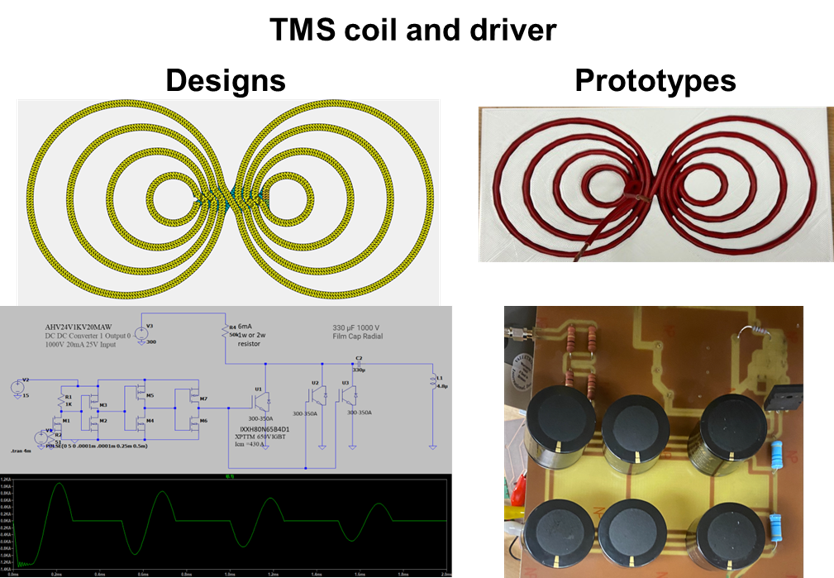
Hardware and low-cost stimulation systems. Because TMS systems are orders of magnitude more expensive than electrical stimulation systems, few neuroscience laboratories can use magnetic stimulation in cell and animal experiments. We design and fabricate low-cost biphasic stimulators and, using the coil optimization algorithms above, small coils with improved targeting and energy efficiency for rodent experiments. Coils and drivers are characterized on the bench and with a motorized spherical phantom that maps the induced electric field (see lab and facilities). A coil and pulse generator for magnetic stimulation experiments in mice have been built and characterized, and this hardware supports our collaborations with experimental neuroscientists and provides validation data for our neuron modeling.
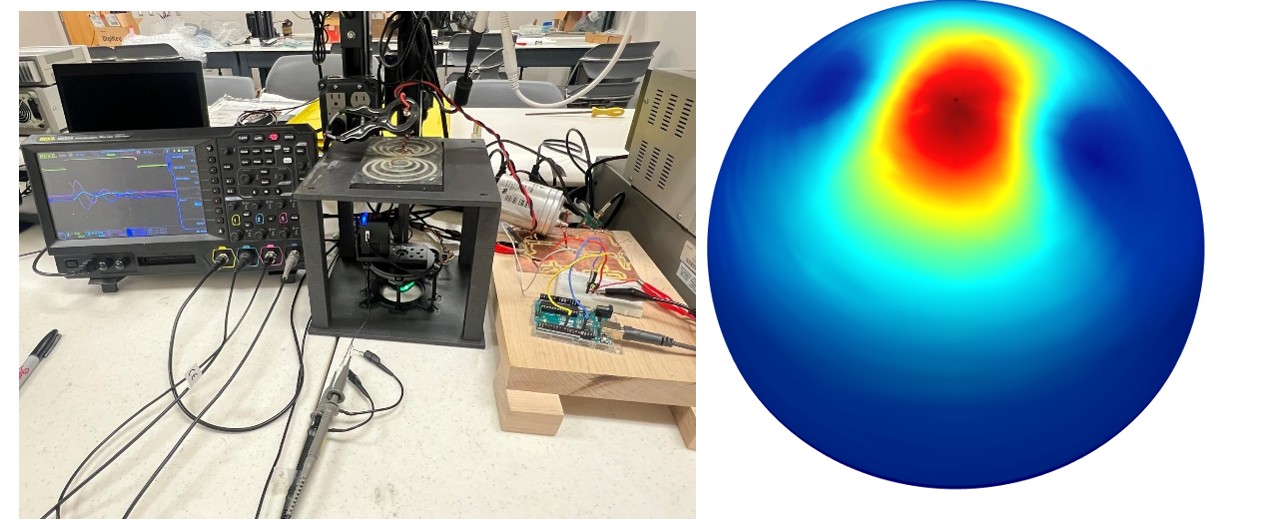
Small-animal TMS pulse driver and validation platform: the driver and coil under test with measured biphasic stimulation pulses (left), and the electric field mapped automatically over a spherical phantom (right).
Publications.
L. J. Gomez, D. L. K. Murphy, L. M. Koponen, R. Hamdan, Y. Li, E. Wood, J. Golden, N. Bukhari-Parlakturk, S. M. Goetz, and A. V. Peterchev, "Optimization, implementation, and performance of TMS coils with maximum focality and various stimulation depths," Journal of Neural Engineering, vol. 23, no. 2, pp. 026001, 2026. link
L. J. Gomez, S. M. Goetz, and A. V. Peterchev, "Design of transcranial magnetic stimulation coils with optimal trade-off between depth, focality, and energy," Journal of Neural Engineering, vol. 15, no. 4, 2018. link
B. Wang, M. R. Shen, Z.-D. Deng, J. E. Smith, J. J. Tharayil, C. J. Gurrey, L. J. Gomez, and A. V. Peterchev, "Redesigning existing transcranial magnetic stimulation coils to reduce energy: application to low field magnetic stimulation," Journal of Neural Engineering, vol. 15, no. 3, pp. 036022, 2018. link
L. J. Gomez, F. Cajko, L. Hernandez-Garcia, A. Grbic, and E. Michielssen, "Numerical Analysis and Design of Single-Source Multicoil TMS for Deep and Focused Brain Stimulation," IEEE Transactions on Biomedical Engineering, vol. 60, no. 10, pp. 2771-2782, 2013. link
L. Hernandez-Garcia, T. Hall, L. J. Gomez, and E. Michielssen, "A numerically optimized active shield for improved transcranial magnetic stimulation targeting," Brain Stimulation, vol. 3, no. 4, pp. 218-225, 2010. link
R. J. Ilmoniemi, Z.-D. Deng, L. J. Gomez, L. M. Koponen, J. O. Nieminen, A. V. Peterchev, and C. M. Epstein, "Transcranial Magnetic Stimulation Coils," in The Oxford Handbook of Transcranial Stimulation, 2nd ed., Oxford University Press, 2022. link
L. Hernandez-Garcia, A. Grbic, E. Michielssen, and L. J. Gomez, "Multi-coil transcranial magnetic stimulation," U.S. Patent No. 9,744,373, August 29, 2017.
A. Murugesan (PD), L. J. Gomez, and W. C. Chew, "Design and Characterization of Coil and its Pulse Generator for Transcranial Magnetic Stimulation Experiments in Mice," International Applied Computational Electromagnetics Society Symposium, May 2024.