
Uncertainty quantification of transcranial magnetic stimulation dosimetry: MRI segmentation errors, anatomical variability, and numerical accuracy
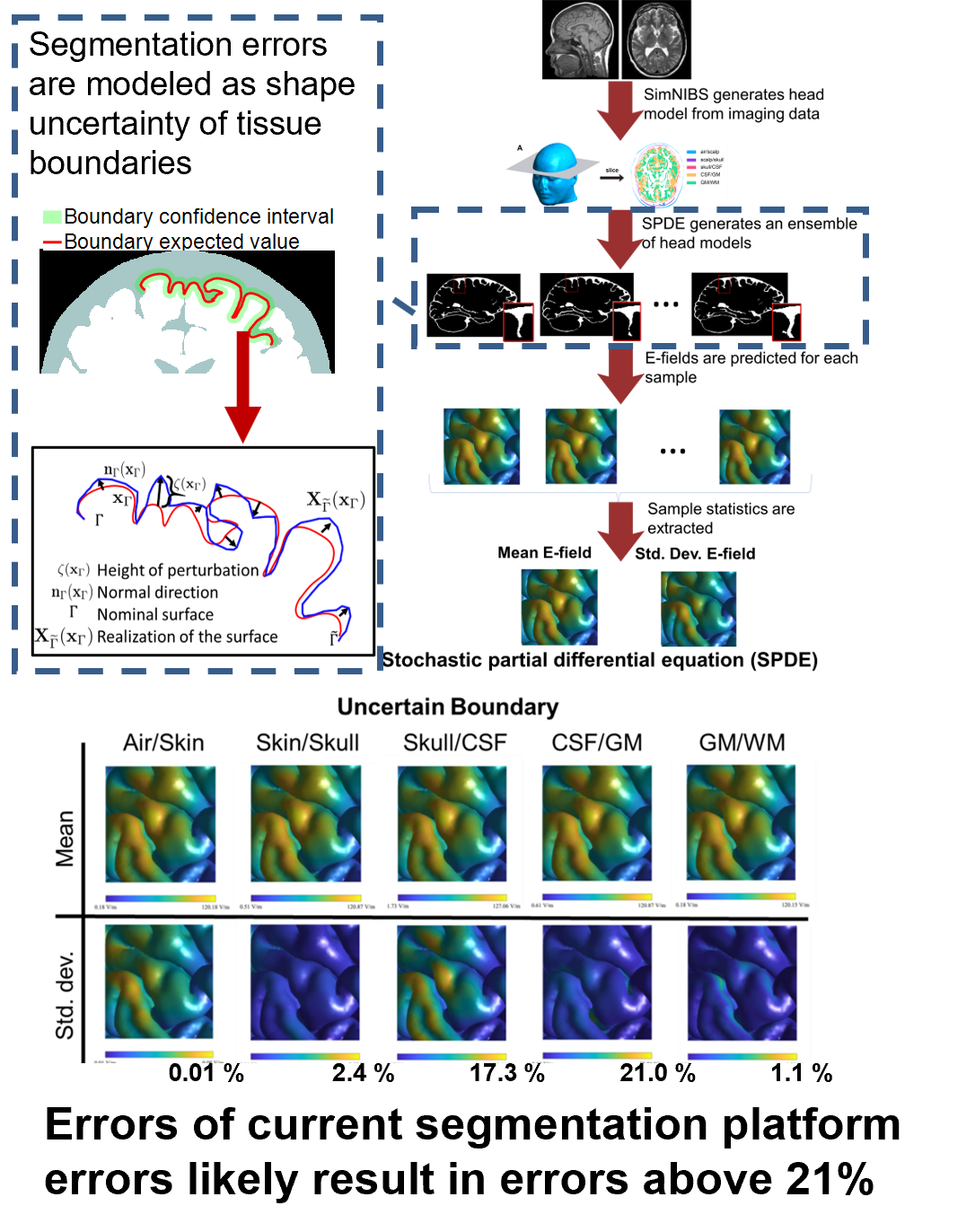
Background. Computational dosimetry of transcranial magnetic stimulation (TMS) relies on head models built by segmenting MRI into tissue compartments. Segmentation errors, anatomical variability across people, coil placement variability, and numerical discretization error all propagate into the predicted brain electric field, yet standard simulations report a single deterministic answer with no measure of confidence.
Objective. Quantify how uncertain the predicted TMS electric field is, identify which sources of error dominate, and establish modeling conditions under which simulations can be trusted.
Approach. Segmentation errors are modeled as geometric uncertainty in the shape of the boundaries between tissues using stochastic partial differential equation representations of random fields on complex surfaces. For each tissue-boundary realization an in-house boundary element solver propagates the uncertainty to the cortical electric field. Earlier work used high-dimensional model representation to propagate uncertainty in coil placement and tissue conductivity, and a systematic convergence study established the mesh resolution and solver settings needed for numerically accurate TMS electric field simulation. Population variability is handled with our fast ensemble solvers and with generative models of synthetic segmented head models.
Main results. Predicted brain electric fields are negligibly sensitive to segmentation errors in the scalp, skull, and white matter compartments but highly sensitive to errors in the cerebrospinal fluid segmentation: errors on the cerebrospinal fluid and gray matter interface produce larger uncertainty in the gyral crowns, and errors on the cerebrospinal fluid and white matter interface produce larger uncertainty in the sulci. Averages of the electric field over a cortical region are markedly less uncertain than point-wise values.
Significance. The accuracy of current cortical electric field simulations is limited by cerebrospinal fluid segmentation accuracy, which points segmentation efforts toward the compartment that matters most. Region-averaged electric field quantities offer a dose metric that is robust to plausible segmentation errors, and the convergence guidelines are used to set up reliable TMS simulations.
Publications.
H. Zhang, L. J. Gomez, and J. Guilleminot, "Uncertainty quantification of TMS simulations considering MRI segmentation errors," Journal of Neural Engineering, vol. 19, no. 2, 2022. link
H. Zhang, J. Guilleminot, and L. J. Gomez, "Stochastic modeling of geometrical uncertainties on complex domains, with application to additive manufacturing and brain interface geometries," Computer Methods in Applied Mechanics and Engineering, vol. 385, pp. 114014, 2021. link
L. J. Gomez, M. Dannhauer, L. M. Koponen, and A. V. Peterchev, "Conditions for numerically accurate TMS electric field simulation," Brain Stimulation, vol. 13, no. 1, pp. 157-166, 2020. link
L. J. Gomez, A. C. Yucel, L. Hernandez-Garcia, S. F. Taylor, and E. Michielssen, "Uncertainty Quantification in Transcranial Magnetic Stimulation via High Dimensional Model Representation," IEEE Transactions on Biomedical Engineering, vol. 62, 2015. link
N. I. Hasan (G) and L. J. Gomez, "Synthetic 2D Segmented Virtual Head Model Generation Using Generative Adversarial Network (GAN) for Population-Based E-field Dosimetry Estimation and Uncertainty Quantification," IEEE International Symposium on Antennas and Propagation and USNC-URSI Radio Science Meeting, July 2022.
L. J. Gomez, D. Wang (PD), M. Dannhauer, H. Zhang, J. Guilleminot, and A. C. Yucel, "Accurate and reliable computational dosimetry and targeting for transcranial magnetic stimulation via uncertainty quantification," Brain Stimulation (abstract), February 2023.