
Scalable bidomain solvers: hierarchical-matrix fast direct solvers, boundary element-cable hybrids, and realistic neuron meshes
Background. BidomainBEM removes the need for multiscale volume meshes, but a morphologically realistic neuron still requires a very fine surface mesh, and a bidomain simulation must solve the resulting dense system at every one of thousands of time steps. Earlier bidomain methods were therefore limited to highly simplified cellular geometries.
Objective. Make bidomain simulation of morphologically realistic reconstructed neurons, and then of groups and networks of neurons, computationally routine.
Approach. Hierarchical-matrix (H-matrix) approximations with adaptive cross approximation compress the boundary element operators and yield a fast direct solver that is factorized once and reused across all time steps of a simulation. A boundary element–cable hybrid formulation represents thin dendrites and axons with a wire kernel, retaining the full electromagnetic coupling of the bidomain model at a fraction of the cost of a full surface discretization, and fast multipole acceleration is being developed for network-scale problems. To supply realistic geometries, we developed an elastic finite element approach for generating morphologically realistic soma and pyramidal neuron surface meshes from reconstructions such as those of the Blue Brain Project.
Main results. The hierarchical-matrix bidomain solver simulates layer 2/3 pyramidal neurons and groups of morphologically realistic neurons from the Blue Brain Project under external stimulation, which previous bidomain approaches could not treat. This work received first-place student paper awards at the 2025 Applied Computational Electromagnetics Society Symposium and the 2025 IEEE International Symposium on Antennas and Propagation.
Significance. Scalable bidomain solvers make it possible to ask how realistic neurons, and eventually cortical-column networks of thousands of neurons with full ephaptic coupling, respond to externally applied electromagnetic stimulation. This capability is the core of our Army Research Laboratory supported work on the mechanisms of electromagnetic effects on individual neurons, carried out with Prof. Krishna Jayant.
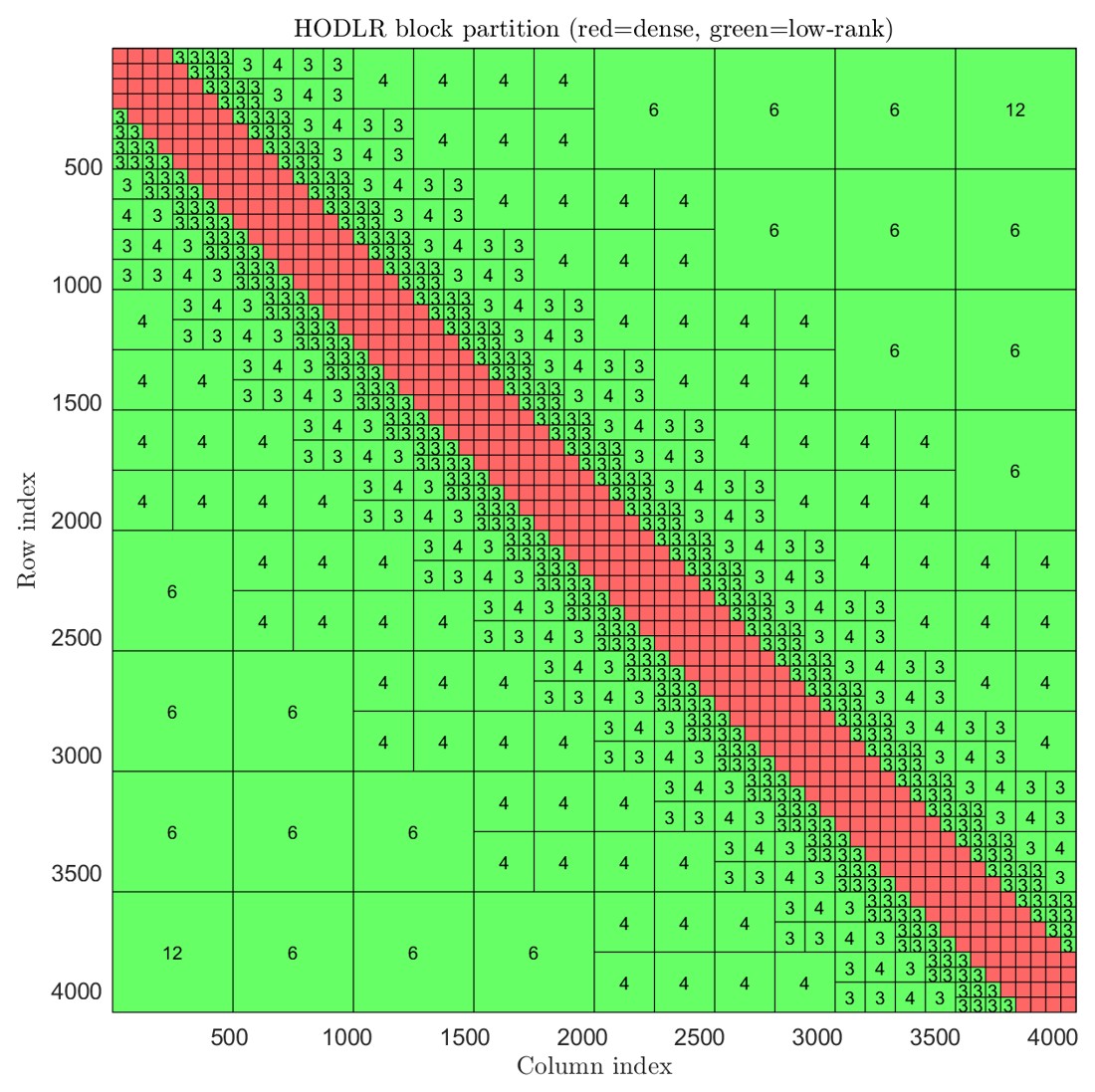
Hierarchical matrix partition of a bidomain boundary element system: dense blocks (red) are kept along the diagonal while off-diagonal interactions (green) are compressed to the low ranks shown, cutting both storage and solve time. Figure by Rodrigo Esparza-Rivera.
Publications.
N. I. Hasan (G), V. Sabino (G), A. J. Walenciak (G), Y. Liu, and L. J. Gomez, "Modeling pyramidal neurons using bidomain boundary element method (BEM) and hierarchical matrix approximation," IEEE Journal of Electromagnetics, RF, and Microwaves in Medicine and Biology, 2026. link
V. Sabino (G), A. J. Walenciak (G), and L. J. Gomez, "A Bidomain Boundary Element–Cable Method for Modeling Neuronal Responses to Electric Fields," Journal of Neural Engineering, under review.
N. I. Hasan (G) and L. J. Gomez, "Modeling Pyramidal Neurons Using Bidomain BEM and Hierarchical Matrix Approximation," IEEE International Symposium on Antennas and Propagation and USNC-URSI Radio Science Meeting, July 2025 (first place, student paper competition).
N. I. Hasan (G) and L. J. Gomez, "Modeling Pyramidal L2/3 Neurons by Compressing Adjoint BEM Using H Matrix Approximation," International Applied Computational Electromagnetics Society Symposium, May 2025 (first place, student paper competition).
N. I. Hasan (G) and L. J. Gomez, "Scalable Bidomain BEM Modeling of Neuronal Activation under Electromagnetic Stimulation," Progress In Electromagnetics Research Symposium, November 2025.
V. Sabino (G) and L. J. Gomez, "A boundary element–cable method for modeling neuronal responses to external electric fields," International Conference on Electromagnetics in Advanced Applications, September 2026.
V. Sabino (G) and L. J. Gomez, "A boundary element–cable formulation for modeling neurons," International Applied Computational Electromagnetics Society Symposium, May 2026.
V. Sabino (G), D. M. Czerwonky (G), N. I. Hasan (G), and L. J. Gomez, "A FMM Bidomain Boundary Element Method for Modeling Electromagnetic Brain Stimulation of a Pseudo-Realistic Cell," USNC-URSI National Radio Science Meeting, January 2025.
V. Sabino (G) and L. J. Gomez, "A MATLAB-Based Solver for Modeling Neurons," International Applied Computational Electromagnetics Society Symposium, May 2025.
A. Walenciak (G) and L. J. Gomez, "Generating Realistic Meshes of Neuron Models," IEEE International Symposium on Antennas and Propagation and USNC-URSI Radio Science Meeting, July 2025.