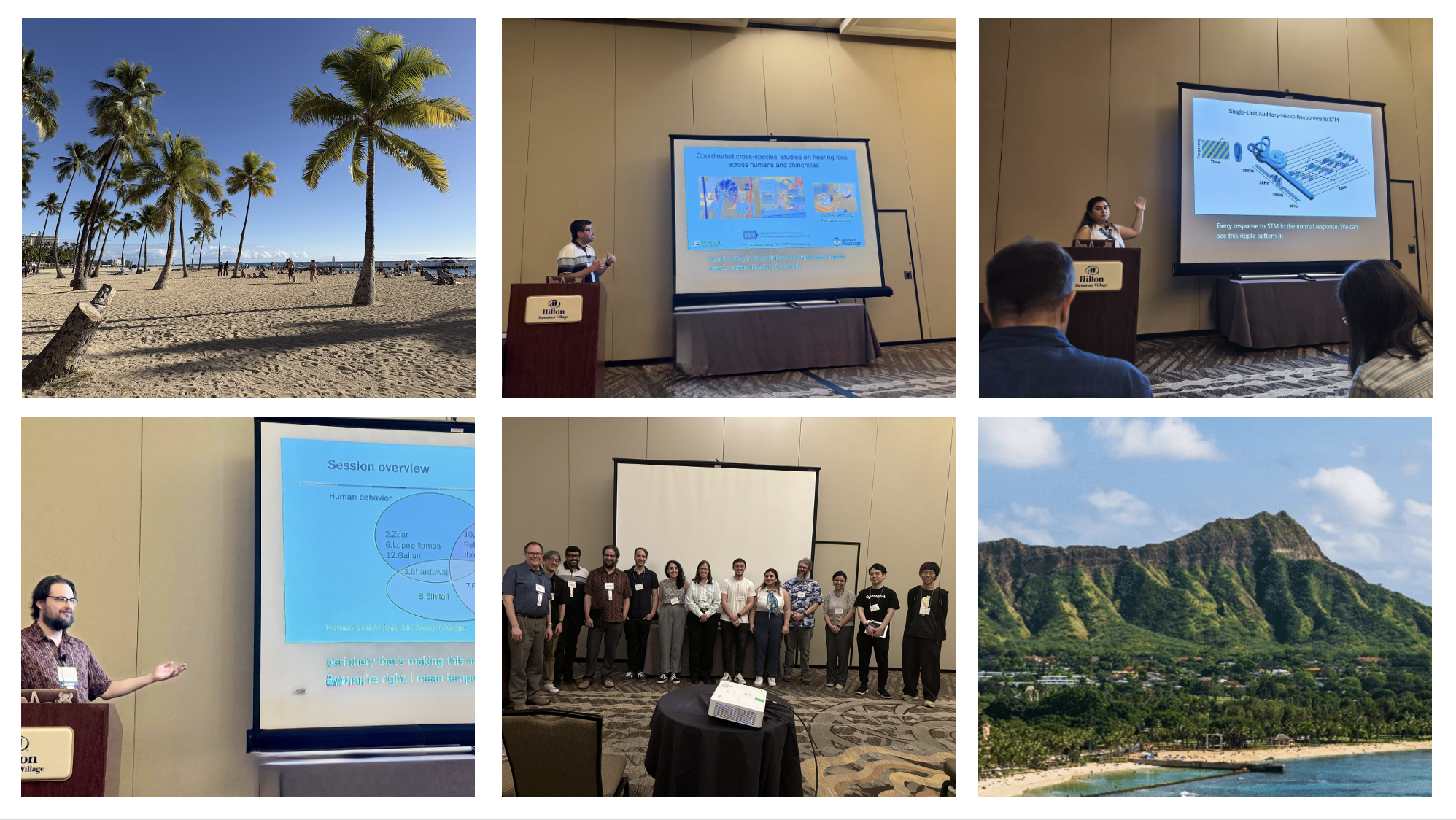
ASA Fall 2025 Special Session Organized by Dr. Heinz and Colleagues Includes an Invited Talk by Heinz Lab Postdoc Afagh Farhadi
ASA Fall 2025 Special Session Organized by Dr. Heinz and Colleagues Includes an Invited Talk by Heinz Lab Postdoc Afagh Farhadi
The session was co-organized by Michael Heinz, Joshua Bernstein, Hari Bharadwaj, and Shigeto Furukawa, and brought together researchers working across auditory neurophysiology, psychophysics, computational modeling, cortical physiology, and clinical science. The talks highlighted the growing role of spectrotemporal modulation (STM) sensitivity as a suprathreshold measure that captures important variability in speech-in-noise perception not explained by audiometric thresholds alone.
Several presentations focused on the clinical translation and interpretation of STM-based measures. Joshua Bernstein framed key questions about what STM sensitivity captures mechanistically and how it relates to speech understanding. Johannes Zaar discussed the development, validation, and clinical use of the Audible Contrast Threshold (ACT) test, a language-independent STM-based assessment designed to complement pure-tone audiometry and support more personalized clinical decision-making. Hari Bharadwaj examined how distorted tonotopy in sensorineural hearing loss may shape individual differences in STM sensitivity and speech-in-noise performance. David López-Ramos presented work on adaptation to noise in STM detection and word recognition, providing insight into how temporal context and noise exposure influence modulation processing.
The session also emphasized links between STM processing and neural representations beyond the auditory periphery. Mounya Elhilali presented work on task-dependent encoding of spectrotemporal modulations in human auditory cortex, highlighting how cortical representations of STM features adapt to perceptual goals. Frederick Gallun discussed STM training and its relationship to speech understanding in noise, addressing whether improving STM sensitivity through training can lead to measurable gains in functional speech perception. Additional talks explored physiological and perceptual modeling approaches to predicting STM detection thresholds (Laurel Carney, Lily Paulick) and computational and machine-learning perspectives linking STM features to speech intelligibility prediction (Takuya Koumura, Katsuhiko Yamamoto).
Within this broader context, Afagh Farhadi presented Heinz Lab work examining spectrotemporal modulation coding in the auditory nerve using single-unit recordings and computational modeling, with the goal of identifying the neural cues that support STM sensitivity and understanding how those cues may be altered by different forms of sensorineural hearing loss.
The session addressed a timely and important question in hearing science and the discussion across peripheral and cortical physiology, modeling, perception, and clinical application underscored the value of integrative approaches and highlighted the need for continued cross-disciplinary collaboration and further investigation in this rapidly evolving area.