Research
Plasma-Based High-Power Tunable Limiter & Switch (plasma as high-power tunable resistor)
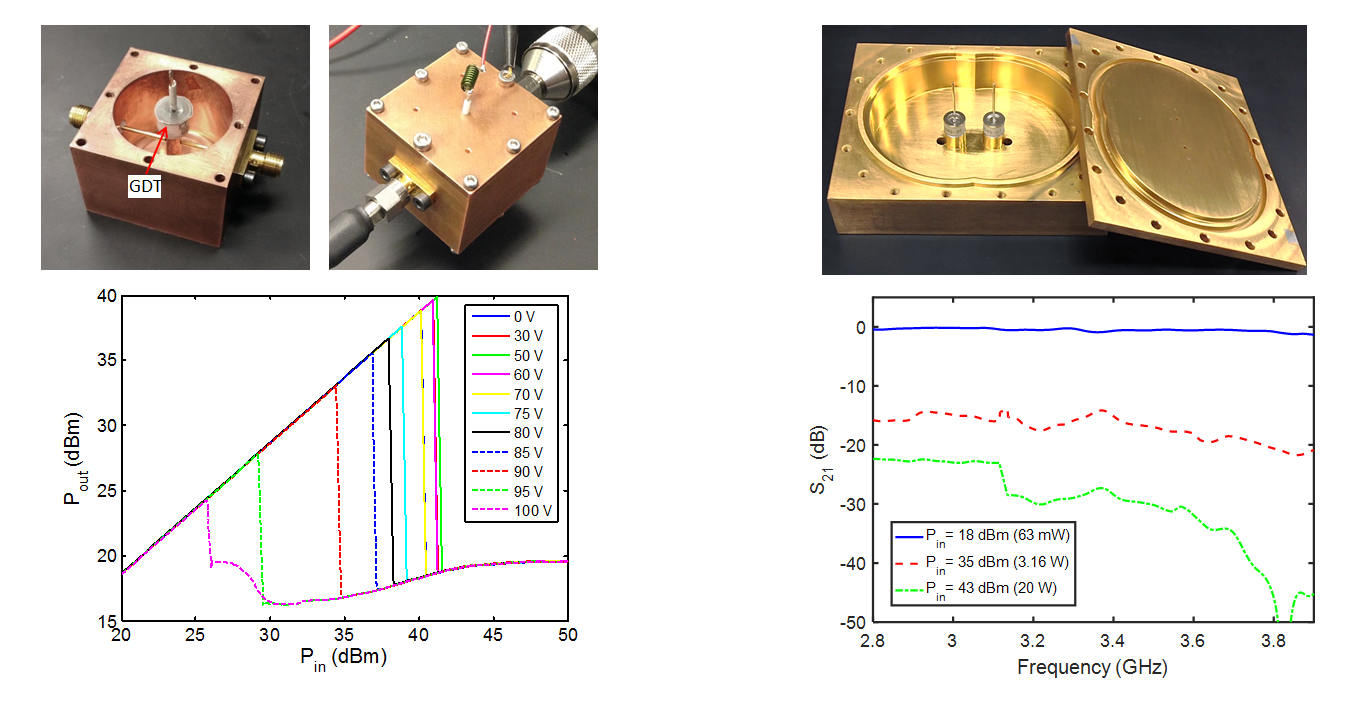
These structures are composed of a high-Q EVA cavity resonator loaded with GDT/s over its post/s. Increasing Pin results in enhancing E-field over the gap, and eventually gas breakdown and plasma formation. The Pth is tunable either coarsely by selecting various GDTs or finely by dc biasing. Since part of the energy required for the plasma ignition is supplied by the incoming electromagnetic waves, the mechanism is quasi absorptive. The ignited microwave plasma operates in the α-discharge regime. So, it is quite stable with no lifetime issues. This technology is a promising solution for emerging high-power applications where other tuning technologies are suboptimal due to power, linearity, and temperature.
Plasma-Based Tunable Resonator (plasma as high-power varactor)
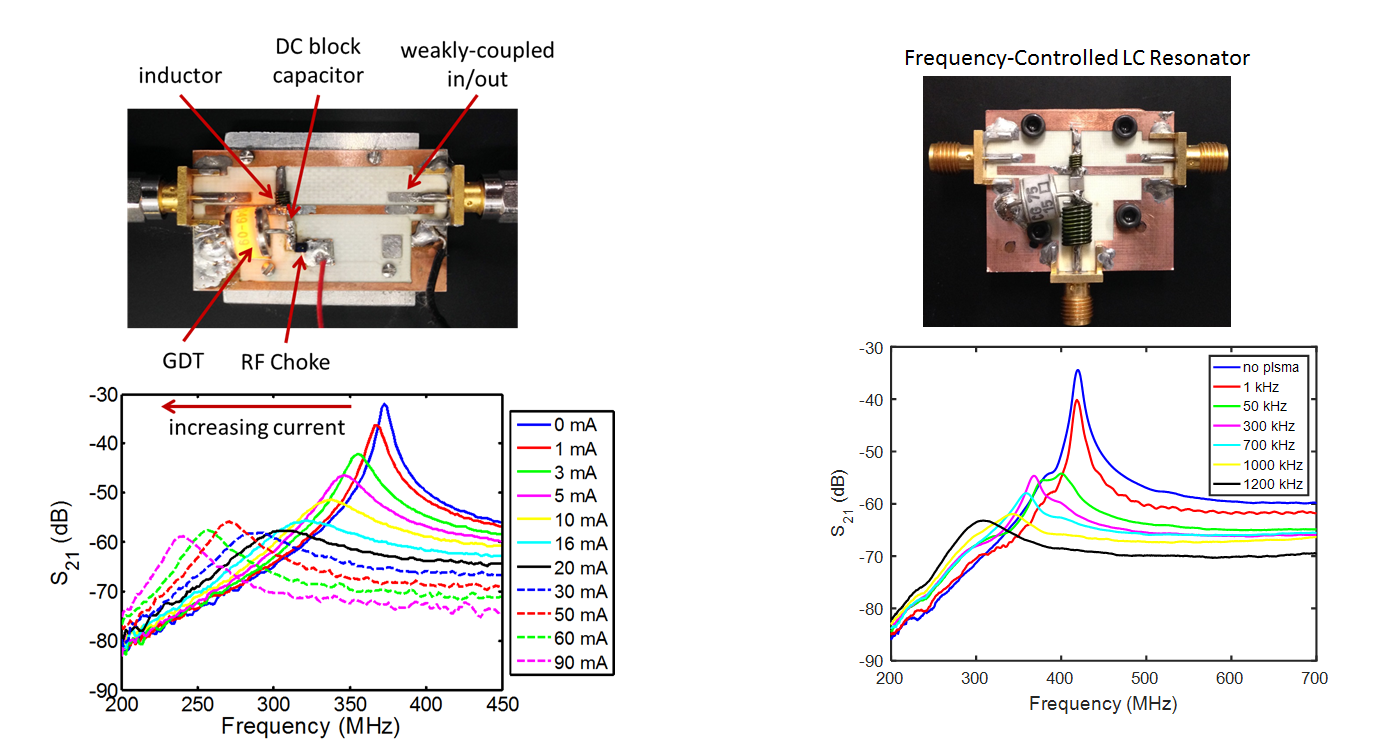
The operating principal of plasma-based variable capacitor (varactor) is the change in the cathode sheath thickness and thus in the capacitance of a plasma cell. To prove this concept, in an LC resonator with a GDT as a variable capacitor, the resonant frequency decreased continuously by up to 50% with increase in the dc discharge current through the GDT in the abnormal glow discharge regime. On the other hand and in RF plasma, sheath thickness also depends on the frequency of plasma excitation field. In another study, by changing the frequency of the plasma excitation signal in the range of 1-1200 kHz, the measured resonant frequency of the LC resonator tuned in the range of 410 MHz to 300 MHz.
High-Power Tunable Cavity-Backed Slot Antenna
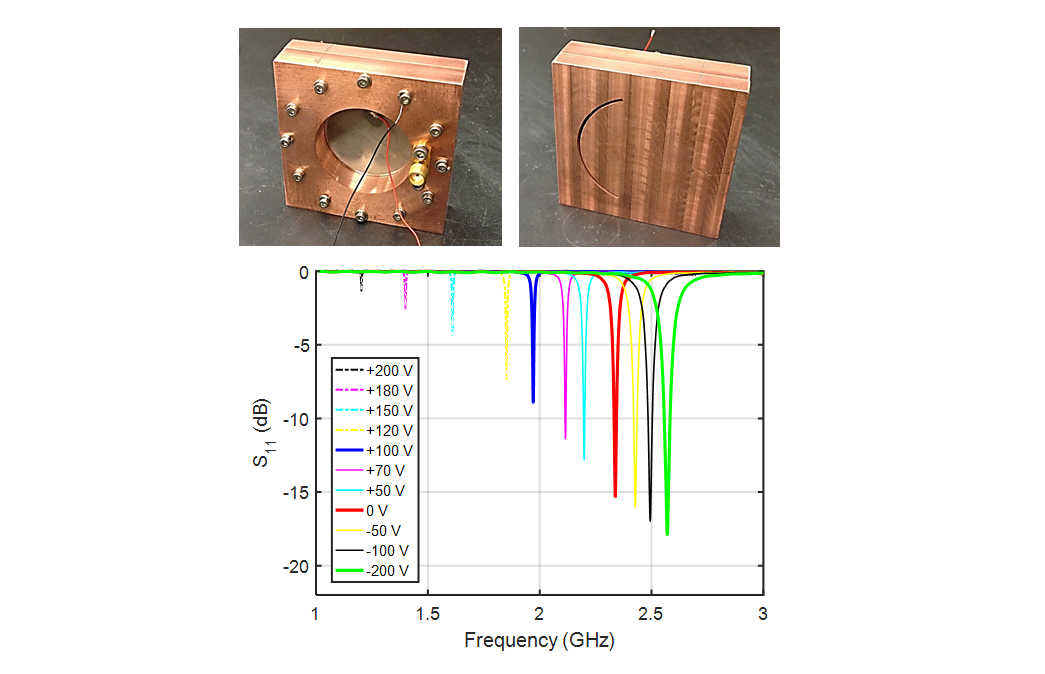
The proposed antenna is composed of a frequency-tunable EVA cavity resonator loaded with an annular radiating slot on the cavity back side. Frequency tuning is performed by changing the critical gap size over the resonator’s post through a piezo tuner disc. A prototype antenna represented about 25% tuning (2 - 2.57 GHz) of the antenna’s 10-dB reflection coefficient when the cavity gap size varied in the range of 17 - 171 μm. The introduced antenna depicted around 5 dBi of gain and radiation efficiency of > 85%. Moreover, the antenna successfully handled 80 W. Since it also showed a good linearity, this antenna is promising for high-power applications.
Electronically-Controlled High-Power Impedance Tuner
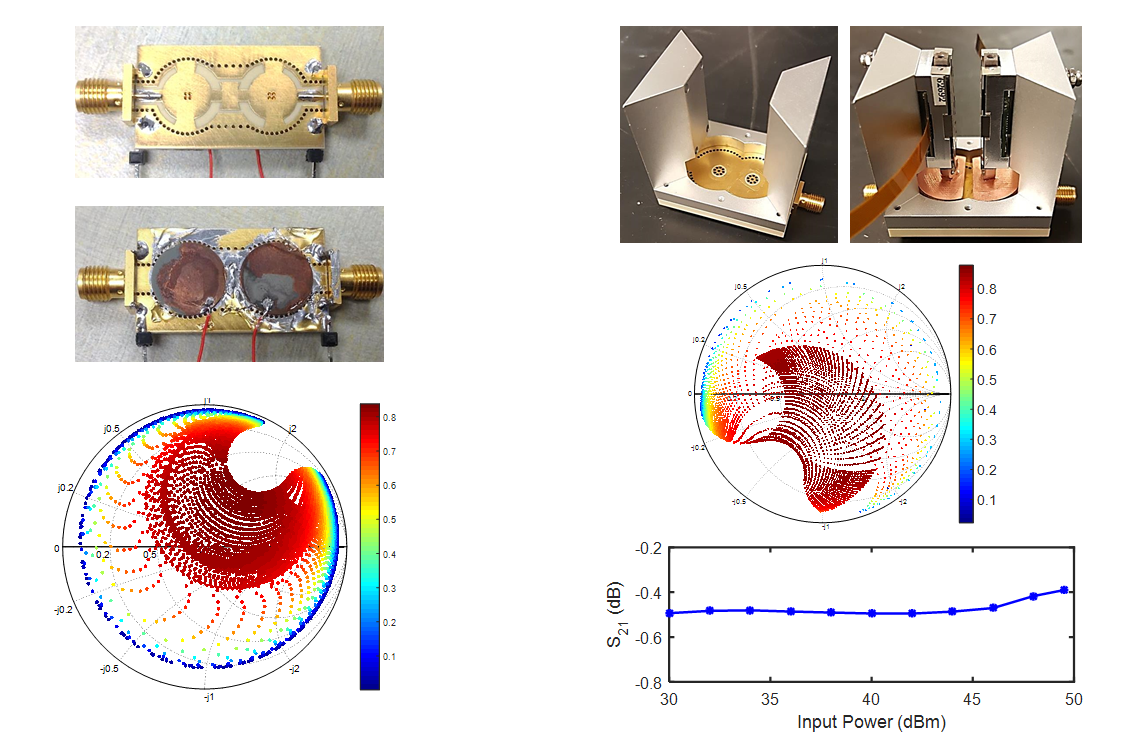
Right: High-power impedance tuner with external linear actuators
The structure of the proposed impedance tuners is based on two individually controlled SIW cavities, implemented as EVA magnetically coupled resonators. The prototype tuners were designed at 3.3 GHz and successfully measured with up to 90-W input power. Two piezo- and external actuator-based tuners showed more than 90% coverage of Smith chart at the center frequency and about 37% frequency bandwidth for covering at least half of the Smith chart. Also, the measured IIP3 and power loss are +64.3 dBm and 0.77 dB, respectively. The proposed tuner is suitable for high-power applications including radars and base stations.
High-Power Air Breakdown in EVA Cavity Structures
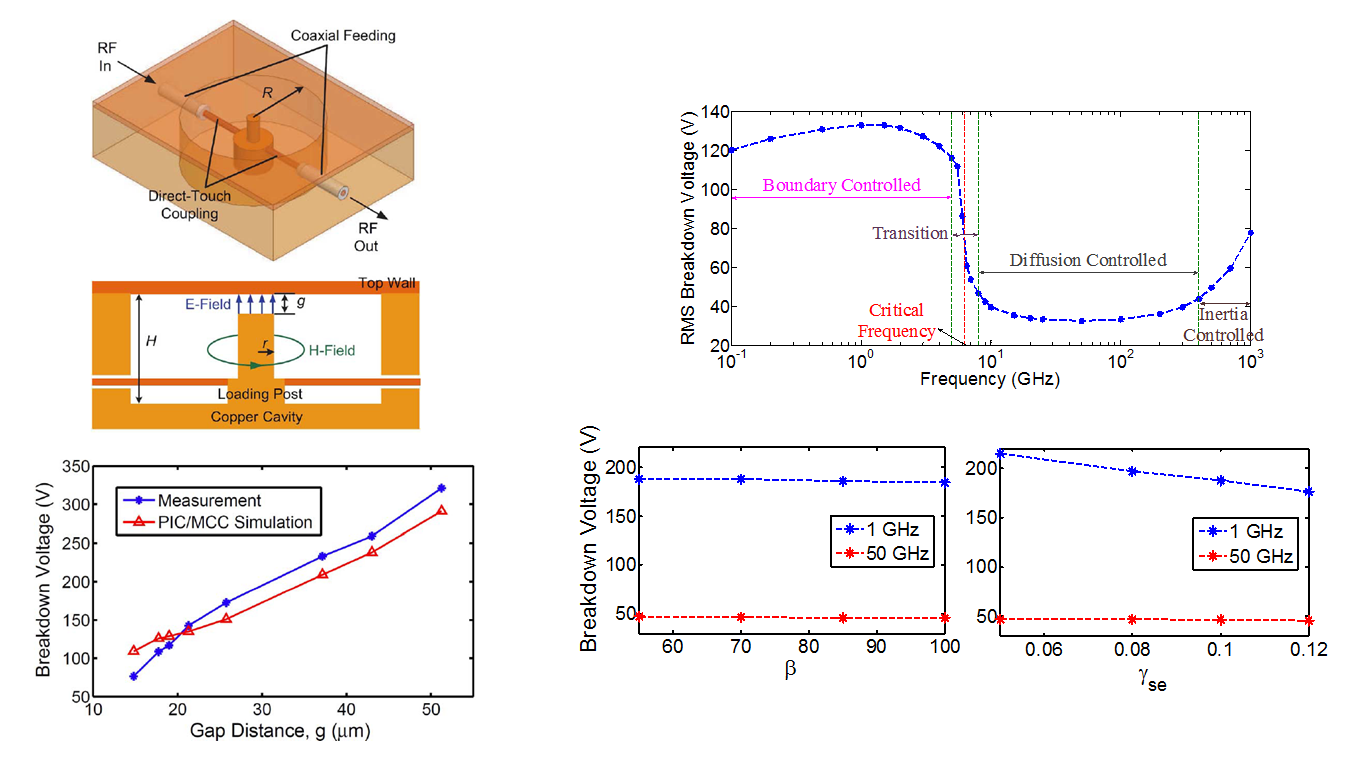
Air breakdown in small gaps is a primary limiting factor in the power handling capability of heavily loaded cavity-based microwave resonators. Specifically, we have been interested in high-power microwave gas breakdown in strongly-coupled EVA cavity resonators in atmospheric pressure and room temperature. These high-Q resonators are widely tunable by changing the gap between their loading post and top wall and are extensively employed in realization of highly-selective tunable filters. We studied the effect of the gas breakdown issue, both numerically and experimentally, and showed that air breakdown and the resultant plasma can significantly increase resonator’s loss.
PIC/MCC Modeling of Microbreakdown
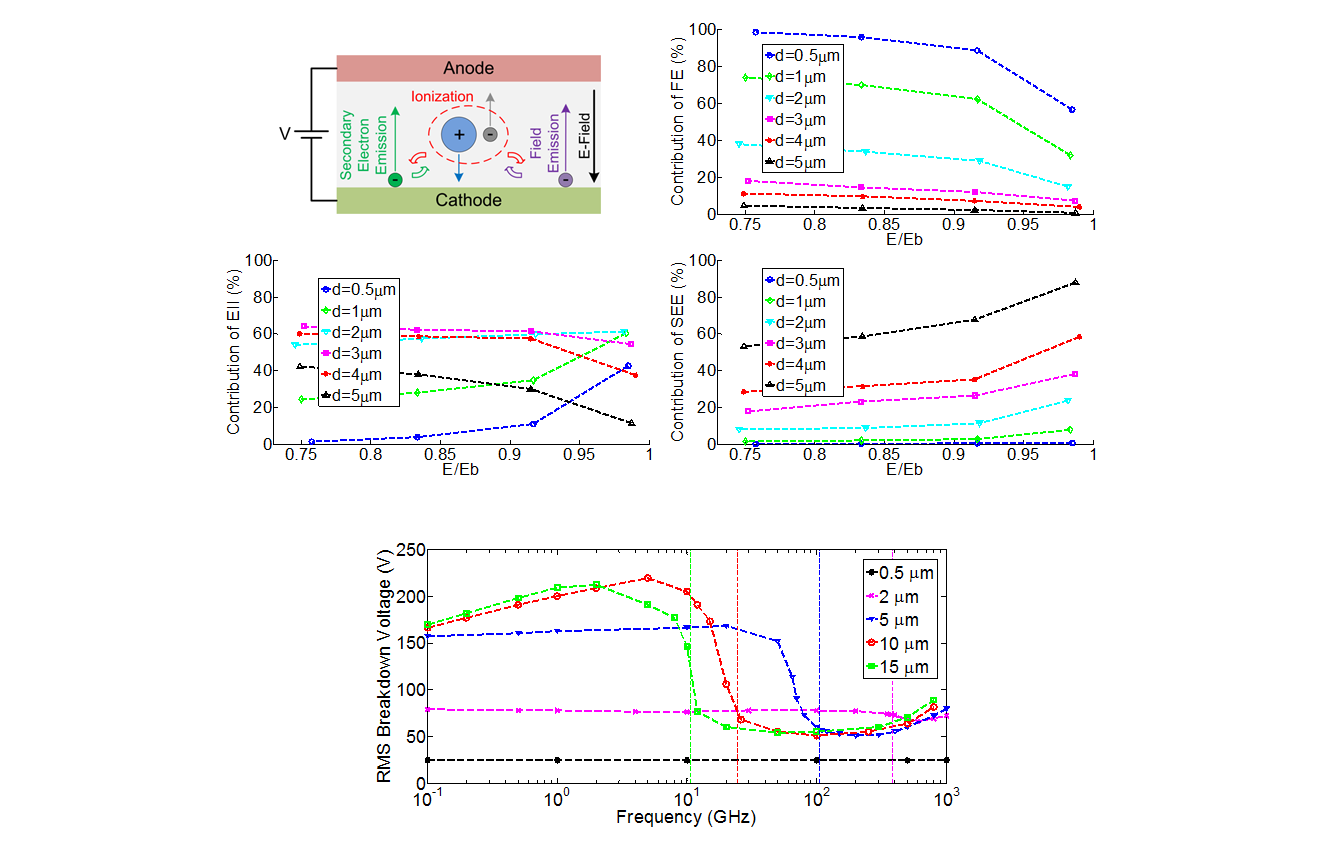
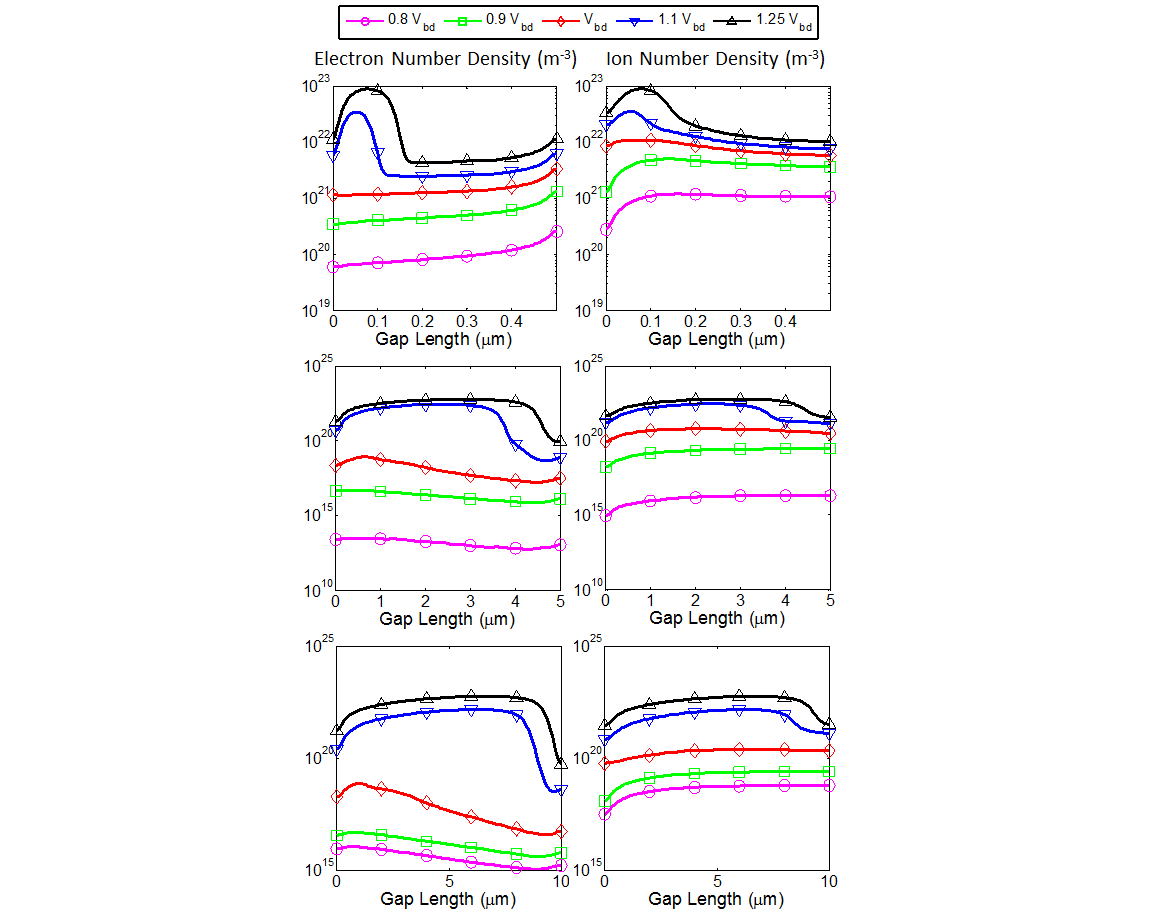
Using the one-dimensional PIC/MCC method, it was numerically showed that for gaps <10 µm, field emission has the most important role in breakdown while for larger gaps, electron-impact ionization and secondary electron emission are dominant. Also, in RF discharge, there is a critical frequency beyond that, the breakdown voltages decreases significantly as the electrons cannot reach to the electrodes due to very fast change in the field direction. Furthermore, we demonstrated that ions are ignorable in post-breakdown conditions, while their role becomes significant in pre-breakdown mode especially for gaps on the right side of Paschen’s curve.